The magical family from "Encanto." Image from Disney.com.
Maybe it’s just me. I’m enchanted with the Disney movie “Encanto,” and, no, I know that’s not just me, as the film seems pretty popular.
What’s just me is that I think it could be taken as being about the COVID-19 pandemic, in a way. Spoiler alert--if you have not seen "Encanto," you may want to stop and go watch it before proceeding to the rest of this blog post.
Think of one of the many popular songs from that film, “We Don’t Talk about Bruno.”
Tio Bruno in the movie gets an unfair bad reputation because he has visions of the future, and when those visions are sad (a goldfish dies), the people blame Bruno. Yet, it’s pretty clear, Bruno didn’t kill the goldfish, nor did his vision. He just saw it and reported it.
Kind of like Dr. Anthony Fauci. The long-time leader of a federal agency called the National Institute of Allergy and Infectious Diseases, Dr. Fauci has been blamed, these past two years, for things he has said about the pandemic.
NIAID image of Dr. Anthony Fauci.
But the good doctor didn’t create the virus. And the tough advice he’s given isn’t some mad power grab, rather attempts to keep us safe.
Thankfully, unlike Bruno in the movie, he hasn’t hidden himself in the walls.
The analogy doesn’t completely hold, I know. Yet the movie characters couldn’t face reality and thus shunned Bruno.
Encanto is an enchanting tale for lots of reasons. For one things, it’s a Disney story where the witches aren’t evil, but blessed by a life-affirming miracle. The characters are in conflict due to difficult family dynamics and a troubled history—not because they are fundamentally evil. They are just normal people, trying their best.
And sometimes being crushed by the weight of their burdens. Yup, loved the song by the strong older sister, too. And yes, I feel like the pandemic is sometimes like the pressure source, too.
And the movie ends with our lead character, one of only two members of a magical family who has no powers, somehow restoring power to the full family.
Because she reconciled with her grandmother. The other not-magical person. In the family of magic, the two most pivotal characters, the true leaders, are the ordinary women who hold the rest together.
Well, great. We will somehow, I hope, learn as a culture to rebuild what has become broken. And maybe learn to let Dr. Tony back in, too.
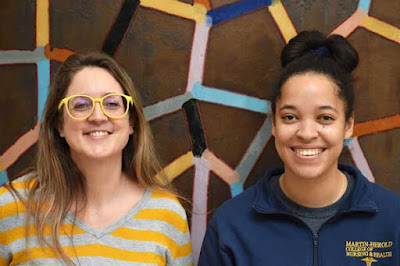
Senior nursing student Jada Veasey named "Pat Pisarik Student Journalist of the Year" by Iowa College Media Association.
Today was a big day for journalism at Mount Mercy University. I knew what was coming, although I couldn’t tell anybody.
Each year, the Iowa College Media Association gives an award called the “Pat Pisarik Student Journalist of the Year” to one student. This year, the judges said there were three outstanding journalists from three colleges who became the finalists—and the winner is from Mount Mercy University. Times Editor-in-Chief Jada Veasey.
And Jada doesn’t even major in journalism. I’ve had a nursing student be editor-in-chief of the Times before (I am the paper’s faculty advisor), but the previous leader did at least minor in journalism. Jada basically leads the staff of a university newspaper capably from life experience—I’m not sure she’s taken even one of my journalism courses, yet she is among the most talented student journalists MMU has ever had.
It comes from several sources. One, Jada is in the news habit. She comes from a home where there was always a newspaper, and she’s always been a news reader—an important education that many communication students are too short on. Two, while she hasn’t taken a journalism class, she is a natural writer, a talented story teller with a flair for choosing the right words. Again, I think this comes mainly from being a lifelong, active reader. Three, she’s mission driven. She believes in the importance of journalism and student journalism, a civics lesson lost on too many these days.
Jada has been particularly important in helping the Mount Mercy Times cover the Covid-19 pandemic. She wrote the news story about a student who died. She had a hand in a set of staff editorials that were recognized as the best in the state, all of them on the pandemic. The headlines of those winning editorials:
“Mustangs: We Must do More to Fight this Deadly Pandemic,” Nov. 19, 2020.
“The ‘Kim Reaper?’ Iowa Not Getting Leadership State Needs in Pandemic,” Feb. 18, 2021.
“We may be tired of pandemic, but it’s not tired of us,” Sept. 16, 2021.
Besides Jada, other MMU students honored included Annie Barkalow, managing editor; Gwen Johnson, opinion editor; and Veronica Jons, last year’s editor-in-chief.
Annie Barakalow and Jada Veasey, managing editor and editor-in-chief of the MMU Times.
Gwen Johnson, opinion editor.
Veronica Jons, who graduated last year, former editor-in-chief of Times.
Annie wrote a news story about problems with a city bike rental program and rented bikes being left on campus. “Needed or Nuisance? City VeoRide vehicles sometimes clutter campus” was the main front page story on Sept. 30, 2021, and was recognized as the best investigative news story in the state.
“Anne with an e,” Annie’s blog, was named the best student blog in the state. Gwen’s “The Girl in the Chair” was second.
The Times was recognized with a second-place for headline writing, too. And one of its front pages was the best in the state (click on image to see larger PDF version):
So, a total of six awards for the paper, including four first-place awards—that is good results. But the Pat Pisarik award for Jada? That was outstanding, and well deserved. I wrote a letter that was part of her application, here it is, and I meant every word. I’m proud of all the students who work so hard at providing MMU with a vibrant student media.
Every day, I post a note like this on my main Meta channel, Facebook: “Got it in 5 today, tough day” or “In 3, not bad.”
Usually, I include the colorful grid that charts letters correct and wrong.
A sister at one point asked what the cryptic notes (that day, no grid) were about, but those in the cult already know. It’s Wordle, an online sensation that netted a software engineer (named Josh Wardle) more than $1 million. The New York Times purchased the app, and didn’t disclose for how much, except it was “low seven figures.”
Well, nice. The game has exploded in recent weeks, for lots of reasons. It’s a word game that tickles the brain, but doesn’t tire it too much. I don’t want to jinx myself, but in several weeks of daily play, I’ve not yet failed to solve the Wordle (although I have sometimes only solved it on the sixth try). I wouldn’t call it super easy, but it’s not a horribly challenging game.
And Mr. Wardle made an incredibly smart move. When you solve the Wordle, it makes the results easily shareable on social media, via phone app or via computer, with an easily recognizable graphical scheme that shows your results and doesn’t spoil it for other players. That graphic, by the way, is the one controversial aspect of the game, as apparently people who use Twitter to share their results kind of mess up visually impaired Twitter users who have the program read tweets—it takes a while, or so I’ve read, for the Twitter robot to read “green square, green square, yellow square, grey square,” etc.
I’m sure the tech minions at the Times will figure that one out soon. When the Times purchased the game it causes some anxiety because it’s been available for free—and does one need a Times subscription in the future to access it? That remains to be seen. But for now, Wordle is an example of something going suddenly hot, for what I think are the right reasons. It’s pleasant, not too taxing, and easily shareable on social media.
It reminds me, a little, of Duolingo, a language app I’ve been using for some time. I am active in three languages: I take Duolingo lessons in Chinese, Hungarian and Spanish.
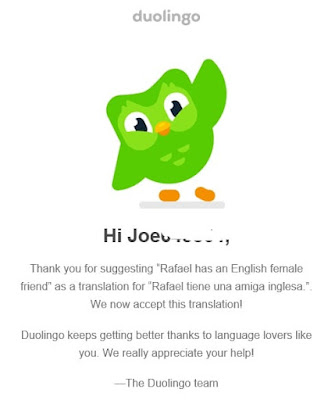
Duolingo does improve over time due to feedback from users. Because, clearly, Rafael doesn't just have a friend, he has a lady friend, and an English speaker who recognizes that "friend" is not a gender neutral word in Spanish shouldn't have his translation traduced. And, Duo now agrees. Nice. Image of email I got after grumbling in the app.
Based on my experience, having some experience with a language before doing Duo makes a huge difference—I move through Spanish lessons much more quickly. Of course, Spanish is an easier language for a native English speaker to learn in the first place—Hungarian is a bit quirky, and Chinese might as well come from the other side of the globe. Which it does.
I don’t aspire to be fluent in Hungarian or Chinese, but am dabbling with those languages for various reasons. I have family connections to both, for one. And, while Chinese is very challenging, I just like the different sound and writing system it has for their being so different.
Hungarian lessons are slightly goofy fun because of the sentences Duolingo uses. It’s a language course that seems partly stuck in World War II. I’m hoping I don’t have to say “The German soldiers are outside the train station” in Hungarian all that often, but just in case, that kind of sentence has been in lessons. The Hungarian course also has some weird, eyebrow-raising statements like: “The Hungarian actresses and thin and pretty while the English ones are short and slow.” That’s not literal, don’t come at me Duo, I’m pretty sure that particular sentence has not been in any lesson, but sentences like it do appear. Not usually in that horrible form I wrote as an example, but more like: “The Hungarian cars and new and fast” (sentence one) “The German cars are slow and old” (sentence two).
Be a little more polite, Duo. After all, there’s a lot of German soldiers over by that train station.
Anyway, in an age of disinformation, I do take a minor amount of comfort that the internet also brings us some pleasant diversions that may be good for our brains.
Like Wordle. Like easily accessible language lessons. Cyberspace that be a hostile part of the world, but it still has its pleasant neighborhoods.
Depressing times in American media. Iowa Republicans have booted reporters out of the Senate floor. The national GOP has announced that it’s now a party rule that whatever crazy-as-a-loon orange-haired Russian tool it happens to nominate in 2024, that addle-brained old nincompoop won’t deign to debate because debates are so beneath King Donald.
I don’t foresee the future, but it seems that the instinct to enact empty-headed authoritarianism is a viral disease that democracies can suffer from now and then. Maybe a few decades ago we though that young democracies, like Germany post World War I, were the most prone to such maladies. Today, we’ve been running a dangerous experiment that shows older democracies are at risk, too.
Well, I don’t know what to say about it. The Republican repudiation of open media coverage and robust political debate will prove, I hope, to be their undoing. But I don’t know. We’ve had too many signs of late that too many in the body politic are willing to be duped, and rivers of money still flood into and warp our politics.
I temporarily give up. I yield.
Not for good (nor for evil, for that matter). It’s just that on this media blog, while I might comment on politics now and then, I’m just not in the mood today. Not that I plan to stay silent, because I think every citizen in a democracy owes some attention to politics, and dropping out due to disgust is a cop out. When the going gets tough, the tough still need to speak and vote. As Anna observes in “Frozen 2,” in your darkest hour when hope seems fleeting, your best choice is to just do the next right thing.
It's just that I just don’t feel I have much to say that explains or illuminates these current troubling trends. I feel a bit adrift in a red state that used to be purple, and I hope that purple may reign here again.
So, on to a completely different topic. My wife and I have a tradition of watching a movie each week, our Friday night film. Sometimes, it’s with a 5-year-old grandchild, sometimes on our own. We sometimes pick an old favorite, but often watch something we have not seen before.
And our most recent three movies were quite nice—two-thirds new, one-third familiar but fun anyway.
I recommend all three movies, although they are very different from each other. In reverse chronological order, starting with the most recent Friday, they are:
“The French Dispatch.” Don’t go into this wondering what the story or plot is, this is not a clearly linear tale. It’s a set of shorter stories, meta stories because they supposedly represent magazine articles that appear in the final edition of a fictional publication of decades ago. That magazine very much looks like vintage New Yorker, and I loved that style—the cartoon illustrations a pleasurable bit of visual flair. The stories are weird, quirky, sometimes drag on a bit, but are also amusing. The movie is a bit too cute in a way, depending a lot on cleverness, camera angle and unexpected humorous detours. Yet, it still works for me. I wouldn’t rate it as one of my favorite movies, nor even my favorite whimsical movie. Yet I found myself wishing I had seen it in a theater. It’s gorgeous, nonlinear, irreverent—my one critique is that it does lack a bit of humanity since it’s filled with caricatures rather than characters. Still, it is worth the watch. As long as you don’t expect a plot.
“Brave.” This came out 10 years ago, but I don’t recall hearing about it then. I was probably just too busy. It’s a Disney-Pixar movie, and Pixar rarely has a miss. This one is a particularly good hit. A young Scottish princess objects to being the object of competition by male suitors, and ends up competing for her own freedom. Along the way, she gets entangled with a witch who turns the princess’s mother into a bear. Kid and grizzly mom (I know, no grizzly bears in Scotland, it’s just a nickname) learn more empathy for each other. It’s a pretty movie (Pixar), but also a pretty good movie. You care about the characters. I love that most of the characters are trying to do the right thing as they see it, but still end up in conflict. Even the “evil witch” isn’t really evil, but instead is just a force of nature that wreaks a little havoc. I found the three naughty younger boys annoying, but in a way that three naughty younger boys often are. They are still, in both human and bear form, key allies of good. It’s a good movie, with noble messages about the need for family to actually listen to each other. And don’t trust abandoned sweets.
“Yellow Submarine.” An extended 1968 psychedelic Beatles music video, it was the choice of the grandson. He’s something of a Beatles fan—when he was 3 and we had to travel across the state with him, he insisted on listening to “Lady Madonna” roughly 10,000 times. One of his favorite current bands is the Mona Lisa Twins because they sing so many songs he likes—Beatles songs. So the movie was perfect for him (it was his choice), but I also have a special relationship with “Yellow Submarine.” It was one of the three defining musicals of my childhood. My earliest memory of the family going to a movie was to view “The Sound of Music.” An annual family tradition was the Christmas time airing of “White Christmas,” important to me partly because my father served in World War II. And then, when I was 10, came the magic of going to a movie theater (a rare treat) in the Lyons district of Clinton, Iowa, to view “Yellow Submarine.” Of the three musicals, I’ll watch and enjoy any of them today—but the one I’ll enjoy most is the one that makes the least sense—it’s that freaky, colorful, beautifully drawn animated Beatles music video. It may be only a “Northern Song,” but I’m glad my kids watched a VHS copy of the movie now and then, and that now I have a DVD for occasional viewing when I’m in the mood (or a grandchild is in the mood) for the vanquishing of Blue Meanies.
These days, a major problem in the real world is an Orange Meanie, and although defeated, he still waits at the edge of Pepper Land, ready to stomp on our butterflies. We may need a bit more than love and music to vanquish him now. But at least it’s good to take a break, pop in a disc, and let some movie magic take my troubles away for a brief time once a week.
"Get your shots or I'll whack you with my shovel." Probably not the winning message.
Misinformation and mistrust have poisoned our response to COVID-19, and the dark days are not yet behind us.
Which surge are we in? The third? Fifth? I’ve lost count, but as a deadly, infectious virus again fills our hospitals—largely with unvaccinated people—I wonder how we can be more effective in getting Americans to take this scourge seriously—to do what we need to do to knock this pandemic down.
The science isn’t too mysterious. Social distance. Mask. Frequently test. Be vaxed and boosted. Don’t seek medical advice from political sites or random social media memes. Do your own research—if you have a pHd in science. Otherwise, pay attention to those who do valid research, not the proverbial 400-pound man in his basement. (For the record, I do look like Santa, but I am not 400 pounds—yes, I am writing this in my basement.)
But science is not enough. When it’s not believed, it’s not working. Omicron is highly transmissible and American are highly resistant to giving two hoots. Mandates for large employers, the military, healthcare workers and first responders may help with the vaccination rates, but pushing people who don’t believe also makes them push back harder.
The herd can’t become humanely immune if the herd won’t hear what must be heard.
Granted, we’ve seen massive failures of political leadership. This pandemic has been politicized, which is a costly tragedy. We once had a president who told us to consider injecting bleach, and we have many so-called pundits promoting quack cures and spreading mistrust of those who should be trusted. In Iowa, our governor assures us we will “do the right thing,” when it’s patently obvious too many Iowans would rather just do the right-wing thing, even when it’s wrong.
I find myself wondering, WWSTBD? What would Smokey the Bear do?
Most of use remember Smokey. He reminded us that only we can prevent forest fires. It didn’t end fires—climate change had led to some massive wildfires in recent times—but that old bear did raise awareness and changed behavior in his day.
And Smokey isn’t the only example of a PSA avatar that has done us some good. Remember the “crying Indian” from 1971? That PSA actually helped reduce littering, and fueled an environmental movement that, even if it can be controversial, has led to a cleaner country.
Neither Smokey nor the Native American who was actually an actor of Italian ancestry were 100 percent successful, and neither symbolizes a problem that was completely licked. But problems don’t work that way. Big problems aren’t so much solved as abated, and I would like more pandemic abating.
One thing that I think has been lacking in our anti-COVID efforts is an effective symbol and slogan. We can shout at each other about facts and disinformation, but we need some messaging that hits us on a more elemental level. We need a COVID equivalent of insurance Flo or the Geico gecko. We need a slogan like “only you can prevent forest fires.” (“Only you can knock down a deadly virus?”) We need messaging that is factually accurate but that is also not a dry recitation of facts—something that will play on patriotism, loyalty, doing what’s right, working together. We don’t just need to hear, we need to feel.
Rosie the Riveter needs to roll up her sleeve for a needle.
I’ve been looking at a few COVID PSAs, and they have information and aren’t always terrible, although sometimes they are also plodding and dull. The CDC has a gabagillion videos on its YouTube channel, but none has yet gone viral. Here is a CDC PSA and another attempt from a medical school, followed by an NHS Facebook ad from the UK, which I think does a better job:
We don’t have a snappy slogan. A compelling character full of pathos. A key, concise, positive message. Something that we should push with a billion marketing dollars to spread a positive, life-saving message.
Get your shot. Wear your mask. Be boosted. Get tested. Fine, but which of those would mean something on a bumper sticker? Those are the messages, but not the means to our hearts nor the memes we would share.
CDC PSA. Fine, but where's Smokey?
Again, OK. But "Proven Safe and Effective" could be a shampoo ad.
I’m not an ad writer, I don’t know what would work. But I see lots of ads for cells phones, promos for shows, snazzy productions for deodorants—my Christmas media wish would be for us to be awash in ads that have more meaning and that could have more impact.
So come on, science. Hear me, Joe Biden. Bring it on. Find the right Mad Men. If not Smokey, Nellie the Nurse. Ashley the Elf who survived Covid? The vax fox? I know I want something even if I’m sure exactly what it is. But when I’m humming the tune of that catchy vax jingle, that may be important progress.
Amy Adams as linguist Louise Banks in "Arrival." That's no human vehicle parked in the background. All images on this post appeared in online news stories or reviews and are credited as Paramount Pictures PR images.
In case you didn’t catch the Amy Adams movie “Arrival” when it came out five years ago, I’ll try to avoid spoilers in this essay about the film. Which seems a bit ironic when writing about this movie, which plays with and twists notions of both time and language. My wife and I noticed the DVD at a sale price, and took a chance on it, and Friday I watched it for the first time. Amy Adams, don't you know. I can watch her read the phone book, I think. She's a bit like Sarah Michelle Geller--in that her eyes to a lot of the acting, too.
What we think are memories aren’t that at all. And what did the word “weapon” actually mean in that pretty ink blot alien tongue? Having just watched the movie for the first time, I feel that I missed a key plot twist that hinges on that word, which, after all, comes close to igniting a world war.
And why did the heptapods (the aliens sure do have feet) come to Earth and give us a language that opens what sounds like a cool super power but that turns out to involve a lot of complexity in choice, fate and pain? Well, that question is partly answered when Abbott (one of the two aliens the Amy Adams character converses with, the other is named, by her future or past love interest, “Costello”) tells her that they will need human help in a few thousand years, but that again raises a whole bunch of questions.
We don’t ever know where the heptapods came from. Did they travel faster than light, or is theirs a different way of viewing reality mean a journey of thousands of years at sub light speed seems undaunting? And that foggy, misty environment that they live in—what is their reality like?
The movie is clever. It plays with the Sapir-Whorf hypothesis in an interesting way, seeming to suggest that we experience time in a conceptual way that is tied to language, which shapes how we think. That hypothesis, by the way, is useful for understanding language, but not always all that useful for understanding all of human experience. It’s the notion that the nature of our language shapes the nature of our perception. What follows is my opinion (although most of what preceded is also my opinion, a fact you probably remembered)—but sometimes I think people take that useful hypothesis too seriously. For example, I’ve seen people make a big deal out of the supposed fact (I don’t know the language, so I don’t know if it’s actually true) that Arabic has no equivalent for the word “compromise.” Or that Inuit people have a gabagillion words to say “snow.” Or that some color labels don’t exist in some languages.
Sure, those are ideas worth exploring. They shape perception. But they don’t dictate it. If I don’t have a label for “teal,” for instance, it doesn’t mean that my eyes won’t see the color (my visual organs and optic nerves are still very similar to the equivalent organs in most other not-color-blind humans), and thus I may notice the hue even if I cannot name it. I think people from a linguistic tradition that doesn’t label “compromise” probably can, and probably do, grasp the idea anyway. I may not have individual words that differentiate between wet or powdery snow, or snow in the air or on the ground, or snow that has blown—but I can still see and appreciate nuances of snow.
As a writer, I believe in the power of the word. I loved the way Amy’s character Louise quickly concocted a lie about “kangaroo” to explain a truth. As humans, our words are inexact attempts for us to capture and share our experiences, but I also think experience can be “real” when it’s not bound up in a word.
That’s a long way of saying that the time-bending nature of “Arrival” was interesting, but didn’t completely work for me. And the foreboding tone of the movie made it sometimes too heavy—Louise Banks seems disturbed and fearful in her contact with the heptapods, and I wanted a bit more wonder and whimsy. The movie was clever, but sometimes too clever (that Hannah is a palindrome seemed to be emphasized way too much—so is dud).
Will I watch “Arrival” again? Yes, I think I will, if existence and time and my life cooperate. It’s not my favorite movie but it was a worthwhile and interesting one, and I’m pretty sure I’ll see details in the next watching that I missed in the first one. I also loved the idea of aliens whose written language has nothing to do with their speech, which made me wonder if there was any meaning at all in their vocalizations, yet again one of those many unanswered questions in the film.
And I respect a movie, especially a science fiction adventure, that doesn’t feel it has to answer all questions and that defies some norms of the genre. It doesn’t rely on too many car chases or breathtaking action scenes—it builds great tension with more subtlety. It has a heroine who never smacks anyone and never fires any weapon, at least as I understand the word even if I still wonder if a heptapod would agree. It’s an alien war drama where war fails to break out out—and where it was the humans and their poor choices and inability to function without clarity that caused the real danger.
Our hero uses her mind and language to save the world. No light saber, just enlightened thought.
Seems human to me. In my life, the most important problems are caused either by mindless microbes or by other hairless apes who irk me—and right now, irksome humans who respond mindlessly to certain microbes.
Obligatory pandemic side rant: I don’t care what “omicron variant” can be rearranged to spell. Potential overlords aren’t dumb enough to leave an obvious clue like that, but silly humans are prone to misinterpret words and forget that the variant wasn’t named omicron for the sake of a sick joke or some secret code; it was just the next letter in an old alphabet. We should respect words, but we can read way too much into them, too. The Sapir-Whorf hypothesis also means that we can construct reality with language, and we’re sometimes shoddy builders.
Back to this interesting movie. I kind of wish Amy could smile or laugh a bit more. She has a few seconds of “oh gee” facial expressions when she meets the aliens, and I kind of wanted a bit of emphasis on that. It seemed to me that wonder was among the reactions that would be worth exploring.
It was a thoughtful, but perhaps too heavy, movie. “Arrival,” how many stars should I give you? I was thinking three, but that seems too few. You're too interesting for that. How about four? And did you remember beforehand that was what I was going to write?
Dr. Joe Hendryx introduces the first event in this year's Fall Faculty Series at MMU. On Sept. 29, Dr. Jim Jacobs, a computer science professor, reviewed events in history that led to 9/11. Jacobs served in the Marines in the decade before, and interspersed his experience with research.
In the Mount Mercy Times, the excellent student editor-in-chief wrote a recent book review of “The Anthropocene Reviewed,” and one point Jada Veasey made in her review is that she finally understands why there is so little fiction about the flu pandemic following World War I.
“As it turns out, living in the time of a plague is terrible, like, absolutely the worst,” she writes, which tends to discourage authors.
Jada and I share high regard for John Green’s nonfiction book.
But the pandemic isn’t all that makes these times so troubling. Besides battling a new virus that is killing far too many, we’re also facing a rising tide of BS.
Which is not a coincidence. It helps explain the lameness of our pandemic response. And that rising tide of disinformation got a boost just as the internet was becoming a huge factor in our lives two decades ago.
MMU Fall Faculty Series 2021 log.
A handful of hijackers, armed with nothing more sophisticated than box cutters, brought down three airplanes on prime targets on Sept. 11, 2001. They struck the Pentagon and caused the collapse of the World Trade Center twin towers in New York.
Speculation is that the Capitol, stormed by our own delusional right-wing mobs on Jan. 6 of this year, was also a target, but passengers fought back and the fourth plane crashed in Pennsylvania.
Conspiracy is not new to the human condition. John Wilkes Booth didn’t entirely act alone when he gunned down Abraham Lincoln. The shot that killed Archduke Franz Ferdinand and brought on both World War I and it’s sequel, World War II, was fired by a young man who was part of a shadowy nationalist group.
We humans conspire all the time. But we also imagine, enlarged and embellish false conspiracy narrratives. All kinds of wild tales grow up around fantastic, unexpected events—and 9/11 was the Mother of all Conspiracy hotbeds.
It spawned an early viral internet video, even before YouTube was a thing, that fed the conspiracy narratives.
And today, we live in a communication environment rife with speculations that seem farfetched to most rational people, but still move millions to believe.
For example, many believe:
The Chinese government developed the virus for COVID-19. In China, the corresponding lie is that the Americans did it. We don’t in truth know the origins of this virus, and the lack of transparency by an authoritarian government isn’t being helpful. I don’t know that China did it. I don’t know that they did not. Nobody, except those potentially involved, yet does, and in the unknowing is fertile ground for uninformed certainty.
Donald Trump had the election stolen. He didn’t. He lost in 2020 by about the margin he won the race by in 2016. The persistence of this particular false narrative, and its fervent backing by too many Republicans, is an existential threat to our democracy based on a fake conspiracy theory.
Insert X false narrative about the current pandemic. Masks don’t matter. Vaccines aren’t safe. Microchips from Bill Gates. Whatever. This pandemic seems to breed false claims faster than a flexible respiratory virus morphs into new variants. Both the infection and the lies surrounding it are proving hard to fight.
So, I’m going to tackle this big topic next Wednesday night as part of the Mount Mercy University fall faculty series called “9/11 Twenty Years Later.”
I don’t exactly know what to expect. I thought Dr. Jim Jacobs gave interesting context to the whole 9/11 event, and I feel like I’m sort of looking at it from the other side—how that event has reverberated in our information and disinformation cyberspace.
Dr. Jim Jaobs speaks Sept. 29.
The towers weren’t the only thing that seemed to fall on 9/11. Our very trust in ourselves and in reality seems a bit more fragile, two decades later.
Sadly, I’m mostly going to describe the problem. I don’t have a solution, but then again, I don’t know how to end the pandemic, either. Plagues and pandemics can linger for years, but don’t last forever. Maybe there’s some hope that the public may tire of the nonsense, that “doing your own research” may come to mean actually using some discretion on which sources you’ll believe rather than tuning into the alt-universe of lies.
I hope the presentation, called "Conspiracy, Myth and Misinformation," goes well. But I’m writing, not about the pandemic, but about something that does not make me happy, and that I don’t really want to be writing about.
Jada, I feel your pain. But I hope to see many people next Wednesday at 6 p.m. in Flaherty. If the pandemic makes you worry, make sure to join in via MMU’s YouTube live-stream.
Not every internet video feeds the disinformation monster.