Showing posts with label war. Show all posts

Monday, June 23, 2025

Watching the War with Iran Unfold


Iran in World War II
The Middle East is a region where empires go to die, as we should know by now. Map of Iran during World War II from Wikimedia Commons, attribution notes: Uploaded a work by NEA Telephoto from Iowa City Press Citizen Newspaper Archives August 26, 1941 Page 1 with UploadWizard

I’ve not made a survey of all, or even a diverse range, of news media sources on the war between the U.S. and Iran—I am too busy living life, I suppose. But I have tuned into the war, consuming news media content and watching, with a great deal of anxiety, as the world again descends into violence and madness.

It is said that truth is the first casualty of war, and as is the case in almost any war, nothing is simple about this current conflict nor will we fully understand it for some time. Take, for instance, the ABC newscast of June 22, 2025, which I consumed in full on Sunday:

What impresses me, partly, was the weird war tone of the newscast, which included the anchor’s best wishes for returning American Air Force planes. They could have played martial music in the background. I don’t resent that sentiment—I’m glad they (the air personnel) returned safely—but I would recognize that this weekend was the final one for some people in Iran who likely were atomized by American bunker-busting bombs. I’d like some best wishes for them, too.

And, while I trust neither President Trump nor the yahoos he appointed (I don’t swell with pride when I see the U.S. Secretary of State nor the Secretary of Defense, for example), I want to recognize, too, that the roots of this conflict are deep and convoluted, even if it feels that the war was launched by a petulant orange toddler whose finger was placed on the nuclear trigger by a base of my fellow American voters whose motives and reasoning I don’t get.

Well. That sentence flew from my fingers almost too quickly. I think there are some emotions at boil in my mind. Wars do that, inflame passion before rational thought kicks in.

Anyway, I’m not a fan of Iran acquiring nuclear weapons, nor of the current Iranian regime, but neither am I liking the path that we are on. Just recently, President Trump was facing massive No King protests that overshadowed his bizarre birthday party tank fest. And suddenly, bam, we’re in a fight—in war, the first reaction usually is to rally around the flag, and American presidents in the past have used wars as a pretext to exceed their usual powers to quash dissent.

Does that play into Trump’s decision to launch U.S. bombers during an air war between Israel and Iran? Hard to say. I don’t know how deeply Trump thinks about anything, and that’s part of my anxiety over this conflict—we don’t have an FDR or even a Richard Nixon or President Bush at the helm. We’re in a time where the captain of our ship of state is old, ignorant, petulant, and spontaneous. There is a horse in the hospital.

Well, American “wars” since World War II have generally been shooting conflicts where Congress was never asked to declare war—although at least some past Presidents (think Johnson with the Gulf of Tonkin Resolution) have at least worked with Congress. And I hope this “war” does not expand, but anything can happen.

One definite change for me is how much I tune into news. My media consumption has shifted because of this little (I hope) war. I usually check the New York Times daily, but now I would say four or five times a day is the new norm. I’m not as regular a checker of other news apps on my phone—I have CNN and Reuters, for instance—but those buttons are being clicked now more often than usual. I read the “Green Gazette,” the electronic version of The Cedar Rapids Gazette, each day and these days pay more attention to the world-national news pages.

I am no expert, but when did that stop any human from commenting online? Here are some of my other takes on this war:

It’s not over. Sure, Iran attacked a U.S. air base today, and President Trump posted that it is time for peace now that Iran got the need to retaliate out of its system—but I am not buying it. The animosities that fueled this conflict are long simmering, and I think the deep thuds of the bunker busting bombs are going to echo for a while. How do most countries react when they are bombed? Did the U.S. say: “It’s OK, Japan, we don’t really need those antique battleships in the era of aircraft carriers, anyway” when Pearl Harbor was attacked? Did the U.K. give up when London burned? In American mythology, it took atomic bombs to convince the Japanese that their war effort was not sustainable, although many historians note that the end of the IJN plus the entry of the Soviet Union into the war may have had more to do with Japan giving up. In any case, conventional bombs that horrifically burned Tokyo (the deadliest air attacks of the war were not the atomic bomb blasts but incendiary bombing of the Japanese capital city) in March of 1945 didn’t motivate Japan to give up.

Bomb damage in Iran
From Wikimedia Common: Bomb damage in Iran. This is from Israeli bombing on June 13, 2025. Still, given what we, the U.S., has done, we're going to share the blame. Original description: At dawn today, several explosions were heard in different parts of Tehran and other cities of Iran.The Zionist regime officially confirmed the aggression of this regime against targets on Iranian soil. The US Secretary of State claimed that Israel has taken unilateral military action against Iran. This is an image from the Tasnim News Agency website, which states in its footer, "All Content by Tasnim News Agency is licensed under a Creative Commons Attribution 4.0 International License." Per this discussion, all images without explicitly watermarked attribution to agency photographers are presumed to be outside this license.

Bombs may have complicated the Iranian drive for atomic power. It’s difficult to believe that they ended the drive—instead, they probably strengthened the Iranian resolve. They were attacked. They may not react well. Who could blame them?

I struggle to maintain good spirits and hope. People are dying in a war that we did not start and seemed all too eager to join. May it all work out for the best, but these are perilous times.

As a political strategy, I do think the Iran war did what Trump probably wanted it to do, a least for a brief time. Anybody been fussing over tariffs lately? The “no kings” movement seems of the distant past, for now. But the patriotic boost Americans feel when our armed forces join in a conflict can often be short-lived, and there is also the danger of a backlash. Even parts of Trump’s base can’t figure out what this “peace president” is thinking. Probably, the answer is not very much, and that’s part of the problem.

For now, Trump is having a moment. Moments are fleeting in politics, however, and even this moment is more chaotic than triumphant for this would-be authoritarian.

Today seems like uncharted times. Iran is a large country, more than 90 million people. It’s also a weak country, due to all kinds of economic, social and political problems. Frankly, the U.S., the world’s strongest superpower, faces ongoing economic, social and political problems. Media, government, everything seems to be in flux these days.

Of course, as Billy Joel sang, we didn’t start the fire. Everything is always in flux, it’s just that the pace and severity of flux these days is breathtaking.

Ethnic makeup of Iran
From Wikimedia Commons, ethnic makeup of Iran. Attribution notes: By Iretn 847362 - Own workA source (reference) has not been provided for the data in this self-made work., CC BY-SA 4.0, https://commons.wikimedia.org/w/index.php?curid=112682697

This war, as every war does, shows how important history is. Iran has a nuclear program in the first place because it was, historically, a U.S. ally, and the Eisenhower administration in the 1950s had an “atoms for peace” program that Iran participated in. When the Shah was overthrown in 1979, the Iranian nuclear program was put briefly on hold, but revived in the 1980s as tensions with the U.S. ratcheted up. 

We bombed Fordo (or Fordow, transliteration is messy), Natanz and Isfahan to, maybe, celebrate the summer solstice (makes as much sense as anything else I have read), and now we are in one of those historical pivot moments.

From Wikimedia Commons, the physical setting--a large country in Asia. As noted in "The Princess Bride," a rule of history is "never get involved in a land war in Asia." There is just so much land. Of course, this is an air war. For now. Attribution information: By Ikonact - Own workSources of data:Topography: ETOPO1 (public domain);Other data: © OpenStreetMap contributors;Tool:The map is created with Octave scripts developed by Ikonact, CC BY-SA 4.0, https://commons.wikimedia.org/w/index.php?curid=89573656

What is good about this situation? A bit. Iran’s drive to be a nuclear power may be stalled (although Iran may have the bomb sooner than we think, they did move nuclear materials before the American bombs fell). The bombings didn’t target cities nor cause mass casualties, even if Trump did tell Iran to “evacuate Tehran.” The retaliation against an airbase in Qatar was not a big deal.

What is bad? A whole bunch of stuff. There is plenty of destroyed Iranian real estate from Israeli bombing, and it is easy to see that we are linked with Isreal in this conflict now, especially from an Iranian point of view. Then, there is what war does to people, to truth, to the fabric of our world. Iran and Isreal are well beyond rhetorical conflict and are trading actual blows. Iran has been driven into the chilling embrace of Vladimir Putin and China. Our U.S. president lied to us during his election campaign when he said he would avoid foreign entanglements—but of all of the huge bucket of bad stuff this unfortunate series of events has unleashed, that somehow seems like the least surprising. We know he lied because his lips are moving. Well, honestly, it is usually his hand toes that are moving on his cell phone when he lies, but you know what I mean.

Supposedly, a Chinese curse is “may you live in interesting times.” I’m not tired of all the winning. I’m exhausted from the interesting.


Wednesday, December 21, 2022

One of the Great Presidential Speeches

President of Ukraine meets President of U.S.
Dec. 21, 2022--President Volodymyr of Ukraine meets President Biden of the United States in White House. Image from the web site of Ukraine's president.

Did you catch the address to Congress by President Volodymyr Zelensky of Ukraine on the darkest day of the year? Dec. 21, 2022, long after darkness fell for our longest night, wearing his trademark green shirt with the presidential symbol on it, Zelenskyy spoke movingly of the struggle his country faces.

I thought it was a speech for the ages, one that will be quoted and studied. Zelensky put the war his country is waging to defend against a Russian invasion in the context of the larger global struggle for democracy—imploring American to remember that aid to Ukraine is not charity, but an important investment in that ongoing struggle that we are a vital part of. (C-SPAN video of speech below, skip ahead to 19:00 when Zelensky enters and then starts speaking.)


And he powerfully evoked some American cultural milestones—the U.S. Army battling the last German offensive of World War II in the Battle of the Bulge; and the battle that helped turned the tide of the American Revolution, Saratoga.

It’s fitting, somehow, that Zelensky referenced the Battle of the Bugle because that battle was raging at this time of year. On Dec. 16, the Wehrmacht used the cover of poor winter weather (to avoid Allied air superiority) to launch an attack through the Ardennes.

The German offensive failed. Just as Russian forces failed to take Kiev last year, the Germans stalled in their drive to split Allied forces by marching to Antwerp.

In that case, the German offensive was a long shot, almost certainly doomed as Germany was running out of resources, particularly fuel. In the case of Ukraine, they are fighting a defensive war against a Russian army with vastly greater resources. Still, the Battle of the Bulge echoes in the American mind, and Zelensky was reminding us of some parallels.

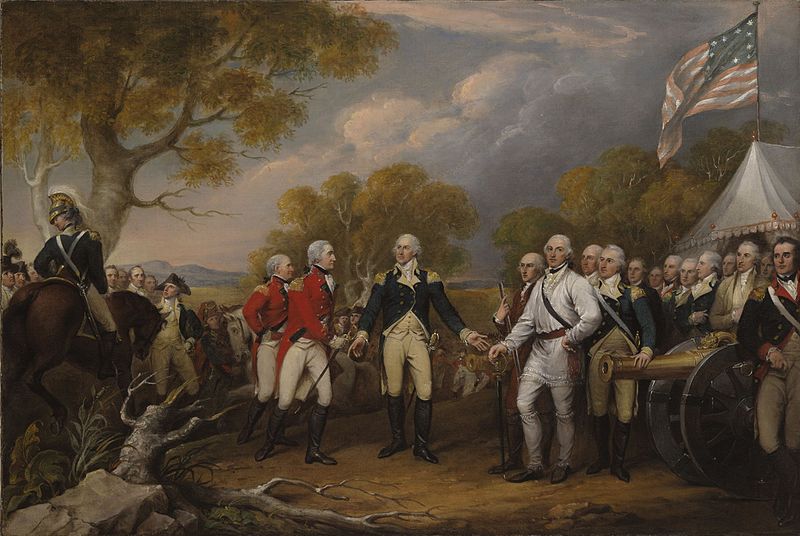
In some ways, I think, the analogy to Saratoga was more apt. In fall of 1777, British forces launched a three-pronged offensive to divide the Americans by splitting New York. Gen. John Burgoyne brought one of those prongs south from Canada, capturing Fort Ticonderoga and sweeping south towards American forces dug in near Saratoga.

The British attacked twice, but the Americans defenders held them off. Faced with losses and being cut off from reinforcement, British General John Burgoyne surrendered to American General Horatio Gates on Oct. 17, 1777. Partly as a result of the battle (technically, I suppose, the battles) of Saratoga, France decided it was worthwhile to support the American cause as the Yanks had demonstrated they maybe could win. And the tide of war was turned.

Painting of surreder at Saratoga
19th Century painting by artist John Trumbull of General John Burgoyne surrendering to General Horatio Gates on Oct. 17, 1777. Painting in collection of Yale University, image from Wikimedia Commons.

Of course, the Russian army didn’t surrender to Ukraine when their invasion forces stalled on the road to Kiev this spring, but still, just as American defenders at Saratoga produced a turning point, Ukraine’s valiant defense of Kiev and offensive to push back in the east give hope to its cause.

As President Zelensky noted, the first Russian defeat was its loss in the psychological war. Most of the world, and most of the body politic in the United Sates, recognizes Russia as the aggressor here. Zelensky reminded us that his country needs continued support as the battle against Russian aggression continues.

It is, as he stated, a key moment in a global fight for democracy. And, Zelensky predicted, a fight that Ukraine will win. That seemed faint hope when Russian tanks trundled across the border this spring—many of us, I’m sure, expected Russia to crush Ukraine. It seems, like the Revolution post Saratoga, that Ukraine’s ultimate victory now is at least a possibility, should its allies show backbone and stay the course and support Ukraine's cause.

Ironically, Zelensky is a TV entertainer turned politician who has proven, in his country’s darkest hour, to be an effective leader. He’s an FDR or Winston Churchill, a great communicator who showed his ability before Congress to sound the right notes, to clarify the issues at state, to rally support.

President Volodymyr Zelensky of Ukraine
Volodymyr Zelensky, president of Ukraine, in March 2022. Image from Wikimedia Commons.

How different from a recent U.S. President who was a TV entertainer turned politician. Indeed, President Trump was impeached for the first time for a corrupt phone call in which he tried to hold aid to Ukraine hostage for political favors. Trump is the anti-Zelensky, a divider, not a uniter, a man who this week was exposed yet again for attempting to undermine American democracy.

I felt it was very weird when the House committee investigating the Jan. 6 insurrection recommended that the former President face criminal charges, and the reaction from Iowa’s Republicans was a yawn. We’ve moved on. We don’t care about Jan. 6 anymore. We’re working on the issues Iowans care about now.

How American. How forgetful we are as a people. It’s less than two years since an American president attempted a violent coup in Washington DC, and too many want to close that chapter and forget about it.

Well, if we don’t forget the Battle of the Bulge or Saratoga, it is way too early to turn the page from Jan. 6. After all, the chief villain in that sad narrative, Donald Jerk Trump, is a leading candidate for President in 2024—the leader of an attempt to subvert our very democratic system is in the running for his party’s nomination for president, and the craven, cowardly “leaders” of his party are too scared of him to note that he’s proven himself unqualified to support and defend our Constitution. I’m one Iowan who hasn’t yet moved on and is disgusted with the gutless Iowa Republicans who claim we should. I’ll move on when the GOP renounces Trumpism and Trump, as long ago they should have.

And this week we have the opposite end of the scoundrel spectrum. A true icon of democracy, President Volodymyr Zelensky, calling on us to remember who we are—we are the victors at Saratoga and The Bugle, a people who have fought for two centuries for the cause of self-government and democracy.

Today, that fight is happening in Ukraine. But also in the hearts of Americans. The dark cancer of Trumpism is still with us. The fight for democracy isn’t just happening in eastern Europe.

Flag of Ukraine


Thursday, March 10, 2022

Murdered Mother, Her Children and Images of War

Somehow, photography still, in 2022, packs an emotional punch. It is a medium that freezes a moment in time.

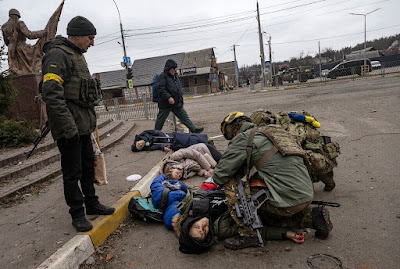
The March 7 edition of The New York Times featured a photograph of a mother, her two children and a volunteer who was helping them attempt to flee to safety in Irpin, Ukraine who died in a Russian mortar barrage.

New York Times image of dead family
From NYTimes.com, web site of New York Times, the famous image by Lynsey Addario, published on the paper's front page .

It’s a stark, dark moment in a stark, dark war. And a reminder of what photography can sometimes do. Think of the emotional punch of the picture of the crying girl over a body at Kent State. Or the fleeting Vietnamese girl, running naked from her village which has just been napalmed.

And now we have Tetiana Perbyinis and her two children, Mykyta and Alisa, teen boy and a young girl, along with a 26-year-old volunteer who had been helping them, dead on the street.

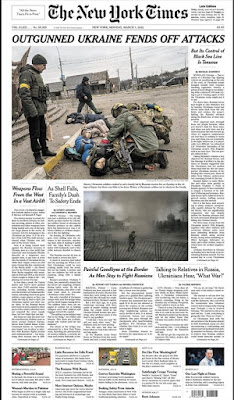
New York Times front page
Image posted on Twitter by New York Times.

American newspaper editors tend to be more prudish about these things than many of their international counterparts, and I’m OK with that. Images of excessive blood or badly damaged human remains are seen as being too cruel, inflicting pain on the family of victims of violence.

Although, in this case, as a follow-up New York Times story details, the husband would rather that the image be shared so the world knows what the Russian military did, what happened to his loved ones.

The Washington Post had an interesting reflection March 9 on how journalists decide what images are not too awful to publish in cases of stories like this. Paul Farhi reports that Times editors didn’t hesitate with this image, considering it too important to the story that needs to be told.

Well, yes, although one issue with an image like this is that the emotional content brings a deep reaction, but not necessarily a lot of insight. How did this happen? What is the context of this war? When are such civilian deaths merely the accidental outcome of conflict vs. the end goal of a country’s actions? Seeing the image itself doesn’t answer anything, nor does it tell us about Teiana, Mykyta, Alisa nor Anatoly Berezhnyi, the man who died with them.

As war in Ukraine has unfolded, I have not widely sampled all American media. I read AP reports in my local paper, The Gazette. I watch CNN and MSNBC reports at night. I listen to radio news from NPR. I find myself often checking the New York Times web site—via computer and my phone—partly because, as a professor at the college where I teach, the Times is made available to me by my institution.

So I can’t speak in broad terms about how this war is covered. But I can say that I have appreciated the depth of the New York Times efforts to cover this war. Journalism, done well, is so important at a dark hour such as ours now.

Lynsey Addario, the experienced photographer who rushed out to make this heart-wrenching image, fulfilled her role here. She witnessed and recorded. These days, images are often not trusted, but everything surrounding this one suggests it was authentic and honest, not some deep fake.

And horrible. And maybe that’s the point.

The freezing of an instant in time. The snap of a shutter after the crack of a mortar shell. And the world bears witness. Let’s hope that sad emotions aren’t the only response. If war journalism does nothing else, at least it forces all of us to recognize what is going on.

Yes, wars happen all the time. And we should pay attention when the victims of violence aren’t 43-year-old white accountants and computer programmers—tan, black, brown and yellow victims of war are just as human and suffer as much pain. Nor can merely learning about such violence be enough to stop it.

But it won’t be stopped if we don’t learn. Even if we do need the words to get the context, the image is an important part of that learning, creating an indelible memory of a tragic moment in time that should not be forgotten.


Saturday, September 4, 2021

How We Frame Memories of 9/11

Twin towers burn
Plumes of smoke from The World Trade Center twin towers on Sept. 11, 2001. From Wikimedia Commons via flickr poster Michael Foran.

Today is Sept. 4, which means the 20th anniversary of the Sept. 11, 2001 attacks on the United States is one week from today.

The 9/11 events were so big that “9/11” is all one has to say and everyone knows you don’t mean any Sept. 11—you mean that Sept. 11.

The world didn’t exactly change 20 years ago. The forces that attacked my country that day had been at work for some time—indeed, there had previous bombing attempts to destroy the World Trade Center. But that September day, sunny and beautiful in Iowa, at least in my memory, was still a pivotal day.

FBI timeline
From the FBI's web site, FBI.gov, a timeline of Sept. 11, 2001.

I have a little trouble picturing myself at 43. I was already greying—did I still have some dark hair? A man in his 60s has a little trouble picturing the world of the 40-something year old. Much in my life has remained the same, and much has changed.

On Sept. 11, 2001, I had a son in elementary school. My oldest daughter was nearing the end of high school, but was adjusting to a large public school—Linn Mar High School—after her first two years of secondary education had been at a tiny Catholic High School—St. Mary’s in Storm Lake, Iowa.

We had just bought a house in Cedar Rapids. The next year would be financially a little dicey for us, as we owned two houses. But both my wife and I had jobs, she at the birth center at Mercy Medical Center (where she would become the nurse manager in a few years), me at the start of a new career. I was fresh out of the world of journalism and into the world of academia, less than a month into my new job teaching at what was then Mount Mercy College.

Hole in Pentagon
A hole in the Pentagon in Washington, D.C. on Sept. 11, 2001. Defense Department image by Cpl. Jason Ingersoll, USMC, downloaded from Wikimedia Commons.

That Tuesday, I was buying tires for our van. I was at a tire shop near Lindale Mall that morning, and it was a very strange morning. Very few people were out, and I was the only customer at what would usually be a busy shop. I think six guys were working on replacing my tires, each taking 2-minute shifts or so before they traded off—the rest to join me in the customer lounge, watching TV. Special report from New York, a plane has struck the World Trade Center. Then, another. The Pentagon. A planned second attack on Washington, D.C., ending with a crashed plane in Pennsylvania.

I can’t recall a lot from that day other than the sense of shock. I was teaching a class that fall that I’m teaching this semester, too—CO 280, Writing for Public Relations. It was an afternoon class, I think, and I scrapped my lesson plan.

We rearranged the room in a big circle. And the students and I just talked about it, the big news of the day.

Ruined TV towers from World Trade Center
My wife and I visited the Newseum in Washington, D.C. during spring break, March, 2015. This is a ruined TV tower that been atop the World Trade Center on display at that museum.

And here we are, almost 20 years later. Two decade of grappling with new realities, of questioning what freedom means, of foreign wars and increasing polarization at home. The internet existed in 2001, but way back then we didn’t carry it around in our pockets and we still watched big events on a chunky, square TV in the customer lounge of a tire shop.

I am just starting to look into it, but I don’t think our current era of struggling with fakery on social media is unrelated to 9/11. That day shook America to its core, and became one of those improbable, shocking events around which wild conspiracy theories swirl.

Sept. 11 headlines at Newseum
Another image from that 2015 visit to the Newseum. A wall of headlines reporting 9/11 attacks, from an era when news media mattered more than social media.

Partly, of course, because it was the result of a shadowy conspiracy, and unpacking it is a process historians will be tied up with for decades.

What does it all mean? A lot, and I’m glad that Mount Mercy University will spend some time grappling with this key world event.

Every year, faculty at MMU designated a topic for a series of public discussions—the Fall Faculty Series. I am proud to have helped start this with our first series in 2014 being on the 100th anniversary of the start of World War I.

This year, the Series has a very simple title: 9/11: Twenty Years Later.” Five faculty members, including me, will give free, public Wednesday talks, all of which will start at 6 p.m., and all of which will take place in Flaherty Community Room in Basile Hall.

MMU 2021 Fall Faculty Series logo
Logo of 2021 Fall Faculty Series at Mount Mercy University.

Here is the schedule, the topics and the speakers:

  • Sept. 29, Precursor Events: At War before 9/11, James Jacobs, associate professor of computer science.
  • Oct. 6, Conspiracy, Myth, and Misinformation, Joe Sheller, associate professor of communication & MMU Times advisor.
  • Oct. 27, Heroism and Sacrifice after the Attack, Norma Linda Mattingly, associate professor of education.
  • Nov. 9, Fear and Trauma after 9/11, Dennis Dew, associate professor of psychology.
  • December 1, Reflections of a Muslim-American Immigrant, Ayman Amer | associate professor of economics.

Wednesday, October 18, 2017

Two Interesting War Fables

Like River in "Firefly," this is one lady not to trifle with. Warner Brothers publicity photo.

Recently, in the past two weeks, my wife and I have attended two movies at the local second-run theater: “Dunkirk” and “Wonder Woman.”

I think we both enjoyed them both, and it was a bit more of a stretch for her, given she is not a fan of war movies. I don’t like all war movies—I am squeamish and don’t care too much for graphic violence, and I prefer movies that at least seem to attempt to be consistent with history as well as telling a compelling story—but I do like a lot of them.

So, for example, one of my favorite movies is “Eye of the Needle,” which is clearly fanciful, but nonetheless captures the spirit of intrigue during WWII and is a good, tense thriller. Other favorites include “Saving Private Ryan” and the HBO series (not really a movie, but cinematic) “Band of Brothers.”

I don’t insist on accuracy down to the rivets, just, please, nothing wild and impossible. Like “Pearl Harbor.” Sure, they did great filming the attack itself, but the whole Doolittle Raid ending felt false and silly. They didn’t use fighter pilots to fly bombers on that raid, and the idea that the Army Air Corps would seek “pilots who can fly bombers like fighters” is ridiculous on the face of it—“we’re seeking long-haul truckers who can ride bicycles like trucks.” It makes as much sense.

Anyway, there is a whole genre of movies around World War II, which ranks as the great mythic good and evil struggle of the movie era. World War I, while a smaller war, was arguably more important as a historic event, but it’s not seen as often in the movies.

Back to the two recent movies—one set in World War I, the other in World War II. One had the feel of reality even if parts of the story were compressed and reshaped for cinematic purposes—still, I found “Dunkirk” compelling partly because there was so little artifice in the story telling. The other movie featured an incredibly sexy actress in a miniskirt and armored corset battling in a mythical World War I. And yet, I forgive “Wonder Woman” if it plays havoc with the actual historic event—because, after all, it’s a movie that features Zeus and immortal Amazons and a hidden magic island and a shield that can stop machine gun bullets—it’s pretty clear we’re not watching a documentary. Still, even as fanciful as it is, “Wonder Woman” does capture something of the feeling of the hopeless, violent carnage that was World War I, so it has some value in showing a modern audience what trench warfare meant.

On the beach, looking for home. Another Warner Bros. photo--as are the rest in this post.

One film, “Dunkirk,” is almost exclusively male. The other, “Wonder Woman,” has a largely male supporting cast, but does include the aforementioned Amazons, an evil female scientist named Dr. Poison, and an entertaining secretary character.

Despite their clear differences, I did find some similarities between the two movies. One is that both are aided by compelling sound work—musical scores, for instance, that do well in setting the mood.

Both are slightly “dark” in a literal sense—the day scenes are often washed out and foggy, and, especially in “Wonder Woman,” the second half portrays both the front and London as rather dingy places. Some key scenes in “Dunkirk” are below deck in ships, and this movie more than most I’ve seen makes those dark, claustrophobic places seem dark and claustrophobic. Although the mythical Amazon island in “Wonder Woman” is a sun-bathed paradise, I appreciated the sparing use of light in the later part of the movie, and the whole muted look of “Dunkirk.”

Both have implicit anti-war themes. When Wonder Woman stabs who she thinks is the evil god she is chasing—and it turns out not to be—she is shocked that men still wage war. In part, this female-driven movie is rumination on the violence of mankind, in a literal sense. You can’t trust the boys. They make war. And I hasten to add that I consider that not very sexist. In mammals, much pointless aggression is fueled by testosterone, and we all know which human gender that impacts most.

Amazon warrior and stock Hollywood bad person--German solider.
“Dunkirk” is a heroic tale of the British living on to fight another day, but I can’t help seeing the random senselessness of the violence—which I think is fair to the reality of actual war—as carrying an anti-war message.

In both, one of Hollywood’s stock stereotypes of villains is used—Germans don’t exactly get a good name in either film. “Dunkirk” is told exclusively from an allied point of view, so Germans are distant and dangerous and shooting at us—and that doesn’t treat them unfairly according that movie’s premise, even if it’s not great PR. “Wonder Woman’s” use of proto-Nazis is a bit more troubling. It’s one of the weaknesses of the whole Indiana Jones set of movies that Nazis are almost cartoonish bad guys, and “Wonder Woman” comes close to that portrayal. German soldiers exist to be speared, stabbed, knocked out of buildings, etc. They aren’t exactly seen as three-dimensional humans.

Neither movie is anti-German—“Wonder Woman” doesn’t suggest Germans are more evil than any other set of humans, but the evil characters in that film are mostly German (except, of course, for the main bad guy).

Well, I don’t think “Wonder Woman” will fuel any anti-German hysteria—no travel ban is being suggested for October beer drinkers. I just thought the portrayal of evil doers was a bit disappointingly shallow in that tale. Beyond importing Indiana Jones Nazis in a world several decades before they existed, the movie has some other odd mojo going on—what the heck was the deal with the gas that the German general was snorting? An implied anti-drug message?—don’t snort drugs, kids, or an Amazon goddess will pin you to the roof with her sharp thingie?

Meh, I’ve lapsed into complaining about “Wonder Woman.” I really liked the movie despite its flaws.

On the dock. Was that a plane I heard? God, I hope it was not a plane ...
I did find “Dunkirk” to be the superior movie, more underplayed. “Wonder Woman” was a bit uneven to me—the early part where our hero grows up and is trained was a bit slow. But the movie picked up when the Germans landed on the beach. And I did appreciate the playfulness of Wonder Woman trying to make sense of 1918 Europe—the customs, the clothes, the odd meaning of it all. She was, in many ways, the “alien” who comments on life—sort of like Spike from “Buffy the Vampire Slayer” only less evil and more lively.

And, despite some flaws, I think I liked “Wonder Woman” on a sort of Buffy level—Buffy was so entertaining because it turned so many horror movie conventions on their heads. The blonde headed down the alley where there were monsters, and the monsters ended up dead. In “Wonder Woman,” the pretty exotic curvy woman in the teeny skirt and tight armor ended up in the trenches, and the Germans all died.

“Frozen” took the movie world by storm, partly because it’s portrayal of a strong female lead character was off the beaten track and resonated with girls (and male feminists like me). “Wonder Woman” has become a feminist icon, too.

More strong women characters in movies, please. And if a story must be male centric (Dunkirk made sense as a boy movie due to its time and place) then at least have it be thoughtful and relatively accurate in its portrayal of history. The anomalies in “Dunkirk,” having the German plane painted wrong, for instance, are mostly minor details and useful from the story telling point of view without really misrepresenting the events.

So thumbs up for both recent movies, different and similar as they are.