Showing posts with label ICMA. Show all posts

Saturday, February 4, 2023

Some Reminders of Why Journalism is Important

Students at ICMA
This and next three images--college student from around Iowa listening to speakers at annual Iowa College Media Association convention, hosted by the Iowa Newspaper Association, Feb. 2, 2023, in Des Moines.


There’s no doubt that journalism is changing. This week, two students and I attended the Iowa College Media Association Convention Feb. 2 in Des Moines.

The convention, which was a two-day affair PC (pre-COVID), was one day this year. It’s hosted by the Iowa Newspaper Association, and with fewer vendors willing to travel in pandemic times and a shrinking base of newspapers, the associated twitched to a one-day affair.

Times they are a-changing. So is the MMU Times, the Mount Mercy University campus newspaper that I advise—it’s gone from broadsheet (full size) to tabloid (half size) with the idea that we’ll be more of an on-line news source. I foresee that a day may come soon where we forsake the printing press for a total emphasis on cyberspace.

We’ll see.
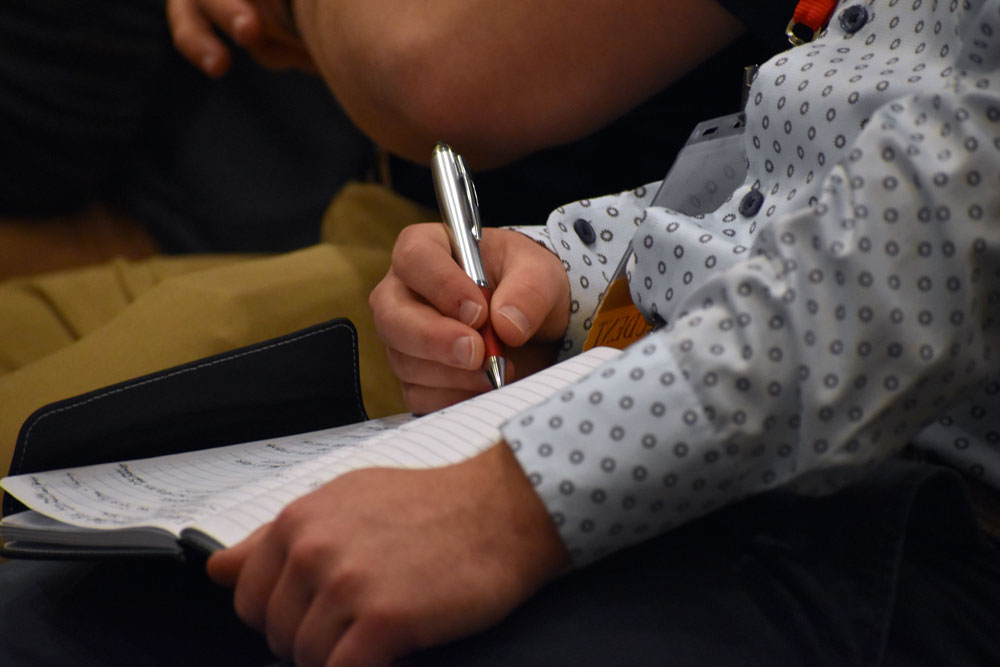
Students taking notes (above and below).

Anyway, it was great to be back in Des Moines. I wore a mask—it’s an event that brings hundreds together from all corners of the state, and I just felt it was prudent. I was almost alone in that, and I hope this convention doesn’t prove to be the super-spreader event that helps the new Kraken sub-variant really get going in the Hawkeye State.

I took a home test tonight. Negative.

But I was pretty positive about the convention. INA’s keynote speaker was the kickoff event, and it was a kick. Dr. Richard Deming, a Des Moines oncologist spoke about “Pursuing Life with Purpose and Passion.”

He runs a sort of adventure travel program that involves taking people who have undergone cancer treatment on trips, such as climbing Mount Everest.
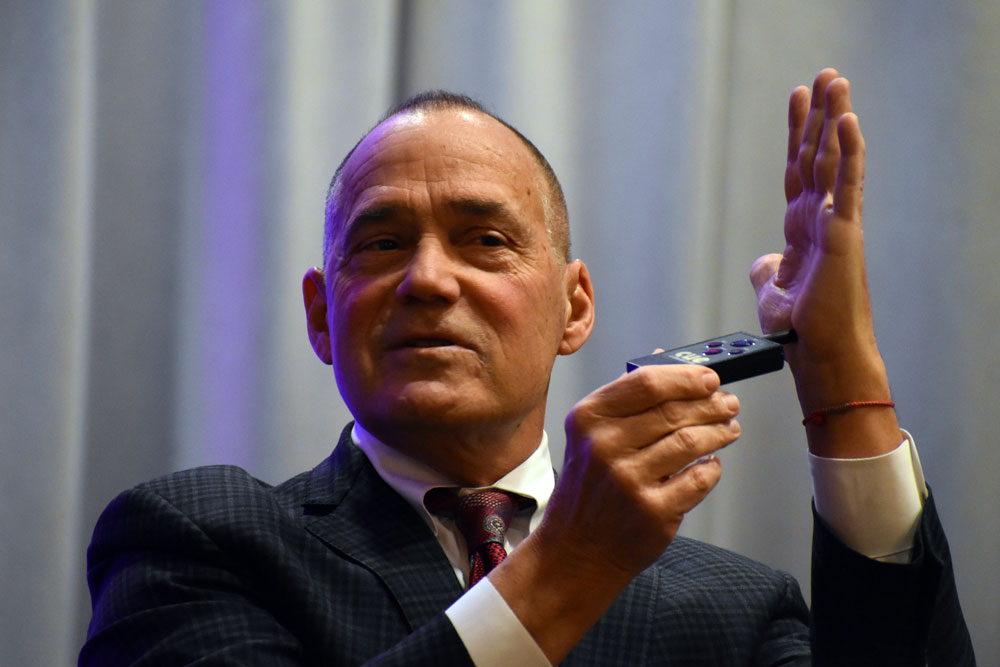
Dr. Richard Deming
Dr. Richard Deming tells stories from the nonprofit "Beyond Cancer" that takes people who have been treated for cancer on adventure trips. He describes it as a form of ministry.

Deming noted that treating cancer is not the most important part of what he does—a great doctor, he said, treats the patient, not the disease. And partly that means taking the time to be part of their story.

“You guys (newspaper people) are story tellers,” he said. “You have to be a story listener before you can be a story teller.”

He touchingly recounted trips and people, showing pictures and telling stories. We met women and men who overcome and live life to the fullest facing whatever hand of cards the universe deals—an elderly lady with poor balance and eyesight, for example, scaling the slope of Kilimanjaro.

She and the others all share a deep appreciation of a reality that we all face but sometimes forget—our time is finite.

“If you have a dream you to want to fulfill, today is a good day to do that,” Deming said.

Also that we need to treat each other with kindness and support. As we all pursue our dreams, none of us can do it alone. And we should do it now, too.

“You don’t have to have cancer to get off your butt and live your life,” he said.

I had been asked to snap and share some images during the convention, so I stuck pretty much to the ICMA speakers. It was enough, they were an interesting group.

EJ Phily Burton
EJ Phily Burton is introduced.

EJ Philby Burton, of Produce Iowa, a state office promoting movie production in Iowa, talked of the opportunities in that industry. I thought much of she said applied to any creative profession, including journalism.

For example, when you’re in a hurry and have a complex task to get done, “power walk, don’t sprint.” If you move too quickly, you’ll get sloppy. I often tell students that their slowest typing should be when they’re writing cutlines or headlines—the last-minute touches done in a rush are also where the most embarrassing mistakes are made. So don’t sprint when you’re in a hurry. Don’t crawl, either—but power walk, working quickly, but deliberately.

She also noted that on a movie set, a smart production assistant won’t whip out their phone, but will look around and see what needs to be done—carefully, so as not to interfere with others’ tasks, but success comes to those who can see what needs to done without always having to be directed.


Sarah Muller
Sarah Muller of Forbes talks of the need for journalism and journalist to evolve and meet their audiences where they are.
At a later session, Sarah Muller, Social Media Lead for Forbes, gave all kinds of example of how media needs to be more active online.

In particular, she urged us to seriously consider TikTok as a story telling venue, given that’s where younger members of the audience are. And Iowa is banning state offices from using that app. I feel another post on another topic coming on soon.

Back to ICMA. “We have to learn to evolve,” Muller said.

The final panel of the afternoon is one I look forward to each year, the “Young Professionals.” They were a good crew this year, as they often are.

Young professionals
Young professionals panels. Hayley Schaefer of Iowa PBS speaks.

The one that stuck with me most was Olivia Allen, a Simpson College graduate last year who now is an education reporter with the Quad City Times. She spoke passionately of her desire to give voice to the voiceless, to write about school policy including the voices of students who are most affected.

It felt, to me, exactly what this gig is all about—giving voice to those whose voices are otherwise not heard. It echoed back to what Dr. Deming had said in the morning, because part of the challenge is to learn to be a story listener in order to be a better story teller.

Olivia Allen
Olivia Allen of the Quad City Times speaks as Nick Brincks of Iowa Public Radio listens.

The other panelists were memorable, too. Nick Brincks, of Iowa Public Radio, was the oldest of the young professionals, having graduated nine years ago. I thought he brought some realism about how life changes as you go from the college life to full adulthood.

The program ended with the ICMA 2022 media contest awards ceremony and keynote speaker.

Ty Rushing
Ty Rushing speaks.

Ty Rushing, a force in Iowa journalism since he joined the ranks of Iowa reporters in 2013, spoke. A native of Kansas City, he told us of his jobs and the lesson he learned at each, including, honestly, what kind of editor not to be.

It took be six years to work my way to an undergraduate degree, so Rushing’s stories of working in a warehouse at night and attending college during the day resonated with me—for me, for part of my academic career, it was an overnight shift in a cat food factory. He took seven years, but he made it.

Anyway, one point both Rushing and the four young journalism panelists emphasized was the importance of getting as deeply involved in student media as possible.

The students I advise at the MMU Times earned seven awards, including:

  • First Place, Staff Editorials (Jada Veasey, Annie Barkalow and Gwen Johnson). I’m thrilled with this award, which the Times has won in the past. It’s a strength of this paper that it can speak with a coherent, powerful voice. The editorial cited included one on COVID-19 policy, and two urging students to take care of their mental health.
  • First Place, Best Vlog or Blog (Catherine Kratoska for Catherine The-Not-Too-Bad). Again, a traditional strength for Mount Mercy (you’ll see us again in second place in the same category).
  • First Place, Best Written Feature Reporting (Annie Barkalow). Mrs. Barkalow’s name came up a lot this year. This was for coverage of a Holocaust memorial speaker at MMU in spring.
  • Second Place, Best News Reporting (Annie Barkalow). A story in spring about student art being removed when some deemed it offensive.
  • Second Place, Best Vlog or Blog (Annie Barkalow for Anne with an E). Second time in a row Barkalow has won this honor. She’s the CCR of blog writers.
  • Honorable Mention, Best Headline Writing (Jada Veasey, Annie Barkalow, Gwen Johnson).
  • Honorable Mention, Best News Reporting (Annie Barkalow). This one confused me a bit, because it’s for an excellent feature about teaching, but I think there was some category confusion. I entered it in “investigative reporting,” and I’m not sure why it shifted categories.

Well, seven awards, with three first-place awards is a decent result. Congratulations to all the MMU winning journalists!

Delcie Sanache
Delcie Sanache at the ICMA convention, with Joselyn Hildebrand in the background. Both are editors on this year's newspaper staff, and, I hope, winners of ICMA awards next year.

And thanks to Delcie Sanache and Joselyn Hildebrand, two Times editors who attended the conference and represented MMU there.

I do miss the two-day conventions, but we have to learn to evolve. And Thursday was a good day.

Craig Schaefer and Jana Shepherd
Craig Schaefer, president of ICMA, congratulates Jana Shepherd of the Iowa Newspaper Association. Shepherd received the John Eighmy Service Award, given by ICMA each year to a supporter of college student journalism. Without her support, ICMA would not be able to have it's annual meeting.


Saturday, February 20, 2021

MMU Times Wins 7 ICMA State Awards


Front page flag of the MMU Times

The Iowa College Media Association award ceremony was both very familiar and very different this year. It is usually held during the Iowa Newspaper Association Convention, but this pandemic winter, the ICMA convention didn’t take place.

Yet, the Thursday night award ceremony did happen Feb. 18. The ceremony, hosted over zoom, was different due to the remoteness of online meetings, and also familiar, with radio awards, TV awards and then “news media” awards, mostly newspaper categories but some online awards, too.

Mount Mercy University’s “Mount Mercy Times” won seven awards. In particular, student Courtney Hoffman, a senior who graduates this year and is managing editor of the Times, was recognized multiple times. Jada Veasey, a nursing junior who is our senior opinion editor, also won several writing awards.

Courtney Hoffman
Courtney Hoffman, MMU Times Managing Editor.

The Times has historically done well in certain categories, and again showed the general strength of its opinion writing. The Times was recognized with a first-place award for staff editorials.

The three submitted were written by Jada Veasey, Courtney Hoffman and Veronica Jons, although the whole editorial board has a hand in setting staff positions and crafting editorials. In my opinion, providing a thoughtful, meaningful voice on policy questions on campus is a key role of a student newspaper, and the Times excellence in this category is evidence that it takes that mission seriously and does well in it.

Veronica Jons
Veronica Jons, editor-in-chief of MMU Times.

Jada Veasey, who I already mentioned, was honored as the best opinion columnist in the state of Iowa in the past year. Jada’s humorous, thoughtful, quirky voice has been a welcome addition to the Times, and it’s good to see her writing recognized on the state level.

Jada Veasey
Jada Veasey, senior opinion editor.

The Times links its web site to blogs written by editors and staff writers—and two of those won recognition. The best newspaper blog in the state, according to ICMA, is written by Courtney Hoffman, managing editor of the Times. The second best is by staff writer Annie Barkalow.

Image of Annie from her blog.
Annie is a nontraditional age student, and I’m glad that she was able to view the zoom award ceremony Feb. 18. The next day, she told me that she had informed her family of her second-place win, and said her teenage daughter’s reaction was, “mom, it wasn’t first place.” Ouch. In Roman times, to keep a victorious general from having too much hubris, a slave would stand with him in his chariot and whisper in his ear that he was only a flawed human during the general’s victory parade. As a father, I guess I can see that one’s teen offspring often serve the same purpose.

Well, congratulations to the talented student journalist who serve an important role at Mount Mercy by providing the community with a vibrant student news outlet. MMU would be a poorer place without that.

In addition to the first-place awards, the Times won awards in feature photos, profile story and page one design.

Thanks, ICMA volunteers, who are busy faculty at Iowa colleges, made all the busier by thousands of extra adjustments during this time of COVID-19. The zoom awards ceremony, like many large zoom meetings, had a bit of a séance feel to it as some major award winners were asked to speak and there was the “can you hear us, are you there” moments. We had extra soundtrack running under part of the event until students remembered to mute. But ICMA got the job done, and I’m grateful for all the work the officers of ICMA do, for the INA for helping the contest and this ceremony happen—but mostly for the student journalists from many Iowa colleges who all seem to have a great time (based on chat reactions) Thursday.

Below is a list of the seven awards won by the MMU Times, by category. With each is the name of the student or students from MMU honored in the award, comments on the individual entry from the contest judges (professional Iowa journalists provided by INA) and, in some cases, category comments, which were notes from the category judge on the whole let of entries in that category from all Iowa college newspapers.

Here are the awards the Times won:

Best Feature Photo, Second Place, Mount Mercy University- The Mount Mercy Times
Accident Leads Back to School—Hands; Courtney Hoffman
Judge’s comment: The portrait of hands clutching a cane powerfully reinforces the message of "true grit."

Best Profile Story, Third Place,
Mount Mercy University- The Mount Mercy Times
Accident Leads Back to School; Courtney Hoffman
Judge’s comment: A nice story that maybe could have used an additional source or two. I would have liked to have seen the social work get moved up to the front. Feels like it could have been shorter.
Category comment: Everybody has a story. The winners in this category run the gamut from people who have an obvious story to people who maybe aren't so obvious. The key to a good profile is a good interview while multiple sources can help flesh out a story. There were a lot of one-source stories in this category.

Best Opinion Writing, First Place, Mount Mercy University- The Mount Mercy Times
Opinion Columns by Jada Veasey
Judge’s comment: A refreshing and engaging writing style made these columns enjoyable to read. The use of analogy and reasoning made them thought-provoking, as well.

Best Blog, First Place, Mount Mercy University- The Mount Mercy Times
Curious Consultations: unsolicited anecdotal advice by Courtney Hoffman
Judge’s comment: Courtney is a conversational and entertaining writer who brings relatable topics front and center for her college audience.
Best Blog, Second Place, Mount Mercy University- The Mount Mercy Times
Anne with an E by Annie Barkalow
Judge’s comment: Through her lens as a nontraditional student, Anne brings her own brand of challenges to the college scene -- and her blog.

Best Staff Editorial(s), First Place, Mount Mercy University- The Mount Mercy Times
Mount Mercy Times staff editorials-Jada Veasey, Veronica Jons, Courtney Hoffman
Judge’s comment: The strength of these staff editorials addressing timely, relevant social issues lay in the numerous examples used to connect them with the local university culture. The specific recommendations offered move each piece beyond mere words into action.

Best Page 1, Third Place, Mount Mercy University- The Mount Mercy Times
Derecho and President Departs by Veronica Jons
Judge’s comment: Very newsy content. Masthead is too large for the page and slightly stronger writing might have pushed this into second.
Category comment: Two things—really focus on your local community. The winners in this category were newspapers that knew their audience and provided information that audience could only get from them. Look at your mastheads and how they balance against the news portion of your page. Watch the use of reverse type, it's hard to read although it can sometimes be an attractive design option used in serious moderation.

Final thought: Iowa universities are beset by many challenges, including, at the state level, a wrong-headed GOP legislature that seems to want to cure was it perceives as free expression problems on campus by a weird series of laws that, in effect, would muzzle expression.

Sort of like in "I Cladius" when the crazy emperor cured a boy's cough by chopping his head off.

Anyway, the Times, like other student media, stands for free expression. As another faculty member reminded us at the ICMA awards ceremony, nobody in your audience cares what you did yesterday, so the challenge is to go out and do it even better tomorrow. I would add, with courage.

My wish for you (link in case video does not show, it doesn't on my phone but does on computer), MMU student journalists and all Iowa student journalists:


Saturday, February 6, 2016

ICMA report 4: Observations on Students and Media

Panel of student journalists who worked with Iowa Watch on caucus night--from Iowa State University, Buena Vista University and Simpson College. They might be, right to left, Alex, Kiley, Zach, Brittany and Michelle. Or perhaps they are in some other oder.
Well, they are young, most of them. And they use media differently.

For example, there were free piles of “The Des Moines Register” readily available, but I saw few college students walking around with them at the Iowa College Media Association convention, held in conjunction with and hosted by the Iowa Newspaper Association convention.

Cell phone use. Bet my picture is better.
At ICMA/INA sessions, when something cool happened, mostly you saw cell phones taken out to snap photos or video. I saw at least one BVU student with an SLR camera, but it seems like my generation is the one more likely to use a camera. Not that old people don't take images with an iPhone, I just noted what I think was a trend as a lugged around my Nikon.

Several Friday, Feb. 4 sessions at ICMA featured advice for student journalists and/or shop talk from them. And even if it would give an old man some comfort to see these youths actually looking at a newspaper, I can take some solace in the quality of their anecdotes.

They care about journalism and think deeply about it.

A one session, Lyle Muller of Iowa Watch invited a panel of reporters who had covered the Iowa Caucuses to speak. Iowa Watch did a project on the caucuses, and two of my students took part. See their posts here and here.

Ahh! Justice! I think that's the name
of the BVU student with the camera.
Anyway, Michelle Hartmann, who I think was from Simpson College, described what it was like to have the Secret Service move you at a Ben Carson rally. I noted that when the Secret Service moves you, you do move. Muller added that you also don’t move until they do move you. “Your instincts (to get on some stairs for a better photo angle) were right,” Muller told Hartmann.

I hope I have the names right. I know Lyle, so I’m pretty sure about him, but there were five panelists from three colleges, and although I wrote their names down from a “names” slide, they were not sitting in the order they were listed. So Michelle might have been Brittany and Brittany/Michelle might have been from Buena Vista University. At least only one student was from ISU!

Lyle Muller is Iowa Watching you.
To me, the irony of my name confusion is that the session with Muller came right after a session on reporting basics by Brian Steffen, professor at Simpson College, spoke to ICMA about how easy it is to get basic facts confused when you report. As I like to warn my own students—get the information right when it’s in front of you. Don’t assume you can check it later. True, that’s advice that I should have followed.

A photographer who was moved by the Secret Service.
Anyway, back to Muller. Brittany Robb from BVU, or possible Michelle, said that covering the caucus night was a lesson in “being prepared for the last thing you would expect.”

That, I think, sums up a lot of what journalism is. In addition, as Steffen said in the previous session, you must verify information. Again, as Robb or someone else said: “Take anything you hear from a candidate with a large grain of salt.”

As Muller pointed out, that’s because a politician is trying to persuade, to sell an action. They are not trying to win the truth-telling contest.

Anyway, I have no way to fact-checking this. It’s just my personal impression, which makes it more blogging than journalism. I sensed enthusiasm at ICMA for basic shoe leather reporting. And I think the students who joined the Iowa Watch effort really gained from that experience, and not just the ones who spoke at ICMA.

As I noted earlier, two of my students wrote caucus accounts for Iowa Watch. Later, versions of their stories will appear in the MMU Times. While it’s great to write for the Times—MMU students, any of you who want to be in a communication-related field should do that—I’m sure the thrill of seeing your mug on the Iowa Watch site is a bit more of a rush then when it appears in the Times.

And it does give me pleasure to work with bright young people (and some not so young) who still seek that rush.
Brian Steffen at the earlier session. The pride of Simpson College.


ICMA report 3: Tears in the morning

Chris Norton delivers Iowa Newspaper Association Kickoff Address (ironic name) Feb. 5 in Des Moines, I was there for the Iowa College Media Association meeting.

At the advisor’s lunch meeting, one of the DMACC people commented: “I didn’t expect to be crying by 9:30 a.m.”

For me, that wasn’t completely true. I didn’t really tear up until about 9:50.

Chris Norton gave a powerful morning speech as the first session of the Iowa News Paper Association/Iowa College Media Association Friday events Feb. 5 in Des Moines. He spoke about his experiences losing sensation and mobility below his neck during a 2010 Luther College football game.

Norton, a freshman, sprinted across the field to tackle an opponent on a kickoff return. He says he dove a fraction of a second too early. The opponent’s knee met his head. And, as Norton describes it, it was like a switch was thrown: nothing below the neck—no sensations at all.

He kept telling the trainers he would be up in a minute. In fact, it took months of effort before he could get into a wheelchair.

Norton is better, now, but not fully recovered. He uses a wheelchair to get around, although he can take steps with assistance. He uses his arms and hands to move his wheelchair.

When did I tear up? It was near the end. Norton spoke about many of the ordeals that he went through, but also the good things that happened to him since the injury He managed to walk to receive his Luther College diploma in 2015. He has written a book with his father and has established a foundation that has raised close to $500,000 to aid people with disabilities. He met, and proposed to, his fiancé.

“If I could go back and change that play, I wouldn’t,” he said. Cue waterworks.

Chris Norton
Along his journey, Norton described two contrasting doctors. When he was feeling very down early in his long hospital stay, a woman named Dr. Georgia knelt down by his bed to get to his level and said : “Look me in the eyes.”

Norton says he wasn’t sure what was coming. “I’m from Wyoming, and people from Wyoming don’t lie,” Dr. Georgia told him, staring him in the face. “You will beat this.”

“It was just what I needed to hear,” Norton said. He urged us to be the “Dr. Georgia” for others in our lives, to encourage when we can—and avoid being the other doctor he called “Dr. Phantom.”

One day, lying in his hospital bed, Norton felt an “exposed” chill in his left big toe. He was very excited and reported the sensation to his doctor, who acted pretty unimpressed, and explained that people with spinal cord injuries often have phantom sensations, and that sensation was what Norton was feeling.

The explanation devastated Norton. However, weeks later, Norton was able to prove Dr. Phantom wrong. Over time, the sensation in his toe increased, and he was finally able to wiggle it. His father didn’t know the toe news, but had developed the habit of giving Norton’s feet “pep talks.”

That Thanksgiving Day, Norton asked his dad to give his left foot a pep talk. “Sure,” his dad said, and leaned over. A few seconds into the talk, Norton wiggled his toe at his dad.

Talk about shock and awe.
Norton, with his dad,
chats with INA attendees after his speech.

Anyway, after hearing Norton, my pile of J-term grading that’s overdue, the many preps and quizzes to write for next week—they don’t seem so onerous or burdensome. Each day is a gift, each challenge a chance to find my better self.

Now I’m writing like a motivation speaker. It’s not what I am—but given the choice, I would sure rather be Dr. Georgia than Dr. Phantom.

Thursday, February 4, 2016

ICMA report 2: Some lessons to learn

I kind of wish I had been videotaping rather than shooting images of the Iowa College Media Association convention. Of course, I have two cameras with me, and they both shoot video, but I don’t really want to edit hours of video.

OK, what I really mean is I wish someone else shot video and edited it to a highlights reel, but then again, there were a lot of highlights from the first day of the ICMA convention.

I thought our keynote speaker was interesting. Are you ready for a mouthful? It was Amalie Nash, who since 2014 has been the executive editor and vice president for news and engagement at the “Des Moines Register.” I must be getting old, as a newsroom title, “VP of news and engagement” sounds way too new age for me.

She made many good points—many of which are not revolutionary, and echo what I’ve long told my students, but I liked the way she put things. When covering news, always ask yourself “why is this a story?” And she was spot on—one of the problems with beat journalism is the risk that the journalist becomes too much a part of the club, or, as I would paraphrase her, the writer beings writing for his or her sources rather than the readers.

Amalie Nash, "Des Moines Register" executive editor

“Know who you are writing for, who is going to read your content,” she urged. CO 120 students, take note.

She also noted that many of her college classmates didn’t end up in journalism careers because they didn’t do an internship, and thus had no professional samples. Again, as I’ve told any MMU student unfortunate enough to be cornered by me—you must write for the Times, even if you’ll never work in newspapers, because you must establish a portfolio. And there is a reason why you can’t get a journalism degree or any other communication degree from MMU without an internship.

As for breaking into the field, Nash’s wisdom isn’t new, but is relevant: Network. Get to know people. Make a name for yourself.

As a young professional (Mariah Young of Dwolla, an e-commerce company) said: “You are your own brand.” “I am a product,” she added.

Aaron Young of the "Des Moines Register"
listens to Mariah Young.

Anyway, I wasn’t entirely comfortable with all of Nash’s speech. I am a bit bit ill at ease with the need for audiences to be “personal” with their journalism sources—I don’t care what she ate at the State Fair, it doesn’t seem like “news” to me. But I don’t deny that she’s fundamentally correct that journalists have to find new ways to reach audiences as the media landscape quickly evolves. And, after all, now that I think about it, my previous blog post about ICMA awards started with what I ate, so who am I to talk?

Mariah Young, by the way, was part of what I think was the best panel of young professionals I’ve seen at ICMA.

In particular, I liked some of the things that Kyle Oppenhuizen of the Greater Des Moines Partnership said. He emphasized that he has changed jobs, and in each has found that good writing skills are the key to his work.


Two MMU students listen to young professionals panel.

“I don’t know much about business, but I know how to be a reporter,” he said.

And what is one key to good writing? “Listening is maybe the most important skill you can acquire,” Oppenhuizen said.

David Ekstrom, Meredith, and Kyle Oppenhuizen.

Amen to that.

Prior to the young pros, there was a panel on diversity. That was interesting, too, partly because Justice Gage of the BVU Tack noted how his campus had a forum on immigration.

The sound you hear is my ears pricking up. I coordinate an annual Fall Faculty Series at Mount Mercy, and our topic for 2016 hasn’t been named yet, but has to do with immigration.

“Everyone has an immigration story,” Gage said. I’m not sure that is literally true—at least one Native American is an official at MMU—but it’s a pretty good generalization. I’m the product of a Hungarian family that came over a bit more than 100 years ago—my grandparents on my father’s side were immigrants. My mother’s Irish family had been in the country longer, but was in the great wave of 19th century immigration that causes so much fear and anxiety in the 1800s.

If Donald Trump were running for president in 1855, he would want to stop all those Irish from coming over “until we can figure out what is going on.” Give it up, Don, you won’t ever figure it out.

Justice Gage, BVU, listens to Danielle Ferguson, ISU.
Anyway, I digress. My point is that we want to play with the way the people of the USA understand their own immigrant heritage and our reactions to new immigrants. So Gage’s remarks resonated with me.

I got a lot of food for thought from the first day of ICMA. For one thing, the editor of the Register asked how many students regularly do video storytelling. Although I require it to a limited extent in my journalism courses, I can’t help but feel even writers need to be pushed more to be conformable with that kind of storytelling.

You have to reach the audience where it is willing to be reached.

And I have to go to bed. Day two of ICMA will be exhausting if it’s as interesting as day one.

ICMA report 1: What the Times won

Three MMU Times Editors with awards--Anna Bohr, multi-media editor; Taylor Zumbach, managing editor; and Billie Barker, copy editor.

It was quite day at the Iowa College Media Association Convention. Because I misread the schedule, and because the parking garage we usually use is a heaping pile of rubble, we completely missed the networking luncheon that was the kickoff ICMA event—and that left me rather bummed.

I was thus put in a sour mood. A foregone feast will do that to me. We had registered for the conference just at noon, an hour late, and there was no shuttle to the lunch spot, but we did find a nearby cafe and I did have a Reuben, one of my favorite sandwiches, so there was that.

I was also missing the opportunity for a media tour, one of my favorite ICMA activities. But then the sessions began, and there was just something about them. There was a student journalism discussion of diversity issues, followed by a young professionals’ panel and then an interesting presentation by a senior Register editor. None of these are new kinds of content for ICMA, but I must say I think we lucked out this year—even if the topics were familiar, I found the speakers to be excellent.

And during a break, I ran into Lyle Muller, and nobody can be in a bad mood for long if you’re a professor and Lyle is trying to recruit your kids for an Iowa Watch project. (Hint, students, I’m on Lyle’s side—yes, you should participate.)

So the afternoon was turning out well, although I was a bit tired and hungry by the time the ICMA awards program came around. The Mount Mercy Times won seven awards—not a record haul for us, but a very nice showing.

Our winners were:
Screen shot of the best news photo of the year.

•    Connor Mahan, first place, best news photograph, for a picture of a young boy searching for a relative’s name at the Moving Wall. It's on page 2 of the PDF.
•    Anna Bohr, second place, best feature photo for a picture from a play rehearsal.
•    Taylor Zumbach, second place, best news photograph, for a volleyball action picture.
•    Billie Barker, second place, best news story. I don’t recall for sure, but I think it was the one she wrote about the author’s speech—Dale Kueter— during the Vietnam series.
•    Madison Coates, third place, best investigative news story, for her freshman CO 120 “enterprise” story on education reform.
•    Taylor Zumbach, third place, best news photograph for a picture of a rose at the Moving Wall. See page one of the same issue that Connor's image is in.
•    Claudia Magana, honorable mention, best sports photograph. Again, the records are at the Times office—I’m pretty sure it was a basketball photo, probably men’s, but could have been women’s.

It was a good night, and we followed the awards ceremony with a hefty meal at Zombie Burger. A nice end to what was, in the end, a nice day. I’m planning to write several more blog posts, so stay tuned. There is a lot to talk about from day one of ICMA.

Don't feed the zombies at Zombie Burger.