Showing posts with label Mount Mercy Times. Show all posts

Sunday, March 15, 2026

Hoping a Meeting Sparks More Journalism

Jada Veasey
Jada Veasey, adjunct advisor to the MMU Times.

The cookies were exceptional and the energy was good. I hope it picks up and something comes of it—the energy, that is.

On March 12, I was invited to speak with a small number of Mount Mercy University students in the newsroom of the Mount Mercy Times. For various reasons, the Times, which had been a student newspaper in years past and now is a student online news source, has been inactive this year, and some at MMU are hoping to change that.

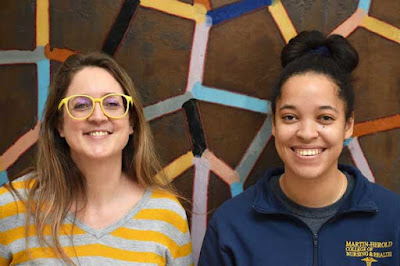
I retired in May 2025 as a communication professor at MMU, and was the faculty advisor to the Times for two decades. This year, a relatively recent MMU graduate, Jada Veasey, was named as the adjunct advisor to the Times. I was speaking with the students at her invitation.

The main reason to bring me in, I think, was to give the students a sense of what journalistic writing is—how a news story is structured. But I started by asking the students what they were doing in the room—what they saw as the role of journalism at MMU.

The questioned stumped them, a bit, but that’s OK. I wasn’t seeking a quick answer nor a “correct” answer, I was more interested in prompting them to think about the “why” of the MMU Times. If you know why you’re doing journalism, the “how” has something to drive it.

Lainey Henley
Lainey Henley, sophomore English and political science major.

Anyway, we had a bit of a broad-ranging philosophical discussion, and then I went over a bit of newswriting 101. I reviewed, briefly, what a lede is, what a bridge is and how to proceed form there.

It was way too quick to turn aspiring writers into journalists but I guess the whole point of the meeting wasn’t to cover a semester’s worth of intro to journalism. It was more to try to feed the spark, prime the pump, get the students to get out there and get started.

Kade McPherrin
Kade McPherrin, sophomore social work major with a minor in sociology.

Meanwhile, Jada, the advisor, also has her own cooking blog and had brought in a set of chocolate chip cookies to test our reactions.

I don’t know how the open-ended ramblings of the old man would be rated. I did leave the meeting feeling good about the potential for student journalism at MMU and hoping that the students, who were only a day away from Spring Break, would feel now is the time to dive in and get something done. As for the cookies, my rating was simple. They were 10 of 10.

Keira Carper
Keira Carper, senior English major and creative writing minor.

Jada, a registered nurse in her day job, was an excellent student journalist at MMU. As a nursing student, she had a difficult, time-consuming major, yet managed to make time to be a guiding light at the Times. She seems to viscerally understands that a community, even a student community, is richer and more informed with journalists active in it.

I think the students there sensed that, too. I hope that they live it.


Wednesday, May 3, 2023

A Dramatic News Shift

Papers on loading dock
Bundles of the Mount Mercy Times on the McAuley Hall loading dock, 8 a.m., May 3, 2023.

How long will there be “paper” newspapers? When will the final print edition of whatever the final publication is smack the porch of the last subscriber?

The hand has been writing on the wall for a while. And, yes, I still get my morning paper, and I still like having the pages there with me at breakfast to flip through, to read what catches my eye. I get The Gazette, the Cedar Rapids, Iowa, newspaper. I also am a digital subscriber to The New York Times.

I like my NY Times, and try to dip into it daily. But I most often look at it on my phone screen, and the words are teeny tiny there—readable, but though the phone is always with me and the pages of the Gazette are not, it is still not as conveniently consumable as ink on paper. I’m sure I consume many more stories in the Gazette than in the Times.

But I have issues with my paper Gazette, too. As their subscriber base narrows, their delivery service is getting iffier. We went from having a carrier who put the paper on our front stoop to “driveway delivery,” which means, it seems, a biplane tosses out papers in our neighborhood that randomly land in the vicinity of subscribers. Finding the paper is a daily morning hunt, and Monday it wasn’t there at all—an occurrence that has become way too common since the biplane was launched.

And one winter day, after a snowfall, I ended up chewing up the Sunday Gazette with a snowblower because I didn’t see it buried under the blanket of white. On rainy days, given the haphazard nature of the paper drop, it’s an even bet whether we have a readable newspaper or a soggy brick of mushy newsprint.

It gets irritating paying for a product whose delivery is getting dicey. My wife and I have discussed whether to continue getting the paper, since we’re not always “getting” the paper. Digital would be an option, but I hate to give up reading a paper newspaper.

When I was growing up, my family usually got three daily newspapers, at least in Iowa. I wasn’t very literate when we lived in California (we moved just before I turned 8), so I can’t say what the sitch was there. 

By the way, Word doesn’t like shortening “situation” to “sitch,” but Word clearly is not a Buffy the Vampire Slayer fan—I am, so that’s the sitch.

Anyway, in Clinton, it was The Quad City Times, The Des Moines Register and The Clinton Herald. In Muscatine, it was the first two (QCT and Register), and The Muscatine Journal.

The local papers were afternoon publications, the area “big city” paper, and the newspaper Iowa used to depend upon when the sports page was Peach colored, were both morning papers. None of them were dropped from biplanes. As I became interested in journalism as a career, two of them became part of my experience—my undergraduate internship was at The Muscatine Journal, and I had a part-time gig as a sportswriter for The Quad City Times when I was a senior in college.

The world changes. Web-fed rotary presses were invented before the Civil War, making mass newspapers possible. Today, that industry makes less sense, which is why it’s scrambling so hard to acquire cents.

And so, we come to today. A big day that I have decidedly mixed feelings about.

My wife set the alarm for 5:30 a.m., a brutally early time to a night owl like me. I had to arise early to get to the Mount Mercy University campus before an early class.

I had the glamorous job of moving the pile of newspapers that are dropped off at a loading dock to the newspaper’s library office, where a student doing work study will later distribute those dead trees around campus.

Newspapers on cart
Papers on cart in MMU Times office. Collector's item soon to be available around campus.

Meanwhile, she will collect all of the fortnight-old copies of the previous edition—well, not “all,” since some get picked up, but a disturbingly large percentage of the previous paper will end up in recycling bins rather than before the eyeballs of our intended audience.

Old fogeys like me love the paper newspapers. Young flappers, like MMU students, apparently, aren’t so enamored by dried ink on dead trees.

The Mount Mercy Times maintains its own web site but, frankly, doesn’t do a great job of it. Partly, that’s because the print product occupies so much energy and time, and partly because the few readers we do have aren’t motivated to seek out a secondary experience online that is not as good as the fish wrap in the news rack.

Nonetheless, the world is changing. Newspapers are an industry that is contracting. Not that the need or desire for information is gone—but that desire is less fulfilled by felling Canadian forests for paper.

We have crossed the Rubicon. Recognizing the media trends in the world and on college campuses, I asked the governing body of the MMU Times, the ill-named “Board of Student Publications,” (there is more than one student publication at MMU, but only the Times is regulated by the board) to review the status of the newspaper this spring, to answer the question: Does it make sense to go all-in as an online news source and leave the paper behind?

Side view of paper
The paper. Get yours later today on campus.

In examining the question, the board surveyed the MMU community. The voluntary responses showed that many people love the paper newspaper and will dearly miss it. But I don’t think it was enough to justify printing and recycling most of a press run.

I was asked to inquire of other colleges what their experiences are, and I queried the Iowa College Media Association. In general, many colleges are committed to maintain a paper newspaper, but only for now. At many places, the frequency of publication and number of pages is in noticeable decline. And at Buena Vista University in Storm Lake, the switch to all online was more than a decade ago.

The board asked me what I wanted. I want the world to go back as it was. I want people to get more of their information from newspapers. I want the college student generation to appreciate and deeply be into reading. What I want, however, doesn’t change what is. Given reality, I don’t know for sure what I should want, but I said it was time that the Times get with the times. We know we’re going online as some point—let’s do it now.

I hope I didn’t make a horrible mistake. Maintaining a vibrant student “newspaper” without any paper will be a challenge. Yet, the staff of the paper will no longer be treating our online presences as an afterthought; instead, it will be the thought.

Who’d have thought it? An old paper fan pushed for the shift to online. What an odd sitch. It feels right to me, sort of. And a little sad, at the same time. I’m not always good at change even if I think it can be a healthy thing.

So, today, I picked up the final paper. Delivered it to the newsroom. And sighed.

Let’s hope what comes next can be vibrant and lively. I don’t want MMU to turn into what too many communities have become these days—news deserts. The news is there, but nobody is covering it.

May we be an oasis of journalism instead. Even if that journalism will now be all electrons dancing in cyberspace and on people’s phone screens.

Front page
Dated May 4, 2023--the final MMU Times paper edition.


Wednesday, September 14, 2022

First Edition of Student Paper Arrives

Warde Hall
Sept. 6--Painter working at Warde Hall, oldest building on Mount Mercy University campus. Some things that are old are worth holding on to. Like reading.

For years, thinkers have written (irony) about a “post literate” world. And, indeed, in our culture we can see all kind of odd impacts of a tendency to avoid reading.

Reading, it seems to me, is such a fundamental act. There is simply no way to tune into long narrative or to absorb certain kinds of raw information that works as well. Yes, I have used YouTube videos when I want to use a new technique or discover how to fix something—I don’t deny that there are other key ways that we humans communicate.

But I see reading as representing a deeper dive into abstract thought.

Well, while reading as an activity is on decline, it hasn’t disappeared. Both reading and writing can still be observed among the young.

In August, I gave one class of writers the assignment to start their own personal blogs—to give themselves a public platform from which to show the world their writing skills. I’m liking the results, including this post one student wrote on the importance of reading.

Typing hands
Aug. 26--Above and below, students in a writing class at MMU begin working on their personal blogs.

And Sept. 15 will be a key day at Mount Mercy University. The first edition of the student newspaper, The Mount Mercy Times, of the fall semester will be distributed. Thus a mass of student writing will be available to student readers—and readers may be a minority of the student body, but they are there.

Today, I handed copies of the paper out in a class where students have written for the paper for the first time. One young man saw that his story was the anchor of the sports page, and I’ve never seen him beam more. It’s heartening to see how excited students can be due to their words.

front page
Front page of Sept. 15, 2022 edition of the Mount Mercy Times.

Right now, the student newspaper is rebuilding. We had a lot of experienced editors graduate last year, and a new crew is just getting started. But the first edition came out. It’s a tabloid this year—we’re saving some paper by using the smaller pages, and emphasizing posting our news online.

So some of the news that is available in paper Thursday was been available online already. Still, the arrival of the first print edition marks something important.

Reading is still alive. And writing can still excite students. Which makes Thursday, in my book, a good day.

A few of the students who brought MMU this edition of the Times, from a "meet the editor" event in the University Center:


Thursday, February 17, 2022

Jada Veasey of MMU is Best Student Journalist in Iowa

Jada Veasey
Senior nursing student Jada Veasey named "Pat Pisarik Student Journalist of the Year" by Iowa College Media Association.

Today was a big day for journalism at Mount Mercy University. I knew what was coming, although I couldn’t tell anybody.

Each year, the Iowa College Media Association gives an award called the “Pat Pisarik Student Journalist of the Year” to one student. This year, the judges said there were three outstanding journalists from three colleges who became the finalists—and the winner is from Mount Mercy University. Times Editor-in-Chief Jada Veasey.

And Jada doesn’t even major in journalism. I’ve had a nursing student be editor-in-chief of the Times before (I am the paper’s faculty advisor), but the previous leader did at least minor in journalism. Jada basically leads the staff of a university newspaper capably from life experience—I’m not sure she’s taken even one of my journalism courses, yet she is among the most talented student journalists MMU has ever had.

It comes from several sources. One, Jada is in the news habit. She comes from a home where there was always a newspaper, and she’s always been a news reader—an important education that many communication students are too short on. Two, while she hasn’t taken a journalism class, she is a natural writer, a talented story teller with a flair for choosing the right words. Again, I think this comes mainly from being a lifelong, active reader. Three, she’s mission driven. She believes in the importance of journalism and student journalism, a civics lesson lost on too many these days.

Jada has been particularly important in helping the Mount Mercy Times cover the Covid-19 pandemic. She wrote the news story about a student who died. She had a hand in a set of staff editorials that were recognized as the best in the state, all of them on the pandemic. The headlines of those winning editorials:

  • “Mustangs: We Must do More to Fight this Deadly Pandemic,” Nov. 19, 2020.
  • “The ‘Kim Reaper?’ Iowa Not Getting Leadership State Needs in Pandemic,” Feb. 18, 2021.
  • “We may be tired of pandemic, but it’s not tired of us,” Sept. 16, 2021.

Besides Jada, other MMU students honored included Annie Barkalow, managing editor; Gwen Johnson, opinion editor; and Veronica Jons, last year’s editor-in-chief.

Annie and Jada
Annie Barakalow and Jada Veasey, managing editor and editor-in-chief of the MMU Times.
Gwen Johnson
Gwen Johnson, opinion editor.

Veronica Jons
Veronica Jons, who graduated last year, former editor-in-chief of Times.

Annie wrote a news story about problems with a city bike rental program and rented bikes being left on campus. “Needed or Nuisance? City VeoRide vehicles sometimes clutter campus” was the main front page story on Sept. 30, 2021, and was recognized as the best investigative news story in the state.

“Anne with an e,” Annie’s blog, was named the best student blog in the state. Gwen’s “The Girl in the Chair” was second.

The Times was recognized with a second-place for headline writing, too. And one of its front pages was the best in the state (click on image to see larger PDF version):

So, a total of six awards for the paper, including four first-place awards—that is good results. But the Pat Pisarik award for Jada? That was outstanding, and well deserved. I wrote a letter that was part of her application, here it is, and I meant every word. I’m proud of all the students who work so hard at providing MMU with a vibrant student media.


Friday, August 20, 2021

The Decline and Fall of the American Empire

Papers on cart
Delivered papers around campus Wednesday morning--first edition of MMU campus newspaper of the year. Looking forward to having a work study student do this!
 

After two decades, it is apparent that the Afghan military we built to hold the country together was unwilling to resist an Afghan extremist faction taking over Afghanistan. I’m no expert in either military strategy nor in foreign policy, but this does not make President Biden look good.

Nor, to be fair, does it make the younger President Bush look good. Nor Obama. Nor Trump. Two decades of no end point were not enough for us to achieve the impossible goals that we never articulated anyway—although there is also a saying that Afghanistan is where empires go to die. Just ask the British or the Union of Soviet Socialist Republics.

Bad as it is to walk away from 20 years of money, sweat and death, the comparison with Vietnam ignores how much bigger an impact that conflict had on America. We lost almost 2,500 American service people in Afghanistan. Tragic as that is, about 17,000 American service people died in 1968 alone in Vietnam, and in the decade that we were engaged in combat there, well over 50,000 American souls were sacrificed.

In both wars, the people of the country where the battles took place paid a much higher price than we did in lives and destruction, something we ought not forget, either. And, as a wiseass man once said, one of the great lessons of history is: “Never get involved in a land war in Asia.” See “The Princess Bride.”

Anyway, to me, the decline of the Pax Americana is only tangentially related to Afghanistan. What we face, more fundamentally, is a crisis of discourse—a tendency to ignore unpleasant facts that don’t coincide with our point of view. We have culturally long downplayed the value of education, and now we’re reaping the rewards of a post-literate culture.

What we have here is a failure to communicate. (Too many movie references, sorry. Thank you, “Cool Hand Luke.”)

And it partly is a result of the decline of the American newspaper. In pre-social media days, Walter Cronkite would report the news to America—and CBS in that era was often influenced by sources like The New York Times or The Washington Post. It was the Post that pursued the Watergate scandal, and CBS that eventually started to pick up the story, too.

Well, I don’t want to be a Luddite. The cortex (a “Firefly” reference, what a great name for the internet) may spread lies too quickly, but it does open the world to many more voices. What’s wrong is that the audience isn’t doing well in knowing which of those voices to listen to. In ancient history (say, the 1990s) there was a vibrant newspaper industry that served as the information algae of the media ocean. And today, that medium is in rapid retreat. The base of the info food chain is drying up. A general economic crisis more than a decade ago knocked the newspaper business model off kilter, and the days when the Penny Press model worked are not coming back.

There are recent signs of that decline in my corner of the world. The Marion Times, a weekly paper that served the largest suburb of Cedar Rapids ceased publication this summer. The Gazette is now that community’s primary newspaper news source. And The Gazette is in decline, too. This summer, delivery of the paper to my house became sketchier, as the paper shifted to “driveway” delivery, which will be fun to cope with this winter.

And more recently and importantly, the paper decided to shut down its press. Mary Sharp wrote a long and interesting feature on the move, see link earlier in this paragraph.

Despite owning several daily papers, The Gazette’s local parent company apparently can’t keep that giant, expensive machinery going, and our paper will now be printed by The Register in Des Moines

Newspaper on driveway
Why the neighborhood gets to see me in my PJs, paper on the driveway. The horror.

And so, it goes. The world turns.

Not all the media trends today are negative. The New York Times recently reported it has reached a subscription level of 8 million. I’m sure that rating number would embarrass Tucker Carlson, but still, old school journalism is, for some players, growing—at least online.

Online—the Wild West. As Americans, we can’t even agree that Joe Biden won the 2020 election, although it’s clear he did. Some significant portion of our population would rather listen to its own crazy echo chamber than tune into the factual universe. Rachel Maddox calls it Earth 2, and it is Earth 2 that is causing America to lost its spirit.

At the university where I teach, my student editor wrote a column in the first edition of the student newspaper this year stating that Mount Mercy University is lucky to still have a print paper. 

She’s right, although we’re also trying to transition to be a more online source. The problem is, once online, will any students pay attention to us?

Paper front page
Special early issue of MMU Times paper.

Of course, do they pay attention to us now? It’s a bit depressing how “reading” has become so old school among young adults who aspire to be college educated.

Post-literate. Not illiterate, just too busy, too amused, too self-indulgent to bother.

But there is hope. Even if it is the world where a jackass like Tucker Carlson shouts anti-Cronkite nonsense in too many ears, there are 8 million New York Times subscribers and growing. And it was a student, a young American adult, who recognized the value of what a little newspaper on a little campus contributed to that campus culture.

Student taking a photograph
Editor of MMU Times making mages for the issue of the paper that came out this week.

Just today, I received a sweet message from a former student. I had posted on Facebook (the modern town square) that I was distributing the first edition of the school paper, and she let me know how much the paper meant to her while she as in school.

This is what she wrote:

Hey Joe!
I was thinking yesterday while doing real estate photos how much the newspaper and you believing in me helped me be able to do this job 🙂 I have social anxiety that was way worse in college. But having events to go to, having friends on the newspaper really helped me face that fear. Just wanted to say thank you 😊 Hope you’re well!


I am well, thank you. I think I would feel more well if I felt a bit better about the state of our democracy. Seeing Afghanistan collapse didn’t feel good—but it’s not the heart of our darkness.


Thursday, November 29, 2018

Assembling Campus Views for Student Use

Fall view of MMU Warde Hall cupola. With blurry birds.
A student of mine in a one-on-one directed study is doing a student media project—he is building a new web site for the campus newspaper, using an online template.

The site he’s posting to uses banners on pages—very cropped, horizontal images. For that use, and for other possible random use on the site he is creating, the student wanted a variety of images of the Mount Mercy campus.

Over the years, I’m sure the student paper’s photographers have shot the campus many times, but mostly those images are narrative—they are part of telling a specific news story. They aren’t background or scenic, so were not the kind of image he wanted.

I, on the other hand, sometimes waste my time by shooting stuff just because I think it’s pretty. And the student wanted lots of campus shots showing pretty views, some MMU icons and the campus in a variety of seasons. So, I did a quick scan of recent (past two years or so) Facebook photo galleries of mine, and came up with these images.

I liked the results. I was surprised I didn’t have more pictures of the Grotto or Chapel of Mercy, and I am sure over the year I have more of those pictures, but again I was sticking only with recent images.

Sit back, relax and enjoy what I hope is pleasing look at some of my recent images of the pretty Mount Mercy University campus:


Another view from fall.

Sister Mary Frances Xavier Warde. Often called Sister Frances Warde.

Wall of Sisters of Mercy University Center.

Oldest image in this set--I think this came from inauguration of current president. The MMU Mace carried at key ceremonies by a senior faculty member.

Sun shines in Chapel of Mercy.

Spring at Warde Hall is announced each year by magnolia bush.

Daffodils in Our Lady of Sorrows Grotto.

Cheers at Plaster Athletic Complex.

Mustang Sally.

Iowa hawk eyes campus from Warde Hall.

Several sky images--MMU is on a hill and is one of the prime places in Cedar Rapids to watch the sunset.


Rohde Family Plaza.

Central campus at twilight.

And, of course, tunnels!


Walking in late afternoon light, Basile Hall in Background.

The woman, the legend, the mother of us all--Sister Catherine McAuley.

Blue winter sky.

Ceremony on plaza.

Cupola.

Green space turns many colors.

Inside the Sisters of Mercy University Center.

School colors held by Sister Catherine McAuley.


Final view--top of cupola of Warde Hall framed by leaves.