Showing posts with label New York Times. Show all posts

Friday, January 31, 2025

Is Cedar Rapids Fading into a News Desert?

Front page of Jan. 31 edition.

On Jan. 14, the Gazette, the daily newspaper of Cedar Rapids, announced that it’s following the trend of many other newspapers in the U.S.: Daily will soon not mean every day.

Starting Feb. 17, the Gazette will print only three editions per week, on Wednesday, Saturday and Sunday. Otherwise, news of the community will be available via the Gazette’s web site.

Meanwhile, the cost of a print subscription remains the same. The Gazette is making an iffy gamble that people are willing to pay, in effect, much more per printed paper. Their argument, made in a follow-up column by editor Zack Kucharski, is that their cost of reporting the news justifies the continued price.

We’ll see. My wife and I are still discussing what we might do—I am sure we’ll still want the Sunday paper, but if the others papers are available online, is paying for the very occasional print product worth it? Reading the Gazette is a daily habit, it gets passed around the breakfast table, and I don’t think my relationship with the digital product will be the same. But it cannot be a daily habit if the paper no longer is delivered daily.

Well, the Gazette isn’t the only paper that I have an online relationship with. I subscribe to The New York Times, and enjoy skimming its list of stories and picking what I want to read, so the idea of treating a “paper” as an online source is not alien to me.

I hope The Gazette can make its digital presence a bit easier. With the NYT, for example, it was “one and done.” I subscribed, signed on, and their app just keeps me signed on. On both my PC and my phone, the Times seems to know who I am, instantly.

As a print subscriber to The Gazette, I’m supposed to have full digital access to their site, too—but it’s not as smooth. It seems very frequently the Gazette demands that I sign in. In my digital life, I have multiple usernames and passwords, and remembering which applies to The Gazette is not easy for me, and there have been days that I just give up and prefer not to read a Gazette story on their web site rather than find and dig through my password file.

So please, Gazette, if I’m going to depend on your app, keep at it making the app more user friendly. Aim for NYT-level ease.

Gazette web site.
Another issue is that the print Gazette gets passed between my wife and I, and our grandson when he is staying with us. When we’re accessing digital content, only one username or password works, I assume. Is there a way that 2 or 3 “readers” can be associated with a digital subscription so my wife could just as easily install the app and access content as a “household” subscriber who lives with me?

Those are technical issue, adjustments I’m sure The Gazette will consider. The larger issue, to me, is what this change means to The Gazette and to my local news environment.

I know the situation is different, but the same forces that the Gazette contends with have changed the nature of the university newspaper, the Mount Mercy Times, that I advise. We made the decision to cease print operations altogether, as it was be coming too expensive and our readers were out of the print habit anyway.

Unfortunately, at the moment, the status of the Times is not great. Our staff has slowly shrunk, our frequency of updating our news has declined and our online readership has not grown as it should. I hope to encourage students to try some new strategies to boost the Times, but first I must recruit more students, and somehow that was easier when there was a print artifact that reminded everyone that student journalism exists at Mount Mercy University.

I hope that The Gazette can maintain a sense of status and strength when it become more ephemeral, when it’s just dancing digits rather than ink on a page. I’ll miss the morning tug of war over who gets section A first, and the experience of skimming the headlines in my hands rather than on the tiny screen of my phone.

Too many communities in the U.S. have become news deserts. That’s not happening here yet, but it does sort of feel like we’re going from a lush news jungle to a drier, dicey news savanna, where the desert no longer seems so far away.

As a customer, paying the same for less product doesn’t make me happy. But as an old news person, a former newspaper editor, I hope the Gazette finds a way where so many papers have stumbled. Society as a whole is no longer as willing to pay for news, and that has left too many of our citizens subsisting on the junk food of social media disinformation, rather than the richer, healthier diet that a quality daily newspaper provides.

The daily Gazette isn’t perfect. But it will leave a hole, for me, when it is no longer there.

So, from a disgruntled customer, to the Gazette: Good luck. I hope you find a way to make it work but I’m worried.

Sunday, November 3, 2024

The End of the Editorial as We Know It

Thanks a lot, Jeff Bezos. Democracy dies in darkness and it seems you’ve turned the lights out.

You got a quarter of a million subscribers to drop the Washington Post by deciding the Post shouldn’t run its already written editorial urging voters to choose Kamala Harris for President. And Bezos is not alone. The Los Angeles Times and the Des Moines Register are joining venerable names in newspaper journalism that have decided not to publish an endorsement editorial in this year’s presidential election.

Are billionaire and corporate newspaper publishers running scared? Or are newspapers returning to their roots? The Post can at least note that 60 years ago it has a tradition of not endorsing presidential candidates, although to cancel a planned editorial via a ruling by your billionaire owner days before an election makes the “we are returning to our roots” explanation a bit thin. However, see excerpt of a Post statement below.

No doubt our politics are becoming more sharply divided. Newspapers have been shedding readers for years, and only a few outlets, such as The New York Times, seem to be getting numbers of online subscribers to compensate for the loss of print readers.

1862 editorial

And online news outlets don’t have the editorial tradition that newspapers have. In 1862, Horace Greeley published “The Prayer of 20 Millions” in The New York Tribune, calling for freeing American slaves during the Civil War. That prompted President Abrahan Lincoln to actually write a letter to the editor in response, arguing his priority was to unite the country, and slavery was not his focus. But months later, Lincoln issued the Emancipation Proclamation, which didn’t actually end slavery everywhere, but nonetheless represented a historic shift in that direction.

Most newspaper editorials aren’t that consequential. But I am a fan of newspapers having an active editorial board that can inject ideas into the marketplace of ideas that are worth considering. To me, if the paper covers national news, that makes a presidential election endorsement almost obligatory. It’s one reason I feel lucky to live in Cedar Rapids, where our daily paper hasn’t yet joined the trend of staying silent on the most obvious public policy question of the day.

The argument against endorsements is that a newspaper’s role is to inform so that voters can decide.

Here is the expert of a statement posted by the Washington Post from William Lewis, publisher and chief executive officer:

“The Washington Post will not be making an endorsement of a presidential candidate in this election. Nor in any future presidential election. We are returning to our roots of not endorsing presidential candidates.
“As our Editorial Board wrote in 1960:
“‘The Washington Post has not ‘endorsed’ either candidate in the presidential campaign. That is in our tradition and accords with our action in five of the last six elections.’”

Fair enough, although it’s a bit lame in the wake of what appeared to be a personal decision by one billionaire rather than a strategy based on traditional journalistic norms. On the contrary, I think expressing clear, sharp opinion informs in a way that merely reporting facts doesn’t. I think thinking an issue through and coming to a conclusion in a public way is part of encouraging civic engagement.

And it can be dicey, especially these days where the social media information system we’re all part of favors quick, over-the-top outrage because the goal is attention, and strong emotion brings more attention.

So, I understand the strategy that there isn’t much to gain by poking the bear and alienating half of your potential readership. However, I disagree with it. Again, I think “traditional” opinion writing, with its careful, rational voice is important.

Gazette, Nov. 1.

See the Gazette’s editorial endorsement of Kamela Harris. I think it’s clear and carefully written. Part of what the Gazette had to say:

“Trump has talked about using the military and Department of Justice to attack ‘the enemy within,’ including his political opponents. Trump has called Inauguration Day ‘Liberation Day’ if he wins. If he doesn’t, he likely won’t accept the outcome. The best way to avoid the shredding of the Constitution is voting for Harris and dealing Trump a loss he can’t come back from.”

It’s a good editorial—and, while readers don’t always understand this, the reporters who report the news are not the editors who opine on behalf of the paper, so this editorial doesn’t mean that the Gazette’s news coverage is skewed for Harris. (It’s skewed for Harris because objective, fair reporting in the fact-based, rational universe doesn’t favor the clearly deteriorating crazy lying old fascist, but that’s another story).

For an even stronger editorial on this topic, see the New York Times endorsement of Harris. Part of what they have to say:

“This unequivocal, dispiriting truth—Donald Trump is not fit to be president—should be enough for any voter who cares about the health of our country and the stability of our democracy to deny him re-election.”

Whew. Don’t be shy, NYT, tell us how you feel.

Screenshot of online version of NYT editorial.

Anyway, I would rather see more newspaper endorsements, even if some are for Donald Trump. I don’t think they move voters a lot. But they help sum up ideas, to sharpen and clarify the necessary public debate in a democratic republic. So, Bezos, you’ve turned out the lights, and you’re not alone. The trend is for dozens of newspapers that endorsed in the past to flip the switch and stay silent this year, when silence is particularly painful in one of our most consequential elections. Darkness, indeed.

And that, to me, the lack of courage to speak out on the part of newspaper editorial boards is a shame.


Thursday, March 10, 2022

Murdered Mother, Her Children and Images of War

Somehow, photography still, in 2022, packs an emotional punch. It is a medium that freezes a moment in time.

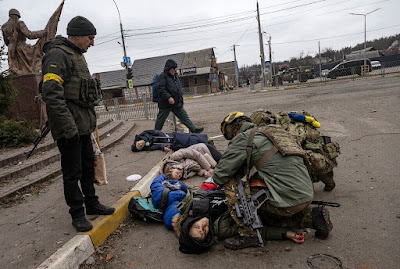
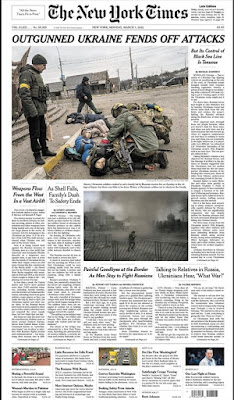
The March 7 edition of The New York Times featured a photograph of a mother, her two children and a volunteer who was helping them attempt to flee to safety in Irpin, Ukraine who died in a Russian mortar barrage.

New York Times image of dead family
From NYTimes.com, web site of New York Times, the famous image by Lynsey Addario, published on the paper's front page .

It’s a stark, dark moment in a stark, dark war. And a reminder of what photography can sometimes do. Think of the emotional punch of the picture of the crying girl over a body at Kent State. Or the fleeting Vietnamese girl, running naked from her village which has just been napalmed.

And now we have Tetiana Perbyinis and her two children, Mykyta and Alisa, teen boy and a young girl, along with a 26-year-old volunteer who had been helping them, dead on the street.

New York Times front page
Image posted on Twitter by New York Times.

American newspaper editors tend to be more prudish about these things than many of their international counterparts, and I’m OK with that. Images of excessive blood or badly damaged human remains are seen as being too cruel, inflicting pain on the family of victims of violence.

Although, in this case, as a follow-up New York Times story details, the husband would rather that the image be shared so the world knows what the Russian military did, what happened to his loved ones.

The Washington Post had an interesting reflection March 9 on how journalists decide what images are not too awful to publish in cases of stories like this. Paul Farhi reports that Times editors didn’t hesitate with this image, considering it too important to the story that needs to be told.

Well, yes, although one issue with an image like this is that the emotional content brings a deep reaction, but not necessarily a lot of insight. How did this happen? What is the context of this war? When are such civilian deaths merely the accidental outcome of conflict vs. the end goal of a country’s actions? Seeing the image itself doesn’t answer anything, nor does it tell us about Teiana, Mykyta, Alisa nor Anatoly Berezhnyi, the man who died with them.

As war in Ukraine has unfolded, I have not widely sampled all American media. I read AP reports in my local paper, The Gazette. I watch CNN and MSNBC reports at night. I listen to radio news from NPR. I find myself often checking the New York Times web site—via computer and my phone—partly because, as a professor at the college where I teach, the Times is made available to me by my institution.

So I can’t speak in broad terms about how this war is covered. But I can say that I have appreciated the depth of the New York Times efforts to cover this war. Journalism, done well, is so important at a dark hour such as ours now.

Lynsey Addario, the experienced photographer who rushed out to make this heart-wrenching image, fulfilled her role here. She witnessed and recorded. These days, images are often not trusted, but everything surrounding this one suggests it was authentic and honest, not some deep fake.

And horrible. And maybe that’s the point.

The freezing of an instant in time. The snap of a shutter after the crack of a mortar shell. And the world bears witness. Let’s hope that sad emotions aren’t the only response. If war journalism does nothing else, at least it forces all of us to recognize what is going on.

Yes, wars happen all the time. And we should pay attention when the victims of violence aren’t 43-year-old white accountants and computer programmers—tan, black, brown and yellow victims of war are just as human and suffer as much pain. Nor can merely learning about such violence be enough to stop it.

But it won’t be stopped if we don’t learn. Even if we do need the words to get the context, the image is an important part of that learning, creating an indelible memory of a tragic moment in time that should not be forgotten.


Wednesday, February 9, 2022

The Keys to an On-Line Sensation: Ease and Sharing

Almost got it in 2. Almost...

Every day, I post a note like this on my main Meta channel, Facebook: “Got it in 5 today, tough day” or “In 3, not bad.”

Usually, I include the colorful grid that charts letters correct and wrong.

A sister at one point asked what the cryptic notes (that day, no grid) were about, but those in the cult already know. It’s Wordle, an online sensation that netted a software engineer (named Josh Wardle) more than $1 million. The New York Times purchased the app, and didn’t disclose for how much, except it was “low seven figures.”

Well, nice. The game has exploded in recent weeks, for lots of reasons. It’s a word game that tickles the brain, but doesn’t tire it too much. I don’t want to jinx myself, but in several weeks of daily play, I’ve not yet failed to solve the Wordle (although I have sometimes only solved it on the sixth try). I wouldn’t call it super easy, but it’s not a horribly challenging game.

And Mr. Wardle made an incredibly smart move. When you solve the Wordle, it makes the results easily shareable on social media, via phone app or via computer, with an easily recognizable graphical scheme that shows your results and doesn’t spoil it for other players. That graphic, by the way, is the one controversial aspect of the game, as apparently people who use Twitter to share their results kind of mess up visually impaired Twitter users who have the program read tweets—it takes a while, or so I’ve read, for the Twitter robot to read “green square, green square, yellow square, grey square,” etc.

I’m sure the tech minions at the Times will figure that one out soon. When the Times purchased the game it causes some anxiety because it’s been available for free—and does one need a Times subscription in the future to access it? That remains to be seen. But for now, Wordle is an example of something going suddenly hot, for what I think are the right reasons. It’s pleasant, not too taxing, and easily shareable on social media.

It reminds me, a little, of Duolingo, a language app I’ve been using for some time. I am active in three languages: I take Duolingo lessons in Chinese, Hungarian and Spanish.

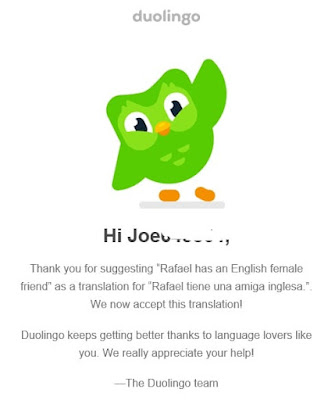
Email from duolingo
Duolingo does improve over time due to feedback from users. Because, clearly, Rafael doesn't just have a friend, he has a lady friend, and an English speaker who recognizes that "friend" is not a gender neutral word in Spanish shouldn't have his translation traduced. And, Duo now agrees. Nice. Image of email I got after grumbling in the app.

Based on my experience, having some experience with a language before doing Duo makes a huge difference—I move through Spanish lessons much more quickly. Of course, Spanish is an easier language for a native English speaker to learn in the first place—Hungarian is a bit quirky, and Chinese might as well come from the other side of the globe. Which it does.

I don’t aspire to be fluent in Hungarian or Chinese, but am dabbling with those languages for various reasons. I have family connections to both, for one. And, while Chinese is very challenging, I just like the different sound and writing system it has for their being so different.

Hungarian lessons are slightly goofy fun because of the sentences Duolingo uses. It’s a language course that seems partly stuck in World War II. I’m hoping I don’t have to say “The German soldiers are outside the train station” in Hungarian all that often, but just in case, that kind of sentence has been in lessons. The Hungarian course also has some weird, eyebrow-raising statements like: “The Hungarian actresses and thin and pretty while the English ones are short and slow.” That’s not literal, don’t come at me Duo, I’m pretty sure that particular sentence has not been in any lesson, but sentences like it do appear. Not usually in that horrible form I wrote as an example, but more like: “The Hungarian cars and new and fast” (sentence one) “The German cars are slow and old” (sentence two).

Be a little more polite, Duo. After all, there’s a lot of German soldiers over by that train station.

Anyway, in an age of disinformation, I do take a minor amount of comfort that the internet also brings us some pleasant diversions that may be good for our brains.

Like Wordle. Like easily accessible language lessons. Cyberspace that be a hostile part of the world, but it still has its pleasant neighborhoods.

Friday, April 28, 2017

Bill: Sorry I’m Not Sorry

Photo credit: By Justin Hoch, CC BY 2.0,
https://commons.wikimedia.org/w/index.php?curid=16673668
Bill O’Reilly is gone from Fox, but probably not gone from our public discourse. My reaction is summed up by the title of my favorite Tessa Violet song: “Sorry I’m Not Sorry.”

O’Reilly was accused by multiple women of sexual harassment at the locker room men’s network known as Fox News. And advertisers didn’t like being associated with a tainted Papa Bear, so they pulled the plug.

I am not sorry to see him go. But, with a multi-million-dollar severance payment and plenty of access to the internet, I don’t think he’s really gone. And I think the O’Reilly case has multiple levels to it.

It was simply a business decision for Fox. His firing wasn’t for any of his misconduct, but because advertisers didn’t want to be on his show—and there is a problem there. O’Reilly worked for the cable news network that was founded with an ideological mission. It was part of an alternative media system that isn’t based on reporting news, but rather on promoting a particular world view.

YouTube Thumbnail.
As Hank the Vlog brother says, it’s cheaper to have nattering heads paid to have different points of view than to engage in serious journalism, and O’Reilly’s huge cable audience was symptomatic of a public shift away from rational, fact-based journalism.

O’Reilly may be gone from Fox. But the alt-right media universe that Fox helped create and that O’Reilly was a star of has morphed into something dangerous, and his being fired doesn’t really change that.

Two commentators that I like and read in my local paper, Leonard Pitts of the Miami Herald and Mary Sanchez of the Kansas City Star had interesting columns on O’Reilly’s Fox departure. They have different reactions, although I find myself agreeing with both. Sanchez, I think, makes an important point: the male sense of entitlement that helped create the O’Reilly affair is not gone.

Kudos to Emily Steele of the “New York Times,” whose stories helped bring Bill down. She was threatened by Papa Bear back in 2015 but kept going. We owe her a debt because she didn’t back down.

And we ought to thank her because she is part of the old school news media that actually tries to report the news. Unlike Fox.