Showing posts with label photography. Show all posts

Thursday, March 10, 2022

Murdered Mother, Her Children and Images of War

Somehow, photography still, in 2022, packs an emotional punch. It is a medium that freezes a moment in time.

The March 7 edition of The New York Times featured a photograph of a mother, her two children and a volunteer who was helping them attempt to flee to safety in Irpin, Ukraine who died in a Russian mortar barrage.
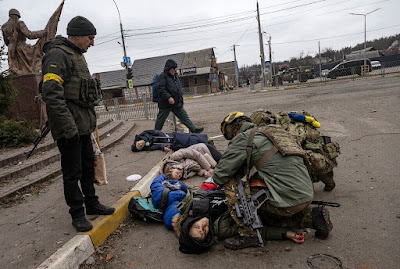
New York Times image of dead family
From NYTimes.com, web site of New York Times, the famous image by Lynsey Addario, published on the paper's front page .

It’s a stark, dark moment in a stark, dark war. And a reminder of what photography can sometimes do. Think of the emotional punch of the picture of the crying girl over a body at Kent State. Or the fleeting Vietnamese girl, running naked from her village which has just been napalmed.

And now we have Tetiana Perbyinis and her two children, Mykyta and Alisa, teen boy and a young girl, along with a 26-year-old volunteer who had been helping them, dead on the street.
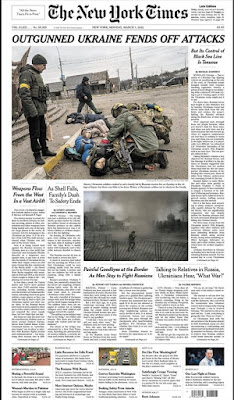
New York Times front page
Image posted on Twitter by New York Times.

American newspaper editors tend to be more prudish about these things than many of their international counterparts, and I’m OK with that. Images of excessive blood or badly damaged human remains are seen as being too cruel, inflicting pain on the family of victims of violence.

Although, in this case, as a follow-up New York Times story details, the husband would rather that the image be shared so the world knows what the Russian military did, what happened to his loved ones.

The Washington Post had an interesting reflection March 9 on how journalists decide what images are not too awful to publish in cases of stories like this. Paul Farhi reports that Times editors didn’t hesitate with this image, considering it too important to the story that needs to be told.

Well, yes, although one issue with an image like this is that the emotional content brings a deep reaction, but not necessarily a lot of insight. How did this happen? What is the context of this war? When are such civilian deaths merely the accidental outcome of conflict vs. the end goal of a country’s actions? Seeing the image itself doesn’t answer anything, nor does it tell us about Teiana, Mykyta, Alisa nor Anatoly Berezhnyi, the man who died with them.

As war in Ukraine has unfolded, I have not widely sampled all American media. I read AP reports in my local paper, The Gazette. I watch CNN and MSNBC reports at night. I listen to radio news from NPR. I find myself often checking the New York Times web site—via computer and my phone—partly because, as a professor at the college where I teach, the Times is made available to me by my institution.

So I can’t speak in broad terms about how this war is covered. But I can say that I have appreciated the depth of the New York Times efforts to cover this war. Journalism, done well, is so important at a dark hour such as ours now.

Lynsey Addario, the experienced photographer who rushed out to make this heart-wrenching image, fulfilled her role here. She witnessed and recorded. These days, images are often not trusted, but everything surrounding this one suggests it was authentic and honest, not some deep fake.

And horrible. And maybe that’s the point.

The freezing of an instant in time. The snap of a shutter after the crack of a mortar shell. And the world bears witness. Let’s hope that sad emotions aren’t the only response. If war journalism does nothing else, at least it forces all of us to recognize what is going on.

Yes, wars happen all the time. And we should pay attention when the victims of violence aren’t 43-year-old white accountants and computer programmers—tan, black, brown and yellow victims of war are just as human and suffer as much pain. Nor can merely learning about such violence be enough to stop it.

But it won’t be stopped if we don’t learn. Even if we do need the words to get the context, the image is an important part of that learning, creating an indelible memory of a tragic moment in time that should not be forgotten.


Thursday, January 28, 2021

An Emotional Trip Down Derecho Memory Lane


Aug. 10, 2020—a day that will loom large in the memory of Cedar Rapidians.

This week, on Wednesday, I zoomed into a session sponsored by The Gazette, our daily paper. Their four-person photojournalism staff shared many images that they made and discussed memories of the devastating storm.

A tornado can be bad. A big, powerful one may stay on the ground for a hundred miles, leaving a sometimes mile-wide swath of destruction. But such monster twisters are rare even here in Iowa where we are used to tornado safety drills and listen for those warning sirens when the summer skies darken.

But the derecho was a whole level of crazy beyond that. We were expecting a storm Aug. 10, but nobody expected an unusual bow of destruction, a bent wall of straight-line winds that would sweep across much of the state, flattening crops, ripping off roofs and uprooting trees as it blew and blew.

C Avenue
Aug. 10, after the storm, C Avenue traffic slows to a crawl as street is blocked by power lines. (Not a Gazette image, see theirs on their video above, all images in this post are mine).

Hurricane-force winds devastated wide areas of the state. Cedar Rapids, its immediately connected communities such as Marion, Hiawatha and Robins, and the small towns in the county surrounding us were hit with a storm that started as a thunderstorm but quickly escalated and seemed like it would never stop. “Derecho” means both “right” and “straight on” in Spanish, and the Spanish word labels a straight-on storm whose violence is hard to image if you have not lived through one.

And in many ways the derecho hasn’t ended. Many homes were damaged—apartments and houses—and the impact of derecho devastation still reverberates in town. One result is that this city, which just last summer featured a beautiful canopy of mature trees, will take a generation to recover its shade. Me and my family were lucky—even though our houses were damaged, and we just signed a contract this week for one derecho-recovery project with more to come.

Last August! I remember the sense of survival instinct in those dark powerless days following the storm. Much food was spoiled, gasoline was not to be had in town, and we had to get creative. But we were among the fortunate one—our problems were manageable and our house inhabitable even if not fully intact.

In Cedar Rapids, we are blessed to have a local newspaper owned by a local company. In many places, photojournalists are an endangered species. We have four talented photographers who freeze historic moments in time, and The Gazette published a book based on their images.

At the session, moderator Mary Sharp noted that Gazette photographers made more than 10,000 images of the storm and its aftermath, and used 1,000 by printing them or sharing them online.

Then, 195 of them were used to publish a book about that storm. The Gazette is donating a part of the proceeds to replanting trees.

Warde Hall
Aug. 11, campus of Mount Mercy University. There was a much beloved grove of huge pines that were in the lawn by Warde Hall. Past tense, they are gone with the wind now. Here, one lies on the building the day after the storm. The campus suffered millions of dollars in damage.

Each photographer took turns describing the story behind the images shown Wednesday. Andy Abeyta shot both the image that become the book cover—it was chosen partly because the image had room for the cover text—and the more famous front-page image of passersby aiding a truck driver caught in an overturned truck.

As Abeyta described it, he was in Iowa City that day to make images of a protest there. He was returning to Cedar Rapids when the once in a century (knock on wood) storm blew through. He saw a truck that had just overturned, parked and ran back to see if he could help—but three other people were already there to aid the driver, so Abeyta took out his cell phone and shot some images.

It is an interesting note that a media photographer with fine digital SLR cameras ended up capturing this key moment with his phone. But I think angle, timing and an eye that can quickly see the possible images—I always tell my students that journalism requires imagination, and I do not mean making stuff up but rather recognizing possibilities in gathering information or making images—are a photojournalist’s most important tools.

It’s not the camera, it’s the photographer. Nothing substitutes for recognizing you’re in the right place at a key moment and using whatever tool you have.

All of the photographers—Liz Martin, the Gazette’s head photographer; Jim Slosiarek, who has recorded the first draft of Cedar Rapids history for many years; Rebecca Miller; and Abeyta told interesting stories of many images.

One lesson driven home again and again is the importance of journalists to get out and about—to report by being there. Again, it’s a key point I try to make with my students, with mixed results. Don’t email all your sources or consult Google to retread information—the best journalism is what you find in the world, and you have to be out there to encounter it. That’s always true of photographers, but is a lesson for the rest of the tribe, too.

And, as Martin noted, news photographers are always looking for “the human impact.” Another journalism 101—don’t just show “the thing.” Show what the thing means to people—and that is very true of photography. I often make images of nature—because I’m a journalism professor, not a journalist—but I have a pretty good reputation as an event image maker at MMU, and I always think what I try to do is capture what something means by capturing the emotions of the people.

Things can be important too, and Martin made the point while showing an image without a person in it, so not every news pictures requires a person in it—but people are usually key.

Squirrel
Later in August, power is finally back on. Butterflies, birds, deer--wildlife had been scarce since the storm, but critters are starting to reappear. Here, an angry squirrel on the felled giant ash tree in front of my house seems to hold me accountable for the disruptions to its life.

One question posed was whether the news photographers were invading people’s privacy at vulnerable moments. They all described asking for consent—and for tying to make images in a respectful way that does not interfere with the moment.

And that gets to anther point. People who suffer through an experience like the derecho can be vulnerable—but what they least want is to be ignored. Journalists—photojournalists like this panel of four but also writers, videographers, radio reporters, TV reporters, web site journalists—are there to prevent that, to tell the stories that otherwise might be ignored.

It was a bit emotional watching the images float by. Photography has power because it does freeze an instant in time, and the best images capture the emotion of that instant. And those of us who lived through the derecho can’t help but recall the intense feelings of that time as we watched the slide show on Martin’s shared desktop.

It was an interesting night. I’m glad that the Gazette gave us this opportunity to learn more about the stories behind the news images.


Sunday, April 9, 2017

What Makes a Good Photo?

My favorites of my photos in the contest--San Francisco Public Library stairs (above), mural in Haight-Ashbury neighborhood, below.


The contest is now closed, and the winner is Audrey Sheller.

When my wife and I visited San Francisco over spring break, she, our oldest son and I decided to have a little fun with photos. We would each pick 10 pictures shot during the week, which would be anonymously posted in the same gallery on Facebook.

Then, we would invite our family and friends to “vote” via Facebook reactions (2 points for love, 1 for any other reaction, 1 for any mention in a comment). You can look and like all you want now, although the voting for the contest is over.

We would have two winners: The one who shot the best overall picture, and the one whose set of 10 scored the highest.

Audrey Sheller won them both. In fact, she had the two first place photos (a tie between a Waldo Street sign and a door with googly eyes) and the next place image, a rainbow flag.

The winners--door with eyes (above) and Waldo Street (below).


The winners earned 10 points, the next place (second or third—two images finished higher, but it had the second-highest score) had 9 points.

Two of my son’s images scored 7 points each.  My highest score was a 6.

The overall point race winner is not a huge surprise. Audrey Sheller was first with 59, next came Jon Sheller with 46 and finally, me with 35.

A crowd favorite, 9 point winner. Rainbow flag from Castro District.
I don’t feel terrible at the results. The “jury” was not professional photographers, and it’s clear emotion played a part in the voting. The top images both feature whimsy. I do think my library stair shot is way more of a made image, but humor counts in this poll.

Here is a list of the photos in the order they appear in the gallery (they were randomly sorted before being posted), who took each, and their scores:

Tree and city hall, Joe, 6.
Clarion Alley images, Audrey, 2.
Waldo Street sign, Audrey, 10.
Golden Gate Bridge, Audrey, 4.
Googly Eye Door, Audrey, 10.
Stars, Jon, 7.
Flower, sky, building, Joe, 6.
Painted ladies full view, Audrey, 6.
Canoe in museum, Joe, 1.
Cable Car museum, Joe, 2.
Lanterns in Chinatown, Audrey, 7.
Pushing cable car, Joe, 4.
Goblen Gate Bridge from levy, Jon, 5.
Park trail, Audrey, 2.
Lombard Street, Jon, 5.
Listen to wall, Jon, 7.
White flower, Jon, 5.
Church in distance, Jon, 4.
Castro, Jon, 5.
Flowers in her hair, Joe, 5.
Sun Dial, Audrey, 2.
Blue hair on garage door, Joe, 1.
Rainbow flag, Audrey, 9.
Haight Ashbury street sign, Jon, 1.
Park stairs, Audrey, 7.
Library stairs, Joe, 6.
Duck, Jon, 3.
Painted ladies skyline closer, Joe, 3.
Cable Car machines, Joe, 1.
Downtown skyline, Jon, 4.

I stopped the count Friday and didn’t include one accidental “like” from Audrey for her own photo (it happened on an iPad, and I understand how clumsy that device is with Facebook and that an accidental like is just an errant finger tap). If a photo was specifically referenced in an overall gallery comment, that comment was awarded to that photo, by the way.

Two images by Jon--yes, the one flower image in the contest was not by me. Flower from Botanical Garden (above) and Lombard Street (below).


Here are other pictures I shot during the week we were in San Francisco. It was a fun contest. It shows, I think, how important subject choice is for photos. We did know when we were shooting that week, at least by mid-week, that the contest was going on, so I can’t fault Audrey for picking the wittiest images.

And yet, Jon and I are the ones who teach photography. Go figure.

Some under-rated images, in my opinion. I just thought the image above felt like a nature shot, even though it is the giant engines that run the cable car system.

San Francisco City Hall and a trimmed tree from plaza by City Hall.

Oh come on, world. It's got sky, flower and building. Winner!

Even our champion was a bit stumped by some of the voting. I think we all agreed this was a cool image Audrey shot in Chinatown, but it did not score very high in the contest.

Saturday, November 28, 2015

In Praise of True Photographers

An MMU student taking photos for the Mount Mercy Times, a channel 9 videographer and a Metro Sports photographer. And me, but you can't see me. Photographers all in dark, MMU AD in white behind them.

These days, the existence of cell phones means that most people are always carrying a camera that can shoot both still images and video.

But, just as having a PC with Publisher on it doesn’t make you a graphic designer, neither does your iPhone make you a photographer.

I was thinking about that this on Saturday in the Hennessy Recreation Center at Mount Mercy University. The university is on Thanksgiving break now, which means few students are around, but the Mustangs had a men’s basketball game that afternoon.

So, I bicycled to campus to grab a newspaper camera from the closed library building (where the paper office is and to which I have a key) for a student to borrow.

And I stayed for half the game to shoot some images.

I don’t know if basketball was the original sport that I shot years ago with my Minolta 35 mm camera. I know that the Calumet at Muscatine Community College had a basketball team, but I don’t recall where they played (there was no gym on campus) nor whether I shot any images of their games (I was one of the editors of the student newspaper at MCC back in the day).

Anyway, I know that I shot some basketball games at Marycrest College, as well as some soccer. At the time, the longest lens I owned was a 135 telephoto—no change in focal length.

My favorite shot of over 120.
At the game this weekend, I had a much nicer camera, my current Nikon D3100. Yet, most of my photos aren’t any good. I shot over 120 images, and consider only a few of them passable. Some samples are on this blog post, a few more can be seen in a Facebook gallery.

These days, as traditional media contract, one endangered species is the news photographer. It’s too easy to give a reporter a camera and tell her to shoot her own images, or depend on the kindness of strangers and their many photo-taking devices.

But I think the really good news or sports photographer is a rare breed worth preserving.

In this day of YouTube and instant photos and videos, we’re awash in images. That doesn’t mean we’re awash in good journalistic images—ones that really tell a key part of the story, that communication the action and emotion of a key instant.

And that kind of image is not easy to capture. Granted, I wasn’t using a really good camera—while my Nikon is an SLR digital camera and came with a 70 to 200 mm zoom, neither the camera nor the lens are the best for this kind of photography.

I can’t blame my low “hit” ratio on the camera, however. I’m a decent amateur photographer, and in my newspaper days, my photo skills did serve me well—but I was never primarily a news photographer.

A metaphorical tip of my imaginary metaphysical hat to those who are news photographers—you preserve instances of history in a way that writers like me should respect and recognize for the artistry, difficulty and skill level that good sports or news photography requires.

A picture is worth a 1,000 words—but only if it’s in focus, well composed and dramatic. And that’s not easy.

I know not much is going on in this image, but I kind of like it anyway. Under Armour vs Nike. When I left, Under Armour was out-scoring Nike about 4 to 1.