Tuesday, January 24, 2023

‘A Man Called Otto’: a Hanks Triumph

Actors in "A Man Called Otto"
Sony Pictures publicity image of Tom Hanks and Mariana Treviño in "A Man Called Otto."

OK, I’m not a movie reviewer, but my wife and I had a “date afternoon” today, attending the cheap movie day at a local theater to see “A Man Called Otto.”

There are lots of funny bits in the trailer, and the movie does have comedy in it. But it’s a serious story about an old man struggling with finding a reason to live—a drama in which he attempts suicide several times. We learn, late in the movie (spoilers coming) that his wife died just six months before the movie. He’s taken a buyout at work and was pushed out the door after his company went through a merger. He’s convinced the world surrounding him is full of idiots—which, since it’s full of normal, flawed humans, it’s not all that far off the mark—although Otto, an engineer, equates intelligence with two traits: following the rules and knowing how machines work.

In short, Otto is ready for his road to reach its destination. Yet, I think part of the point of the movie is that Otto learns his views are too constrained. His keen mechanical intelligence doesn’t always give him empathy and insight. He may be a good engineer, but he’s not too keen on understanding the souls of the creatures—human and feline—around him.

It takes a stray cat and a new family in the neighborhood to reawaken some of his appreciation of life. It doesn’t fix it all, inevitably the movie is about the end of Otto’s life, but it helps illustrate why, even in dark times with a broken heart, it’s worth it to still be here, to still care, to still read a story to young children in the voice of a bear.

Besides Hanks, to me, the movie’s next most important actor is Mariana Treviño. She plays the mother in the new family and becomes, to some extent, Hank’s surrogate daughter. She’s fantastic in her role, and is the center of both her own family and the newly enlarged family with Abuelo Otto.

And other cast members and characters are well done, too—the only slightly off characters, to me, were the evil real estate ones—the movie wasn’t about them, but they didn’t seem to be the three-dimensional humans the other characters were.

Movie poster

Small point. It’s a poignant story, fantastically acted, gripping and moving. Franky, it was a hoot going to the movie just as an experience. It was almost sold out, and the crowd tended to the elderly—I think my wife and I were among the “youngsters” there. We bought our tickets late and had to sit in the front row, but with new recliner seats, that worked out. We were in a row with several old ladies, who were funny, chatty and sociable—the idea that reaching out and not trying to live life all on your own wasn’t just a theme of the movie, it was a theme of the whole matinee theater experience.

I suppose the fact that my own dad was a man called Otto, and who was also an engineer, endeared me even more to the movie—but it’s also true that my father led a different life with different struggles and was a different kind of man.

Book Cover

The movie is based on the novel “A Man Called Ove.” My wife has read the book and recommends it, so it’s on my to-read list now.

And, if you care about this non-reviewer’s movie choices, yes, I heartily recommend “A Man Called Otto.” See it with some old ladies in the front row. If you’re like me, you’ll be a bit misty-eyed at the end, but glad you came nevertheless.


Saturday, December 31, 2022

Remembering a Key Figure of the Big 3 Era

Barbara Walters in 2008
From Wikimedia Commons, an image of Barbara Walters at the Metropolitan Opera in 2008, posted on flickr by Rubenstein, link to image.

“Every female broadcast journalist working today owes a debt of gratitude to the O.G., Barbara Walters, who died Friday at age 93.” Katie Couric, writing in The New York Times.

There was Walter Cronkite. There were Chet Huntly and David Brinkley. And there was a woman, a fiercely talented, competitive person named Barbara Walters. No, I don’t mean she was a TV giant of the stature of a Cronkite, but she was an important TV personality who brought needed change to a male-dominated medium.

I first became aware of her in the late 1960s as my family sometimes had the Today show tuned in on our 19-inch black-and-white TV.

I don’t recall her much from that time, but I was young. I became more aware of her as the first female network co-anchor starting in 1976 on ABC, a gig that honestly didn’t go all the well. But as she had done many times in her long career, Barbara Walters had the courage to try something new, and after she was an anchor, she reigned as the queen of celebrity and news maker interviews, first at 20/20 on ABC, and then in a series of prime-time specials.

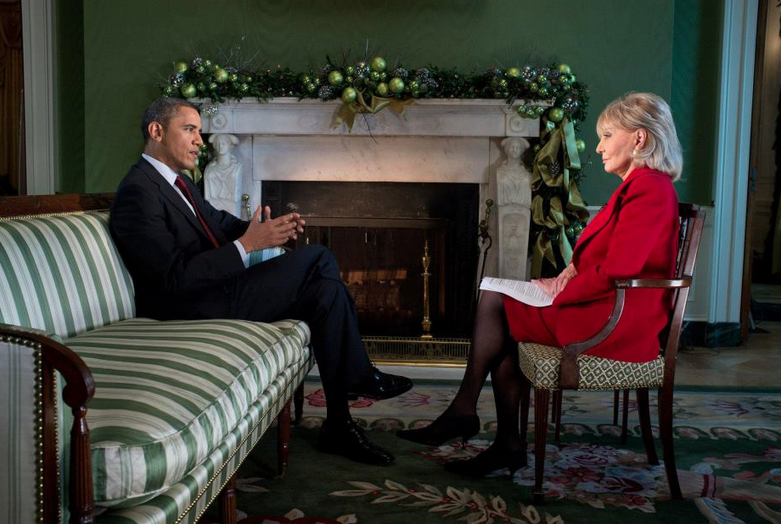
Barbara Walters with President Barack Obama
An image of Barbara Walters speaking with President Barack Obama on Jan. 20, 2013. Image posted on flickr by Ester Vargas, link.

At an age when many people have returned, Walters in her late 60s helped create The View, a daily talk show, in 1997.

The news today, of course, is that Barbara is no longer with us. She has died at age 93. An important female figure of the Big 3 TV era is gone. Her passing is a reminder of that bygone era, and her long career a testament to her tenacity and talent.

Wednesday, December 21, 2022

One of the Great Presidential Speeches

President of Ukraine meets President of U.S.
Dec. 21, 2022--President Volodymyr of Ukraine meets President Biden of the United States in White House. Image from the web site of Ukraine's president.

Did you catch the address to Congress by President Volodymyr Zelensky of Ukraine on the darkest day of the year? Dec. 21, 2022, long after darkness fell for our longest night, wearing his trademark green shirt with the presidential symbol on it, Zelenskyy spoke movingly of the struggle his country faces.

I thought it was a speech for the ages, one that will be quoted and studied. Zelensky put the war his country is waging to defend against a Russian invasion in the context of the larger global struggle for democracy—imploring American to remember that aid to Ukraine is not charity, but an important investment in that ongoing struggle that we are a vital part of. (C-SPAN video of speech below, skip ahead to 19:00 when Zelensky enters and then starts speaking.)


And he powerfully evoked some American cultural milestones—the U.S. Army battling the last German offensive of World War II in the Battle of the Bulge; and the battle that helped turned the tide of the American Revolution, Saratoga.

It’s fitting, somehow, that Zelensky referenced the Battle of the Bugle because that battle was raging at this time of year. On Dec. 16, the Wehrmacht used the cover of poor winter weather (to avoid Allied air superiority) to launch an attack through the Ardennes.

The German offensive failed. Just as Russian forces failed to take Kiev last year, the Germans stalled in their drive to split Allied forces by marching to Antwerp.

In that case, the German offensive was a long shot, almost certainly doomed as Germany was running out of resources, particularly fuel. In the case of Ukraine, they are fighting a defensive war against a Russian army with vastly greater resources. Still, the Battle of the Bulge echoes in the American mind, and Zelensky was reminding us of some parallels.

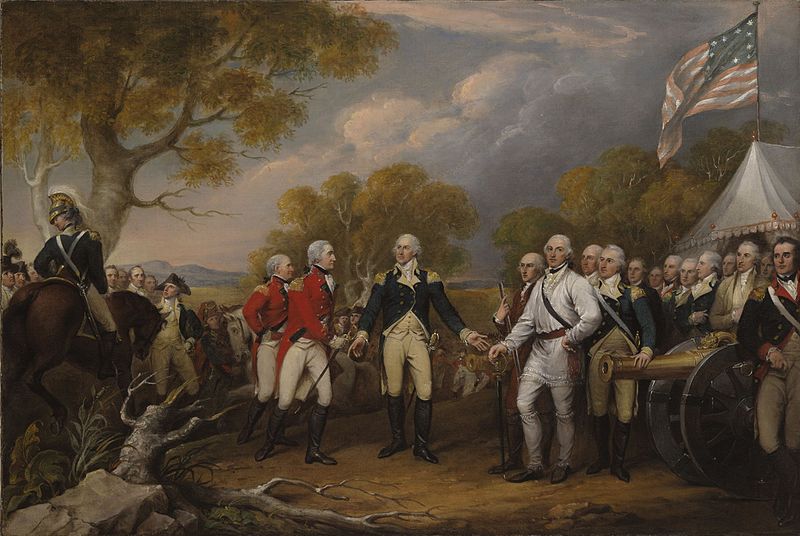
In some ways, I think, the analogy to Saratoga was more apt. In fall of 1777, British forces launched a three-pronged offensive to divide the Americans by splitting New York. Gen. John Burgoyne brought one of those prongs south from Canada, capturing Fort Ticonderoga and sweeping south towards American forces dug in near Saratoga.

The British attacked twice, but the Americans defenders held them off. Faced with losses and being cut off from reinforcement, British General John Burgoyne surrendered to American General Horatio Gates on Oct. 17, 1777. Partly as a result of the battle (technically, I suppose, the battles) of Saratoga, France decided it was worthwhile to support the American cause as the Yanks had demonstrated they maybe could win. And the tide of war was turned.

Painting of surreder at Saratoga
19th Century painting by artist John Trumbull of General John Burgoyne surrendering to General Horatio Gates on Oct. 17, 1777. Painting in collection of Yale University, image from Wikimedia Commons.

Of course, the Russian army didn’t surrender to Ukraine when their invasion forces stalled on the road to Kiev this spring, but still, just as American defenders at Saratoga produced a turning point, Ukraine’s valiant defense of Kiev and offensive to push back in the east give hope to its cause.

As President Zelensky noted, the first Russian defeat was its loss in the psychological war. Most of the world, and most of the body politic in the United Sates, recognizes Russia as the aggressor here. Zelensky reminded us that his country needs continued support as the battle against Russian aggression continues.

It is, as he stated, a key moment in a global fight for democracy. And, Zelensky predicted, a fight that Ukraine will win. That seemed faint hope when Russian tanks trundled across the border this spring—many of us, I’m sure, expected Russia to crush Ukraine. It seems, like the Revolution post Saratoga, that Ukraine’s ultimate victory now is at least a possibility, should its allies show backbone and stay the course and support Ukraine's cause.

Ironically, Zelensky is a TV entertainer turned politician who has proven, in his country’s darkest hour, to be an effective leader. He’s an FDR or Winston Churchill, a great communicator who showed his ability before Congress to sound the right notes, to clarify the issues at state, to rally support.

President Volodymyr Zelensky of Ukraine
Volodymyr Zelensky, president of Ukraine, in March 2022. Image from Wikimedia Commons.

How different from a recent U.S. President who was a TV entertainer turned politician. Indeed, President Trump was impeached for the first time for a corrupt phone call in which he tried to hold aid to Ukraine hostage for political favors. Trump is the anti-Zelensky, a divider, not a uniter, a man who this week was exposed yet again for attempting to undermine American democracy.

I felt it was very weird when the House committee investigating the Jan. 6 insurrection recommended that the former President face criminal charges, and the reaction from Iowa’s Republicans was a yawn. We’ve moved on. We don’t care about Jan. 6 anymore. We’re working on the issues Iowans care about now.

How American. How forgetful we are as a people. It’s less than two years since an American president attempted a violent coup in Washington DC, and too many want to close that chapter and forget about it.

Well, if we don’t forget the Battle of the Bulge or Saratoga, it is way too early to turn the page from Jan. 6. After all, the chief villain in that sad narrative, Donald Jerk Trump, is a leading candidate for President in 2024—the leader of an attempt to subvert our very democratic system is in the running for his party’s nomination for president, and the craven, cowardly “leaders” of his party are too scared of him to note that he’s proven himself unqualified to support and defend our Constitution. I’m one Iowan who hasn’t yet moved on and is disgusted with the gutless Iowa Republicans who claim we should. I’ll move on when the GOP renounces Trumpism and Trump, as long ago they should have.

And this week we have the opposite end of the scoundrel spectrum. A true icon of democracy, President Volodymyr Zelensky, calling on us to remember who we are—we are the victors at Saratoga and The Bugle, a people who have fought for two centuries for the cause of self-government and democracy.

Today, that fight is happening in Ukraine. But also in the hearts of Americans. The dark cancer of Trumpism is still with us. The fight for democracy isn’t just happening in eastern Europe.

Flag of Ukraine


Saturday, December 3, 2022

The Presidential Circus Leaves Iowa Behind

Amy Klobuchar
Jan. 19, 2002, Sen. Amy Klobuchar speaks in Marion, Iowa. I listened to her and backed her in the Democratic caucuses that year.

Bernie Sanders
Jan. 20, 2016--Sen. Bernie Sanders speaks at the University of Iowa in Iowa City. I was there, although I don't think I caucused for him.

The Republicans will still do it. The Democrats say they are shaking things up.

The Iowa Caucuses have been the lead-off political event of the presidential contest season for as long as I’ve been a voter. When I was 17 in 1976, I was a Gerald Ford guy, was elected at a precinct meeting to attend the county convention and was a delegate to the next level—my memory is a bit fuzzy, I think it was a district convention, but the state meeting may have been the next step up.

I didn’t try to go to the national convention, although I recall toying with the idea (which suggests the counties sent their delegates to the state level). I didn’t have the means.

And 1976 was it, for me and the Republican Party. I was a Ford man to stand in the way of the Reagan upsurge, and when Reagan took the nomination in 1980, I became part of the immoral minority that voted against him.

In the 1980s and 1990s, I wasn’t involved. After I graduated from college in 1982, I was a newspaper journalist in Missouri. I returned to Iowa in 1991, but was preoccupied with family and don’t recall attempting to caucus in the 1990s.

I was back by 2008. I got caught up in the Obama bandwagon.

Vampire Weekend
Lead singer from Vampire Weekend warms up Bernie Sanders crowd, Jan. 30, 2016.

In 2016, I was torn. I was interested in feeling the burn for Bernie Sanders, but don’t recall if, in the end, I went that route.

My 2020 choice was Amy Klobuchar. I still, in my heart, would feel better if she were President.

Face at Klobuchar rally
Jan. 19, 2020--Face in crowd at Amy Klobuchar rally.

Anyway, I drove downtown in Cedar Rapids with my youngest daughter to attend an Obama rally in 2007. I saw Amy Klobuchar speak in Marion Iowa in 2020. In 2016, Vampire Weekend sang at a Bernie Sanders rally in Iowa City before Bernie Sanders spoke, and I was there. Sadly, the Oxford Comma wasn’t.

The Iowa Caucuses were a bit of a political anomaly. In 1972, Sen. George McGovern fared well in caucuses whose date had been set early as the party grappled with complicated new rules enacted after the fiasco of 1968. That gave him a boost, and caused Iowa politicians to take note. The two political parties colluded (imagine that) to set the 1976 caucuses early, and a Georgia nuclear engineer, governor and peanut farmer—Jimmy Carter—organized early and did well, propelling him to the White House and the Iowa Caucuses onto center stage.

There has been a lot written about the value of the retail politics that the caucuses provided, and how important it was to have early voters actually meet candidates. But, in recent cycles, Democrats, in particular, became increasingly disenchanted with that process.

Iowa is not very racially diverse. It’s more rural, white and older than the nation as a whole. And Democrats are all about diversity.

Well, this week, the news from the national party is not good. A recommendation to make South Carolina the first state to select a Democratic candidate in 2024 has been approved by the panel planning such things. The 2020 Iowa caucuses, with their software glitches and delayed count, were a bit of disaster that shifted momentum perhaps forever away from Iowa’s first status in presidential contests.

Listening to Amy Klobuchar
Someone listens to Amy Klobuchar, Jan. 19, 2020. Klobuchar speaking (below), same date.

Amy Klobuchar speaking

Still, Republicans, undeterred by the whiteness and age of Iowans, are going ahead with their early contest in this increasingly cherry red state.

I will miss the caucus hoopla. I’ll miss the chance to drive to a local bar and listen in person to a potential future president. And I’m afraid the national party decision, while it makes sense, is another blow to the Iowa Democratic Party at a time when the party is already down.

For 50 years, from 1972 to 2022, the caucuses have been important. Perhaps their time is gone. If the Democrats won’t caucus here first in 2024, how long will the Republicans? Even if they continue, a one-party contest isn’t the same.

Besides Democrats, another loser may be Iowa media companies. In 2015, a big owner of local TV stations, Gray TV, purchased channel 9 in Cedar Rapids for $100 million. The company then raked in lots of revenue from the 2016 and then the 2020 presidential contests. The flood of campaign money into Iowa TV stations may be abating.


Saturday, November 19, 2022

It’s Not Just Elon Musk Making Us Sadder

Crowd in Flaherty
Crowd ready to listen to Dr. Travis Lacy speak. I helped carry in extra chairs, and yes, I wore my mask. Most popular event of this year's MMU Fall Faculty Series.

Dr Travis Lacy
Dr. Travis Lacy, assistant professor of religious studies, speaks.

"So when at times the mob is swayed
To carry praise or blame too far
We may choose something like a star
To stay our minds and be staid."

Quote from "Choose Something Like a Star" by Robert Frost, quoted by in a presentation by Dr. Travis Lacy.

I live in the modern world, too, even if I learned to keyboard on a manual typewriter and didn’t own my first computer until the 1980s were almost the 1990s. So, like many who live now on the planet, I exist in a zone that includes both the actual reality around me and the virtual reality that beckons like a siren.

Does social media make me sadder? Probably. Am I addicted to what Dr. Travis Lacy, assistant professor of religious studies at Mount Mercy University, noted is a “hit of dopamine” we get from “likes” on social media?

I’m not sure that something that is habitual is an actual addiction, in a psychological or medical sense, but it’s something like that. And yes—I write three blogs that have fairly low readership, but if someone responds to what I write, or even just likes the link or image that I post on Facebook, it does make me feel better.

Of course, I think there is more going on. I think writing, for me, is more than just a habit or a means to get the next hit of positive brain chemistry—it’s the muscle I used for years to earn my living and that now I do for the pleasure of creation. It’s brain therapy, too—it keeps my most important organ, the one between my ears, a bit more in tone.

Ironically, to me, thus what I post on social media is partly the antidote to social media—I am ruminating on my life, processing my experience, connecting, in an introvert’s lonely way, to reality. Not just running from it. Author (and social media creator) John Green recently talked about the value of creating online:

But I do use my smart phone to “kill time,” as Lacy called it. Dr. Lacy spoke Nov. 15, giving the final presentation in a fall faculty series at Mount Mercy University on “Humans and Machines” in a provocative discourse that he entitled “Scrolling is Unpaid Labor.” The thing that we do when we feel private and alone on our phones or tablets is not as alone as we think—it’s an act that is recorded, watched and commodified.

Our attention is a product that we produce. And advertisers pay, according to data cited by Dr. Lacy, more than $500 billion a year to catch some of that digital audience's attention. Oddly, as he noted, online ads are weirdly different from classic advertising, in that most of us don’t recall much of those ads we see on Instagram or Facebook or YouTube—and an impression that funds the marketing marketplace of cyber commerce is defined as half of a screen being on our device or at least a second.

Dr. Travis Lacy
Dr. Travis Lacy makes a point.

True, ads exist to motivate consumers. True, that is not a new concept, in our culture, as the main system that funds American media—both news and entertainment—has historically been ads. But what feels weird is the brief snippet of eyeball attention that somehow seems so disconnected from an act in the real world would be so valued.

Then again, consumers tend to define themselves as immune to ads in a way that advertisers know they’re not. If online attention were completely divorced from actual commerce, it would wither. It’s not withering.

Yet, the way social media is constructed, it’s almost insidiously rewarded for making us sad. As Dr. Lacy noted, an addict is most vulnerable when the pain of their real life demands some balm. Whether whiskey or the Meta-verse, whatever drug we turn to when we’re down can give us a brief relief, but often leaves us hollow in the long run, more divorced from our lives, more troubled in our souls.

Notebook against a computer screen
Book title from my notes, propped against my computer screen as I write this post. "Iber Pumpon Makes You Stupid?" How dare Iber Pumpon.

I’m not trying to recreate Dr. Lacy’s whole message here. I’ve skipped Karl Marx and his insight into labor. And I wrote down the title of a book Dr. Lacy cited, because it sounded like something I would want to read, but my handwriting is so bad that I can’t make it out. “Something Something Makes You Stupid” states the illegible ink squiggles, on my notebook’s page. The something-something in my notes looks like “Iber pumpon,” which seems a bit unlikely as a book title.

Update Nov. 20: Thanks to Dr. Lacy (and Dr. Joy Ochs) for noting the title of the book in question. It's “How PowerPoint Makes You Stupid,” by Franck Frommer. Iber Pumpon seems more like a prescription drug name than the name of slide-making software.

I tell my communication students that the act of hand writing notes helps fix memory, and I believe there is some truth there. Still, it can fail. It may help if the squiggles themselves aren’t made by an old southpaw whose handwriting was always iffy (a consistent D grade on my paper report cards in elementary school), and whose crippled index finger and arthritic hands aren’t improving his finger dexterity.

Hand taking notes
Above and below, others making notations during Dr. Lacy's speech. May their notes be more legible than mine.

Hand holding pen

Nonetheless, while I was sitting in that room, listening to Dr. Lacy read a long script (not as bad as it sounds, speech students, as I say in class, you should learn to deliver from an outline so you can engage an audience, but if you’re experienced, you can learn to read a script and still be engaging, and Dr. Lacy has achieved that higher level of speech competence), I was connected. I was not “killing” time, but inhabiting it, living in it, enjoying it at the slower pace that the unfolding world can provide.

I don’t hate social media. I understand it’s a force that can, and often does, isolate us and make us sadder. But we each construct our own social media—my Google is not yours—and can, I believe, learn to use it to also inhabit the real world in a more healthy way. Used in reasonable doses, it’s like red wine. It would hurt us if we use it too much, but modest use is not only OK; it can even improve us.

Face of listener
Above and below, people listening to Dr. Lacy, not killing time on social media, but inhabiting time.

Face of listener

Face of listener

Face of listener

Maybe by listening to each other. Maybe by making images, writing essays and then sharing our actual creative work.

Even if it’s unpaid labor. Because creating a full thing that you’re engaged in and care about is not labor that alienates you, it connects and grounds you.

Now, turn off your phone and go take a walk.

Mother and baby
Key audience members, connected in reality to the speaker. And maybe social media just made you a little happier.


Monday, October 3, 2022

Master of the Walk-Off to Retire

Leonard Pitts, Jr.
Leonard Pitts, Jr., who will retired in December as a Miami Herald newspaper columnist, at the 2015 Texas Book Festival, image by Larry D. Moore from Wikimedia Commons.

I read the news this week that Leonard Pitts, Jr., a columnist for the Miami Herald whose syndicated work appears in The Gazette, the newspaper I read, is to retire from newspaper writing this December.

Darn. Pitts has spoken several times nearby, not that long ago at Coe College. I don’t recall what was going on that I did not attend, but I regret it. He’s a sharp, smart, talented newspaper opinion writer, and a type of voice sorely needed in our public discourse. I wish I had heard him speak.

Pitts was very opinionated, and I don’t mean that as a pejorative statement. I think an opinion writer should make clear points. But I don’t think Pitts, winner of a Pulitzer Prize for commentary, was a bomb thrower.

His columns read like a smart person ruminating out loud, thinking it over. He’d begin by grabbing your attention, and then build his essay, paragraph by paragraph—often, sharp, short paragraphs. As a result, his writing had a pleasing rhythm to it.

And he was a master of the clincher, of the ending that summed it up in a crescendo. The most recent column he wrote—about his lack of surprise that the increasingly conservative Republican party is also measurably more racist than any other mainstream political group, according to a social science study of attitudes—ended in this line:

“It isn’t surprising in the least.”

Pitts will let you know where he stands. His was a voice worth listening to. Besides being a newspaper writer, he’s written several books, and according to reports, isn’t retiring from writing but devoting himself to the longer form. I’ve not read any of his books yet, but given how much I like his columns and will miss them, it’s something I should look into.

And if they turn out to be good? Well, I think a wise man summed up what I think my reaction would be: “It isn’t surprising in the least.”

Leronard Pitts, Jr., in Columbia, Missouri
2017 image of Leonard Pitts by Emily Johnson/Columbia Missourian. The 2004 Pulitzer Prize winner for commentary spoke in Columbia, Missouri, as one of the Missouri Honor Medal winners awarded by the MU School of Journalism.

Wednesday, September 14, 2022

First Edition of Student Paper Arrives

Warde Hall
Sept. 6--Painter working at Warde Hall, oldest building on Mount Mercy University campus. Some things that are old are worth holding on to. Like reading.

For years, thinkers have written (irony) about a “post literate” world. And, indeed, in our culture we can see all kind of odd impacts of a tendency to avoid reading.

Reading, it seems to me, is such a fundamental act. There is simply no way to tune into long narrative or to absorb certain kinds of raw information that works as well. Yes, I have used YouTube videos when I want to use a new technique or discover how to fix something—I don’t deny that there are other key ways that we humans communicate.

But I see reading as representing a deeper dive into abstract thought.

Well, while reading as an activity is on decline, it hasn’t disappeared. Both reading and writing can still be observed among the young.

In August, I gave one class of writers the assignment to start their own personal blogs—to give themselves a public platform from which to show the world their writing skills. I’m liking the results, including this post one student wrote on the importance of reading.

Typing hands
Aug. 26--Above and below, students in a writing class at MMU begin working on their personal blogs.

And Sept. 15 will be a key day at Mount Mercy University. The first edition of the student newspaper, The Mount Mercy Times, of the fall semester will be distributed. Thus a mass of student writing will be available to student readers—and readers may be a minority of the student body, but they are there.

Today, I handed copies of the paper out in a class where students have written for the paper for the first time. One young man saw that his story was the anchor of the sports page, and I’ve never seen him beam more. It’s heartening to see how excited students can be due to their words.

front page
Front page of Sept. 15, 2022 edition of the Mount Mercy Times.

Right now, the student newspaper is rebuilding. We had a lot of experienced editors graduate last year, and a new crew is just getting started. But the first edition came out. It’s a tabloid this year—we’re saving some paper by using the smaller pages, and emphasizing posting our news online.

So some of the news that is available in paper Thursday was been available online already. Still, the arrival of the first print edition marks something important.

Reading is still alive. And writing can still excite students. Which makes Thursday, in my book, a good day.

A few of the students who brought MMU this edition of the Times, from a "meet the editor" event in the University Center: