Friday, May 12, 2023

Honoring A Graduating Great Student Journalist

Note: This post is the text of the presentation I did at the 2023 Honors Convocation at Mount Mercy University, May 12, 2023. Convocation is kind of the kick-off event of a series of events associated with commencement at MMU. The first two images below were used during the presentation, the rest are just bonus images from Annie’s time at Mount Mercy.

Annie Barkalow reflection

Hello, my name is Joe Sheller, associate professor of communication at Mount Mercy University. Many know me for being faculty advisor to the MMU Times, as well as official DJ of the Times office.

Here is an early image I made of Annie Barkalow, covering an event in fall 2020, when she came to Mount Mercy and first began writing for the Mount Mercy Times.

Annie
Fall 2020--The masked era. Annie Barkalow covering a speech for the MMU Times.

By fall of this year, she achieved the high office and dignity of Editor-in-Chief of the campus newspaper.

Annie
Fall 2022--Annie as editor recruiting students at Involvement Fair.

As you can see, some things have changed over the years. Annie has grown, partly fueled by new life experiences. She herself wrote in her final column for the Times that being on the editorial staff of the newspaper, and of the MMU literary magazine Paha, were important to her. As Annie states:

Quote: Being part of these publications was the highlight of my school experience and proved to be invaluable. Writing for the Times, I learned how to ask strategic questions, honed my writing and photography skills and met a lot of interesting people. Unquote.

Annie was quite complimentary to both me and to Dr. Mary Vermillion, advisor of Paha, and I appreciate her kind words. Kind, but heartfelt, too, because that was Annie—she has the attributes that a great journalist and writer needs: a big heart combined with a critical-thinking mind.

I am proud to have been part of Annie’s growth over the past three years. True, Reece’s Peanut Butter cups were also a part of that growth, for both of us, but I mean the growth of her skills and mind.

Every student faces a balancing act of life and school and activities, and Annie showed a lot of grit and determination completing her undergraduate degree as a non-traditional age student whose balancing act is incredibly challenging. I hope that her family shares fully in the pride those of us at MMU feel in seeing what Annie has been able to do. As a journalist for the MMU Times, Annie covered key stories with maturity, balance and insight. She wrote about MMU removing art installations in a controversy last spring. She wrote about the struggles of teachers in a challenging time for education. She covered a Holocaust remembrance ceremony in a story that was recognized as the best feature story in the state by the Iowa College Media Association. Her personal blog, Anne with an E, was recognized twice by ICMA for being among the best student journalist’s blogs in Iowa.

More than the accolades from ICMA, I think Annie will long be recalled for her clear devotion to the newspaper and its service to MMU. She innovated, creating, for example, the “Flashback” feature that is an ongoing aspect of the Times.

She wrote many of our best news stories, staff editorials and features, and made many of our best photographs, over the three years she spent on The Hill.

It is my pleasure to recognize the many contributions that Annie Barkalow has made to Mount Mercy as a journalist. The outstanding student journalist of the year for 2023 is Anne with an E, a.k.a. Annie Barkalow.


Wednesday, May 3, 2023

A Dramatic News Shift

Papers on loading dock
Bundles of the Mount Mercy Times on the McAuley Hall loading dock, 8 a.m., May 3, 2023.

How long will there be “paper” newspapers? When will the final print edition of whatever the final publication is smack the porch of the last subscriber?

The hand has been writing on the wall for a while. And, yes, I still get my morning paper, and I still like having the pages there with me at breakfast to flip through, to read what catches my eye. I get The Gazette, the Cedar Rapids, Iowa, newspaper. I also am a digital subscriber to The New York Times.

I like my NY Times, and try to dip into it daily. But I most often look at it on my phone screen, and the words are teeny tiny there—readable, but though the phone is always with me and the pages of the Gazette are not, it is still not as conveniently consumable as ink on paper. I’m sure I consume many more stories in the Gazette than in the Times.

But I have issues with my paper Gazette, too. As their subscriber base narrows, their delivery service is getting iffier. We went from having a carrier who put the paper on our front stoop to “driveway delivery,” which means, it seems, a biplane tosses out papers in our neighborhood that randomly land in the vicinity of subscribers. Finding the paper is a daily morning hunt, and Monday it wasn’t there at all—an occurrence that has become way too common since the biplane was launched.

And one winter day, after a snowfall, I ended up chewing up the Sunday Gazette with a snowblower because I didn’t see it buried under the blanket of white. On rainy days, given the haphazard nature of the paper drop, it’s an even bet whether we have a readable newspaper or a soggy brick of mushy newsprint.

It gets irritating paying for a product whose delivery is getting dicey. My wife and I have discussed whether to continue getting the paper, since we’re not always “getting” the paper. Digital would be an option, but I hate to give up reading a paper newspaper.

When I was growing up, my family usually got three daily newspapers, at least in Iowa. I wasn’t very literate when we lived in California (we moved just before I turned 8), so I can’t say what the sitch was there. 

By the way, Word doesn’t like shortening “situation” to “sitch,” but Word clearly is not a Buffy the Vampire Slayer fan—I am, so that’s the sitch.

Anyway, in Clinton, it was The Quad City Times, The Des Moines Register and The Clinton Herald. In Muscatine, it was the first two (QCT and Register), and The Muscatine Journal.

The local papers were afternoon publications, the area “big city” paper, and the newspaper Iowa used to depend upon when the sports page was Peach colored, were both morning papers. None of them were dropped from biplanes. As I became interested in journalism as a career, two of them became part of my experience—my undergraduate internship was at The Muscatine Journal, and I had a part-time gig as a sportswriter for The Quad City Times when I was a senior in college.

The world changes. Web-fed rotary presses were invented before the Civil War, making mass newspapers possible. Today, that industry makes less sense, which is why it’s scrambling so hard to acquire cents.

And so, we come to today. A big day that I have decidedly mixed feelings about.

My wife set the alarm for 5:30 a.m., a brutally early time to a night owl like me. I had to arise early to get to the Mount Mercy University campus before an early class.

I had the glamorous job of moving the pile of newspapers that are dropped off at a loading dock to the newspaper’s library office, where a student doing work study will later distribute those dead trees around campus.

Newspapers on cart
Papers on cart in MMU Times office. Collector's item soon to be available around campus.

Meanwhile, she will collect all of the fortnight-old copies of the previous edition—well, not “all,” since some get picked up, but a disturbingly large percentage of the previous paper will end up in recycling bins rather than before the eyeballs of our intended audience.

Old fogeys like me love the paper newspapers. Young flappers, like MMU students, apparently, aren’t so enamored by dried ink on dead trees.

The Mount Mercy Times maintains its own web site but, frankly, doesn’t do a great job of it. Partly, that’s because the print product occupies so much energy and time, and partly because the few readers we do have aren’t motivated to seek out a secondary experience online that is not as good as the fish wrap in the news rack.

Nonetheless, the world is changing. Newspapers are an industry that is contracting. Not that the need or desire for information is gone—but that desire is less fulfilled by felling Canadian forests for paper.

We have crossed the Rubicon. Recognizing the media trends in the world and on college campuses, I asked the governing body of the MMU Times, the ill-named “Board of Student Publications,” (there is more than one student publication at MMU, but only the Times is regulated by the board) to review the status of the newspaper this spring, to answer the question: Does it make sense to go all-in as an online news source and leave the paper behind?

Side view of paper
The paper. Get yours later today on campus.

In examining the question, the board surveyed the MMU community. The voluntary responses showed that many people love the paper newspaper and will dearly miss it. But I don’t think it was enough to justify printing and recycling most of a press run.

I was asked to inquire of other colleges what their experiences are, and I queried the Iowa College Media Association. In general, many colleges are committed to maintain a paper newspaper, but only for now. At many places, the frequency of publication and number of pages is in noticeable decline. And at Buena Vista University in Storm Lake, the switch to all online was more than a decade ago.

The board asked me what I wanted. I want the world to go back as it was. I want people to get more of their information from newspapers. I want the college student generation to appreciate and deeply be into reading. What I want, however, doesn’t change what is. Given reality, I don’t know for sure what I should want, but I said it was time that the Times get with the times. We know we’re going online as some point—let’s do it now.

I hope I didn’t make a horrible mistake. Maintaining a vibrant student “newspaper” without any paper will be a challenge. Yet, the staff of the paper will no longer be treating our online presences as an afterthought; instead, it will be the thought.

Who’d have thought it? An old paper fan pushed for the shift to online. What an odd sitch. It feels right to me, sort of. And a little sad, at the same time. I’m not always good at change even if I think it can be a healthy thing.

So, today, I picked up the final paper. Delivered it to the newsroom. And sighed.

Let’s hope what comes next can be vibrant and lively. I don’t want MMU to turn into what too many communities have become these days—news deserts. The news is there, but nobody is covering it.

May we be an oasis of journalism instead. Even if that journalism will now be all electrons dancing in cyberspace and on people’s phone screens.

Front page
Dated May 4, 2023--the final MMU Times paper edition.


Thursday, March 16, 2023

Kevin, Tucker and the Weird Big Lie

The stunt that Kevin McCarthy pulled, releasing hours of Capitol video to Fox News host Tucker Carlson, may be backfiring.

I think part of the problem is that too many of use recall Jan. 6, 2021. Trying to reframe it now as peaceful patriots simply visiting our seat of government is to completely miscast events we watched unfold. It seemed like a violent insurrection meant to gum up the work of democracy only because it was a violent insurrection meant to gum up the works of democracy.

Take, for instance, this clip, in which Tucker says video “proves” a Capitol police officer was not a victim of violence:


But wait, there’s more. As PolitiFact points out, in an essay on seven lies pushed by Carlson, the video doesn’t prove what Tucker claims it proves.

Well, as violent historic events go, the Jan. 6 riot was not all that organized. It wasn’t 9/11 nor Pearl Harbor—the death toll was much more modest, the Capitol was damaged but not burned as it was when British tourists wearing red coats visited early in the 19th century. But it was not peaceful, either, and it was an attempt to shut down a peaceful transfer of power following a legal election.

Let’s say it again. The 2020 election was not stolen. Joe Biden won. It’s OK to not be OK with that, but it’s not OK to not acknowledge it as a reality. When you lose an election, you dust yourself off, pick yourself up and vow to come back in the next election.

You don’t march on the Capitol and demand a redo.

And if you’re the Speaker of the House, and you want to go against the advice of law enforcement and release a bunch of raw video form that day, at least you release that video to all media all at once, not some weird alt-universe commentator like Tucker Carlson.

What McCarthy did, and how Tucker used that video, is not transparency. It is the opposite. It’s ink in the water. It’s a big lie, parading around like it was truth.

We are always better off if we at least can agree on the basic facts, and the problem with Tucker and Trump’s Big Lie is it remains a Big Lie. And Jan. 6, 2021, was a shameful day. People did die. Democracy was in danger. And it still is.


Sunday, February 19, 2023

Echoes of the Other Nixon Scandal

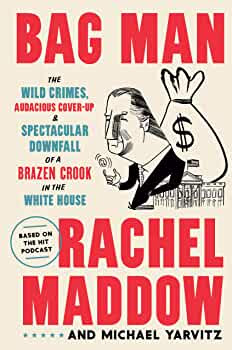
"Bag Man" book cover
Over image from Amazon.com.

In my media history classes, we do spend some time on Watergate, a scandal that started in 1972 and eventually brought down a president who had just won a landslide reelection.

But I also mention Spiro Agnew, President Nixon’s first vice president, forced to resign in disgrace. Mostly I teach about him because, as the designated attack dog of the Nixon years, Agnew constantly attacked the news media, pointing the way to a Republican strategy of shooting the messenger that has intensified as it continued through the decades.

While Richard Nixon was no Donald Trump—in Nixon’s case, he was a long-time public servant who had some grasp of both government and history, subjects that Trump has flunked in his adult life—Nixon’s scandals did scar and shape the future of his party. So there is a through line to the modern GOP flirting with a cult of personality and proto-fascism.

Anyway, I just finished reading “Bag Man: The Wild Crimes, Audacious Cover-Up & Spectacular Downfall of a Brazen Crook in the White House” by Rachel Maddow and Michael Yarvitz. I did a few seconds of internet research, but could not find out who drew the interesting cartoons that begin each chapter—a mystery to me that I wish I could solve.

Despite wondering where the cover and chapter art comes from, I found the book to be a readable, interesting summary, not just of Spiro Agnew’s crimes, uncovered by federal prosecutors in Baltimore, Maryland—it’s instructive in terms of how Agnew chose to fight the charges and frame the scandal.

Spiro Agnew
From Wikimedia Commons, official White House mug shot of a criminal: Vice President Spiro Agnew.

Because he pretty clearly was a felon. He had taken large cash bribes to award construction contracts for state projects as governor of Maryland--and continued to take bribes as Nixon's VP. But to get him out of office before Nixon’s fall—otherwise the U.S. would have had a criminal president, something we didn’t really get until we crazily elected one in 2016—the Justice Department agrees to let Agnew escape the ignominy of wearing prison garb in exchange for his quitting.

The Nixon years were years of political shocks. There was Lyndon Johnson, deciding in March of 1968 to quit the race for reelection even as Nixon's primary campaign was just taking hold. Bobby Kennedy being shot during the primary campaign. Nixon picking an obscure, right-wing governor of Maryland, who he never respected, because Nixon was shoring up right-wing support in his own party. A close election that Nixon won. Years of paranoia about the media culminating in the CREEP engaging in clumsy, illegal manipulation in 1972.

And just as Johnson stunned the nation in 1968 with his sudden departure from the campaign, we have the sudden execution of the “the deal,” where Agnew unexpectedly cashed in the only cards he held, giving up his public office. He maintained his innocence, not just to the end, but beyond, claiming at one point that Nixon was plotting to have him killed and that federal prosecutors had engaged in a “witch hunt” against him.

AGnew with crew of Apollo 10
Happier days for Spiro Agnew--as VP, meeting crew of Apollo 10 in 1968. NASA official image downloaded from Wikimedia Commons.

I was pretty young when it all broke and, at least briefly in my young adulthood, a Republican. But I lived in a newsy house—my parents always watched the nightly news, they subscribed to three daily newspapers and news was always around. I never bought into Agnew’s version; it was pretty obvious at the time to any consumer of the news that he was a crook.

Yet he did maintain a base of support. I suppose he could have shot a man on Fifth Avenue and some of his supporters would have remained loyal to him.

Politics in this country is a rough game—I guess it is globally and throughout human history. Just ask Julius Caesar what he thought of Brutus. Our particular times are not particularly different, except we have stumbled on a system that at least balances our worst impulses with some rule of law and some semblance of We the People having our say.

As our democracy wobbles a bit in election denial—face it, today’s Republicans, Joe Biden won with no trickery, deceit nor widespread conspiracy—it is nice that we survived those Nixon year shocks. Yet buying into Trump’s lies today is in line with a darker moment of your past recent history.

Agnew did it. Sure there was a witch hunt but the point is that there really was a witch (or warlock). They caught him but didn’t burn him just so that he would never become president. And Agnew's evasions created an odd playbook that, sadly, is still being applied by crooked politicians today.


Saturday, February 4, 2023

Some Reminders of Why Journalism is Important

Students at ICMA
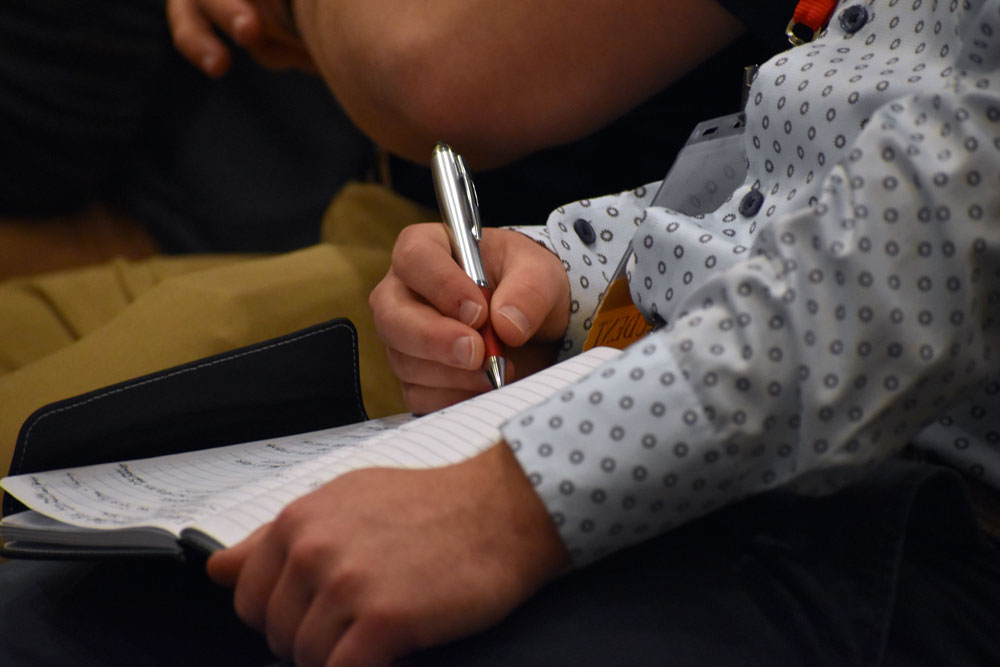
This and next three images--college student from around Iowa listening to speakers at annual Iowa College Media Association convention, hosted by the Iowa Newspaper Association, Feb. 2, 2023, in Des Moines.


There’s no doubt that journalism is changing. This week, two students and I attended the Iowa College Media Association Convention Feb. 2 in Des Moines.

The convention, which was a two-day affair PC (pre-COVID), was one day this year. It’s hosted by the Iowa Newspaper Association, and with fewer vendors willing to travel in pandemic times and a shrinking base of newspapers, the associated twitched to a one-day affair.

Times they are a-changing. So is the MMU Times, the Mount Mercy University campus newspaper that I advise—it’s gone from broadsheet (full size) to tabloid (half size) with the idea that we’ll be more of an on-line news source. I foresee that a day may come soon where we forsake the printing press for a total emphasis on cyberspace.

We’ll see.

Students taking notes (above and below).

Anyway, it was great to be back in Des Moines. I wore a mask—it’s an event that brings hundreds together from all corners of the state, and I just felt it was prudent. I was almost alone in that, and I hope this convention doesn’t prove to be the super-spreader event that helps the new Kraken sub-variant really get going in the Hawkeye State.

I took a home test tonight. Negative.

But I was pretty positive about the convention. INA’s keynote speaker was the kickoff event, and it was a kick. Dr. Richard Deming, a Des Moines oncologist spoke about “Pursuing Life with Purpose and Passion.”

He runs a sort of adventure travel program that involves taking people who have undergone cancer treatment on trips, such as climbing Mount Everest.

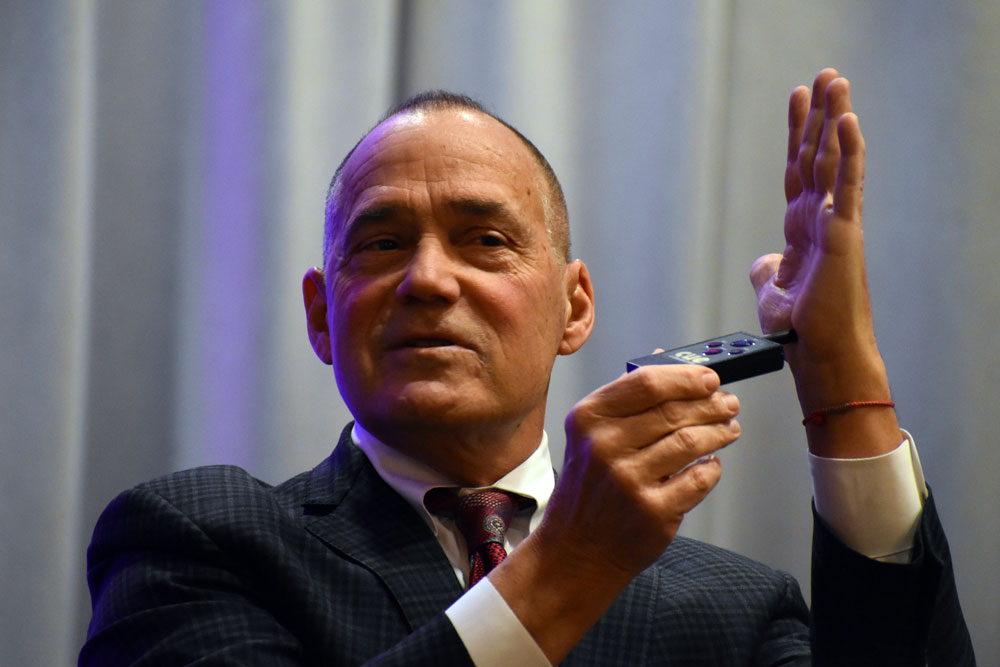
Dr. Richard Deming
Dr. Richard Deming tells stories from the nonprofit "Beyond Cancer" that takes people who have been treated for cancer on adventure trips. He describes it as a form of ministry.

Deming noted that treating cancer is not the most important part of what he does—a great doctor, he said, treats the patient, not the disease. And partly that means taking the time to be part of their story.

“You guys (newspaper people) are story tellers,” he said. “You have to be a story listener before you can be a story teller.”

He touchingly recounted trips and people, showing pictures and telling stories. We met women and men who overcome and live life to the fullest facing whatever hand of cards the universe deals—an elderly lady with poor balance and eyesight, for example, scaling the slope of Kilimanjaro.

She and the others all share a deep appreciation of a reality that we all face but sometimes forget—our time is finite.

“If you have a dream you to want to fulfill, today is a good day to do that,” Deming said.

Also that we need to treat each other with kindness and support. As we all pursue our dreams, none of us can do it alone. And we should do it now, too.

“You don’t have to have cancer to get off your butt and live your life,” he said.

I had been asked to snap and share some images during the convention, so I stuck pretty much to the ICMA speakers. It was enough, they were an interesting group.

EJ Phily Burton
EJ Phily Burton is introduced.

EJ Philby Burton, of Produce Iowa, a state office promoting movie production in Iowa, talked of the opportunities in that industry. I thought much of she said applied to any creative profession, including journalism.

For example, when you’re in a hurry and have a complex task to get done, “power walk, don’t sprint.” If you move too quickly, you’ll get sloppy. I often tell students that their slowest typing should be when they’re writing cutlines or headlines—the last-minute touches done in a rush are also where the most embarrassing mistakes are made. So don’t sprint when you’re in a hurry. Don’t crawl, either—but power walk, working quickly, but deliberately.

She also noted that on a movie set, a smart production assistant won’t whip out their phone, but will look around and see what needs to be done—carefully, so as not to interfere with others’ tasks, but success comes to those who can see what needs to done without always having to be directed.


Sarah Muller
Sarah Muller of Forbes talks of the need for journalism and journalist to evolve and meet their audiences where they are.
At a later session, Sarah Muller, Social Media Lead for Forbes, gave all kinds of example of how media needs to be more active online.

In particular, she urged us to seriously consider TikTok as a story telling venue, given that’s where younger members of the audience are. And Iowa is banning state offices from using that app. I feel another post on another topic coming on soon.

Back to ICMA. “We have to learn to evolve,” Muller said.

The final panel of the afternoon is one I look forward to each year, the “Young Professionals.” They were a good crew this year, as they often are.

Young professionals
Young professionals panels. Hayley Schaefer of Iowa PBS speaks.

The one that stuck with me most was Olivia Allen, a Simpson College graduate last year who now is an education reporter with the Quad City Times. She spoke passionately of her desire to give voice to the voiceless, to write about school policy including the voices of students who are most affected.

It felt, to me, exactly what this gig is all about—giving voice to those whose voices are otherwise not heard. It echoed back to what Dr. Deming had said in the morning, because part of the challenge is to learn to be a story listener in order to be a better story teller.

Olivia Allen
Olivia Allen of the Quad City Times speaks as Nick Brincks of Iowa Public Radio listens.

The other panelists were memorable, too. Nick Brincks, of Iowa Public Radio, was the oldest of the young professionals, having graduated nine years ago. I thought he brought some realism about how life changes as you go from the college life to full adulthood.

The program ended with the ICMA 2022 media contest awards ceremony and keynote speaker.

Ty Rushing
Ty Rushing speaks.

Ty Rushing, a force in Iowa journalism since he joined the ranks of Iowa reporters in 2013, spoke. A native of Kansas City, he told us of his jobs and the lesson he learned at each, including, honestly, what kind of editor not to be.

It took be six years to work my way to an undergraduate degree, so Rushing’s stories of working in a warehouse at night and attending college during the day resonated with me—for me, for part of my academic career, it was an overnight shift in a cat food factory. He took seven years, but he made it.

Anyway, one point both Rushing and the four young journalism panelists emphasized was the importance of getting as deeply involved in student media as possible.

The students I advise at the MMU Times earned seven awards, including:

  • First Place, Staff Editorials (Jada Veasey, Annie Barkalow and Gwen Johnson). I’m thrilled with this award, which the Times has won in the past. It’s a strength of this paper that it can speak with a coherent, powerful voice. The editorial cited included one on COVID-19 policy, and two urging students to take care of their mental health.
  • First Place, Best Vlog or Blog (Catherine Kratoska for Catherine The-Not-Too-Bad). Again, a traditional strength for Mount Mercy (you’ll see us again in second place in the same category).
  • First Place, Best Written Feature Reporting (Annie Barkalow). Mrs. Barkalow’s name came up a lot this year. This was for coverage of a Holocaust memorial speaker at MMU in spring.
  • Second Place, Best News Reporting (Annie Barkalow). A story in spring about student art being removed when some deemed it offensive.
  • Second Place, Best Vlog or Blog (Annie Barkalow for Anne with an E). Second time in a row Barkalow has won this honor. She’s the CCR of blog writers.
  • Honorable Mention, Best Headline Writing (Jada Veasey, Annie Barkalow, Gwen Johnson).
  • Honorable Mention, Best News Reporting (Annie Barkalow). This one confused me a bit, because it’s for an excellent feature about teaching, but I think there was some category confusion. I entered it in “investigative reporting,” and I’m not sure why it shifted categories.

Well, seven awards, with three first-place awards is a decent result. Congratulations to all the MMU winning journalists!

Delcie Sanache
Delcie Sanache at the ICMA convention, with Joselyn Hildebrand in the background. Both are editors on this year's newspaper staff, and, I hope, winners of ICMA awards next year.

And thanks to Delcie Sanache and Joselyn Hildebrand, two Times editors who attended the conference and represented MMU there.

I do miss the two-day conventions, but we have to learn to evolve. And Thursday was a good day.

Craig Schaefer and Jana Shepherd
Craig Schaefer, president of ICMA, congratulates Jana Shepherd of the Iowa Newspaper Association. Shepherd received the John Eighmy Service Award, given by ICMA each year to a supporter of college student journalism. Without her support, ICMA would not be able to have it's annual meeting.


Tuesday, January 24, 2023

‘A Man Called Otto’: a Hanks Triumph

Actors in "A Man Called Otto"
Sony Pictures publicity image of Tom Hanks and Mariana Treviño in "A Man Called Otto."

OK, I’m not a movie reviewer, but my wife and I had a “date afternoon” today, attending the cheap movie day at a local theater to see “A Man Called Otto.”

There are lots of funny bits in the trailer, and the movie does have comedy in it. But it’s a serious story about an old man struggling with finding a reason to live—a drama in which he attempts suicide several times. We learn, late in the movie (spoilers coming) that his wife died just six months before the movie. He’s taken a buyout at work and was pushed out the door after his company went through a merger. He’s convinced the world surrounding him is full of idiots—which, since it’s full of normal, flawed humans, it’s not all that far off the mark—although Otto, an engineer, equates intelligence with two traits: following the rules and knowing how machines work.

In short, Otto is ready for his road to reach its destination. Yet, I think part of the point of the movie is that Otto learns his views are too constrained. His keen mechanical intelligence doesn’t always give him empathy and insight. He may be a good engineer, but he’s not too keen on understanding the souls of the creatures—human and feline—around him.

It takes a stray cat and a new family in the neighborhood to reawaken some of his appreciation of life. It doesn’t fix it all, inevitably the movie is about the end of Otto’s life, but it helps illustrate why, even in dark times with a broken heart, it’s worth it to still be here, to still care, to still read a story to young children in the voice of a bear.

Besides Hanks, to me, the movie’s next most important actor is Mariana Treviño. She plays the mother in the new family and becomes, to some extent, Hank’s surrogate daughter. She’s fantastic in her role, and is the center of both her own family and the newly enlarged family with Abuelo Otto.

And other cast members and characters are well done, too—the only slightly off characters, to me, were the evil real estate ones—the movie wasn’t about them, but they didn’t seem to be the three-dimensional humans the other characters were.

Movie poster

Small point. It’s a poignant story, fantastically acted, gripping and moving. Franky, it was a hoot going to the movie just as an experience. It was almost sold out, and the crowd tended to the elderly—I think my wife and I were among the “youngsters” there. We bought our tickets late and had to sit in the front row, but with new recliner seats, that worked out. We were in a row with several old ladies, who were funny, chatty and sociable—the idea that reaching out and not trying to live life all on your own wasn’t just a theme of the movie, it was a theme of the whole matinee theater experience.

I suppose the fact that my own dad was a man called Otto, and who was also an engineer, endeared me even more to the movie—but it’s also true that my father led a different life with different struggles and was a different kind of man.

Book Cover

The movie is based on the novel “A Man Called Ove.” My wife has read the book and recommends it, so it’s on my to-read list now.

And, if you care about this non-reviewer’s movie choices, yes, I heartily recommend “A Man Called Otto.” See it with some old ladies in the front row. If you’re like me, you’ll be a bit misty-eyed at the end, but glad you came nevertheless.


Saturday, December 31, 2022

Remembering a Key Figure of the Big 3 Era

Barbara Walters in 2008
From Wikimedia Commons, an image of Barbara Walters at the Metropolitan Opera in 2008, posted on flickr by Rubenstein, link to image.

“Every female broadcast journalist working today owes a debt of gratitude to the O.G., Barbara Walters, who died Friday at age 93.” Katie Couric, writing in The New York Times.

There was Walter Cronkite. There were Chet Huntly and David Brinkley. And there was a woman, a fiercely talented, competitive person named Barbara Walters. No, I don’t mean she was a TV giant of the stature of a Cronkite, but she was an important TV personality who brought needed change to a male-dominated medium.

I first became aware of her in the late 1960s as my family sometimes had the Today show tuned in on our 19-inch black-and-white TV.

I don’t recall her much from that time, but I was young. I became more aware of her as the first female network co-anchor starting in 1976 on ABC, a gig that honestly didn’t go all the well. But as she had done many times in her long career, Barbara Walters had the courage to try something new, and after she was an anchor, she reigned as the queen of celebrity and news maker interviews, first at 20/20 on ABC, and then in a series of prime-time specials.

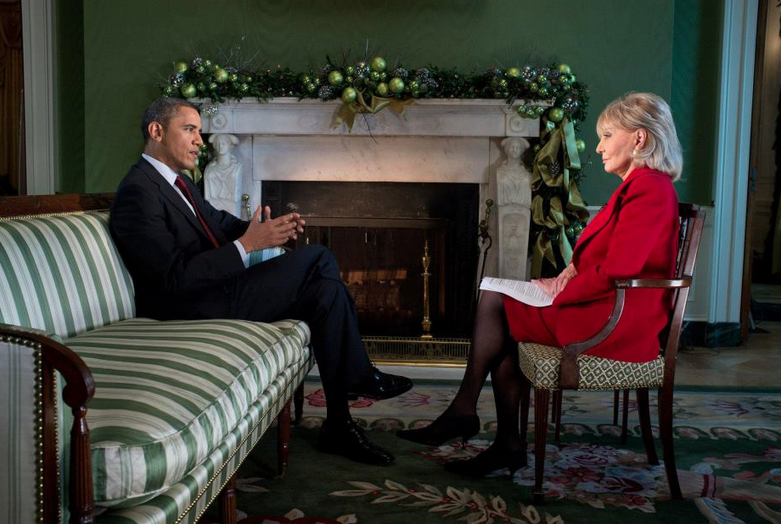
Barbara Walters with President Barack Obama
An image of Barbara Walters speaking with President Barack Obama on Jan. 20, 2013. Image posted on flickr by Ester Vargas, link.

At an age when many people have returned, Walters in her late 60s helped create The View, a daily talk show, in 1997.

The news today, of course, is that Barbara is no longer with us. She has died at age 93. An important female figure of the Big 3 TV era is gone. Her passing is a reminder of that bygone era, and her long career a testament to her tenacity and talent.