Showing posts with label Disney. Show all posts

Tuesday, May 24, 2022

'Turning Red' Almost Makes Me a 4-Townie

Movie poster
Movie posters. Images, besides YouTube videos, from https://movies.disney.com/turning-red.

Have you seen “Turning Red,” the latest Pixar-Disney movie? “Turning Red” was, for me, yet another hit, a worthy follow up to the other recent female coming of age saga, “Encanto” (yes, I know, “Encanto” was a Disney flick, not a Pixar flick, but it was part of the same film genre, to me) “Turning Red” is mostly delightful.

“Turning Red” starts with a very charming opening credit scene, when Mailin Lee goofs off as only a confident 13-year-old can. In my experience with children, there is an age, around 10 or 11, that I think of as the start of the “mini-adult” stage. The storms of adolescence are not yet in full force, for one thing. If the child is bright, if they’re well-read enough and smart enough, they can make interesting observations. They can be confidence, not yet too self-absorbed and fun to be around. Their future adult personality is showing, but not yet the angst of the teen years.

Not every tween is like that—some who will grow to be dull adults are already working on the intelligence level of bagels, reading makes a huge difference—but there is for many tweens this time of relative sophistication combined with a fresh take as a new human spirit starts to grapple with the universe. Yet, it's an awkward time too, for both young women and young men, a spirit captured in the Barenaked Ladies song "This is Me in Grade Nine."

And Mailin, a driven first-generation Chinese-Canadian living in Toronto, fits into the mini-adult mold. She has a good relationship with her parents (for the most part), a supportive set of close friends and is doing well in school, one of the keys to early adult onset. So it’s not just the Toronto Transit Authority—in some ways, Mailin has reached a foreshadowing proto-adult level of maturity.

Of course, humans are cognitively complex beasties, and it’s dangerous to generalize. And faux adulthood of a 13-year-old isn’t adulthood. There’s puberty (and panda magic) that will create new life challenges.

“Turning Red” is yet another movie in which a maternal ancestor creates the conflict. In "Encanto," it was abuela. In “Turning Red,” mom is having trouble adjusting to the maturing daughter’s changing life—and grandmother is a bit of a foreboding figure, too, as dysfunctional generational patterns that can persist in families is one of the themes of this tale of the red tail.
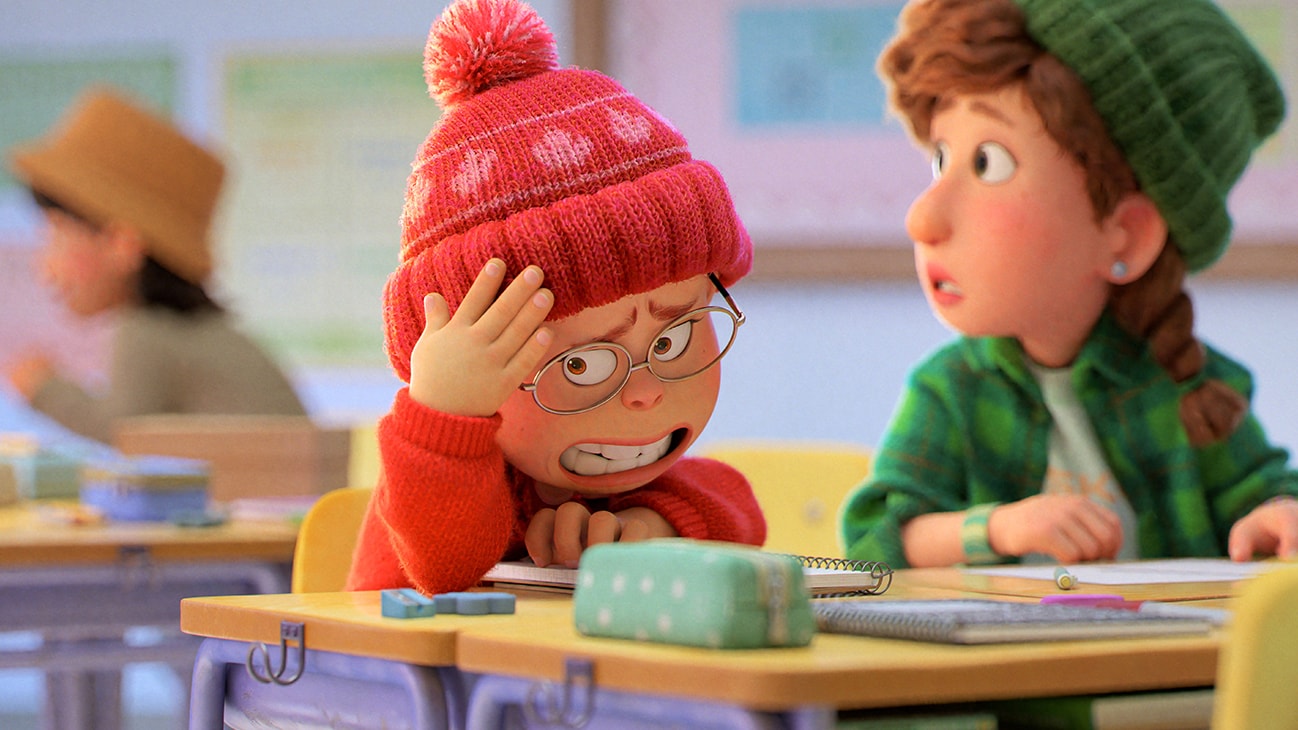
Girls in class
Parents can be a pain. Mailin reacts after Miriam tells her that her mother is outside.

Partly, the movie is a cautionary tale for helicopter parents. If you try too hard to control or solve every problem for your child, you risk driving them farther away when the inevitable life changes come.

Partly, the movie is a female coming of age story, which is both familiar to and different from the coming-of-age process for males. Menstruating is not exactly a common theme in Disney or Pixar films, and, honestly, I was rather delighted that it was a topic in “Turning Red”—as something natural, normal and that makes men (dad) a bit uncomfortable.

It’s also interesting that the movie is set in the early zeros. People who were 13 then are becoming parents now, and if their daughters aren’t yet at the red panda stage of life, making a Pixar movie that will evoke so much nostalgia in new parents does seem like a pretty smart move.

There is some child sass in “Turning Red,” which may make some adults uncomfortable—but it’s a magical realism story where the sass is not overdone and the early teen rebellion is tempered a bit by the reality that the main character still loves her parents and, while wanting to assert herself, doesn’t want to be too far from them, either.

What don’t I like about “Turning Red?” Why “mostly” delightful? My problem is with mom, not only her dismissive treatment of Mailin, but her equal dismissive treatment of her introverted but insightful husband. His “maybe we should trust her” line is bulldozed over.

The most cringeworthy scene is mom’s tirade in the Daisy Mart, and that felt off, to me. That was a level of public shaming of a daughter that even most protective parents could avoid. That, and stalking your daughter and holding up a box of pads before her entire class to say she forgot them—I would think almost any parent, in that situation, would have quietly left the box in the school office with the request that the daughter be notified to discretely come get them.

Mom’s freakout and turning into the “Turning Red” equivalent of the Stay-Puff Marshmallow Man from “Ghostbusters” didn’t bother me as much. That the panda spirit was slightly different in each woman of the family, and that the mom, who suffered so much internal discord over her relationship with her own mother, would have a larger, more violent panda kind of worked. It did seem over-the-top peril of every teen and boy band member at the concert, true, but it was in a clearly fictional Toronto and no actual 4-Townies were stomped in the making of this panda-pocalypse.

In short, I enjoyed the movie. I wish mom had been toned down a little, and that there had been a bit more of the friend group. Miriam was really my favorite character, but I liked all of the friends and wanted a bit more of them.

Was it a better movie than “Encanto?” I don’t think so. It was a different movie and a very good one, but I felt the family themes of “Encanto” ran a bit deeper. And, while the music in “Turning Red” was fun, “Encanto” was a genuine musical production with superior songs that moved the plot.

Also, “Encanto’s” Miriam was Mirabel, and it was nice that the central figure who held the group together was the main character of the film. In “Turning Red,” the heart of the Scoobies, Miriam, was too much of a side note.

Also, not to diss Pixar, one of my favorite movie companies, but “Encanto” was a step above in animation—a visual feast. “Turning Red” was well done but it didn’t have Mirabel’s swirling dress nor bouncing curls (yes, it had a fluffy panda, but I mean overall “Encanto” had far more pleasing, colorful visual details).

I do like that both movies. Along with the “Frozen” universe, they represent a clear, positive evolution in the Disney-verse of the heroine. Unlike the princesses of movies past, current Disney females have much more drive, intelligence and decision-making power. And I’m a fan of the diversity representation, too. We’ve come a long way since “Pocahontas,” thank goodness.


Saturday, February 19, 2022

We Don’t Talk about Tony, No, No, No

Encanto family
The magical family from "Encanto." Image from Disney.com.

Maybe it’s just me. I’m enchanted with the Disney movie “Encanto,” and, no, I know that’s not just me, as the film seems pretty popular.

What’s just me is that I think it could be taken as being about the COVID-19 pandemic, in a way. Spoiler alert--if you have not seen "Encanto," you may want to stop and go watch it before proceeding to the rest of this blog post.

Think of one of the many popular songs from that film, “We Don’t Talk about Bruno.”

Tio Bruno in the movie gets an unfair bad reputation because he has visions of the future, and when those visions are sad (a goldfish dies), the people blame Bruno. Yet, it’s pretty clear, Bruno didn’t kill the goldfish, nor did his vision. He just saw it and reported it.

Kind of like Dr. Anthony Fauci. The long-time leader of a federal agency called the National Institute of Allergy and Infectious Diseases, Dr. Fauci has been blamed, these past two years, for things he has said about the pandemic.

Dr. Anthony Fauci.
NIAID image of Dr. Anthony Fauci.

But the good doctor didn’t create the virus. And the tough advice he’s given isn’t some mad power grab, rather attempts to keep us safe.

Thankfully, unlike Bruno in the movie, he hasn’t hidden himself in the walls.

The analogy doesn’t completely hold, I know. Yet the movie characters couldn’t face reality and thus shunned Bruno.

Encanto is an enchanting tale for lots of reasons. For one things, it’s a Disney story where the witches aren’t evil, but blessed by a life-affirming miracle. The characters are in conflict due to difficult family dynamics and a troubled history—not because they are fundamentally evil. They are just normal people, trying their best.

And sometimes being crushed by the weight of their burdens. Yup, loved the song by the strong older sister, too. And yes, I feel like the pandemic is sometimes like the pressure source, too.

And the movie ends with our lead character, one of only two members of a magical family who has no powers, somehow restoring power to the full family.

Because she reconciled with her grandmother. The other not-magical person. In the family of magic, the two most pivotal characters, the true leaders, are the ordinary women who hold the rest together.

Well, great. We will somehow, I hope, learn as a culture to rebuild what has become broken. And maybe learn to let Dr. Tony back in, too.


Tuesday, August 31, 2021

The Cat Steals the Show

Disney poster, from Wikipedia.
Have you seen the 2008 Disney animated movie “Bolt?” I had not until a 5-year-old grandson picked it to watch on Friday night (his usual movie night) of last week.

The movie started with an improbable, over-done action sequence, and I was worried I had agreed to an empty experience like “Penguins of Madagascar,” a movie I intensely dislike.

But, no. The improbable action sequences were part of a show inside a show—in the movie, Bolt is a TV star dog who acts sincere because he doesn’t know it’s an act. It’s a “coming of age” film in which the child star, in this case a dog, learns the hard truth that he’s just a normal creature.

And the nice truth that being a normal creature can be a beautiful thing. Bolt is lost and trying to get back into his media bubble, and bullies a cat named Mittens to aid his journey.

Mittens, it turns out, is the true star. She knows Bolt’s world is fake. Mittens is a con cat, she’s been fooling pigeons into paying her in a protection racket based on the potential use of claws that she doesn’t even have.

It is Mittens, the lost, feral cat, who must teach Bolt how to become a properly domesticated, and thus happier, dog.

Hamster, dog and cat from "Bolt"
Flickr stream of  Cthomasuscg: Rhino, Bolt and Mittens, three main characters of the movie "Bolt."

I ended up loving the movie (and Mittens). I thought it great because it’s a child-friendly glimpse into the reality that media you see is not actual life. The fourth wall is torn down and the fictional nature of entertainment media is laid bare.

There are media stock characters, to be sure. A “director” too caught up in his artistic vision who finds he must please “Mindy from the network,” who he had belittled on first meeting. It turns out, it’s not the art, it’s the business that has the power in showbiz.

I was slightly disappointed that Bolt and his girl end up retiring from showbiz—I would have preferred that Bolt learn he’s an actor and be willing to continue acting—but I still thought that the movie worked both at the level of entertaining a 5-year-old, and pleasing a media professor in his 60s by illustrating key media realities.

And now, to me, Mittens is my favorite Disney princess.
'


Wednesday, December 18, 2019

And So Anna Becomes Queen

Disney publicity image downloaded from Variety web site. Anna wonders: What the heck is my odd older sister up to now?

Elsa has retired and moved north to live as some sort of ice demigod, the fifth elemental spirit in this tale with an ecological subtext.

The dam is bad. We need brute force (send in the brutes) to get rid of the damn thing.

I just saw “Frozen II,” and I was impressed. I think Disney was a bit taken aback by the success of the first movie in this franchise, and as always when such a story succeeds, there’s the question of where does it go from here?

And the central unresolved question of “Frozen” was: What the heck is Elsa? And that’s exactly the MacGuffin for this plot. Unless you consider four stones with rather bland logos for elemental forces to be four MacGuffins—or is mist a MacGuffin? Are we back to the dam?

Also, is it just me, or is Olaf the character Jar Jar Binks wanted to be but never was?


Whatever. I don’t think “Frozen II” will hit with the power of the first movie. I don’t expect to see YouTube videos of enthusiastic Marines reacting to the signature music video from this film. But there is a lot to like in this second installment.

While there is an environmental theme here, it’s not the main point of the movie. Anna and her journey to womanhood is really more what’s going on. Elsa is being lured down a different life path by a siren voice who turns out to be ghost mom who also sends ghost horse—but then Elsa dies and is reanimated, so maybe “Frozen II” is a reverse zombie apocalypse there the zombie saves the town and installs the sweet younger sister as the benign despot.

But I’m getting away from my point, if I had one. I’m like Olaf explaining the plot.

I liked this movie partly because it allowed its characters to evolve. That’s even a theme that Anna ruminates on, how even a satisfactory moment in time is really only a moment in time, and things inevitably change. Someone once observed that a happy ending always depends on ending the story at the right place, because in the long run, the characters are all dead.

Which is even used as a joke in “Frozen II.” It’s a rather smart movie, with lots to unpack.

Anyway, my actual favorite theme of the movie isn’t the one about how, as Olaf says, technology can save or destroy us, as interesting as that dam theme is. Nor is it about what Elsa is and how Anna gets to be all growed up. Instead, to me the main theme is Anna facing the likelihood of her best possible choice destroying the town that she loves and is princess of.

To have peace, it’s necessary to tear down that wall. In this case, the wall is holding a reservoir full of water, and doing the right thing means flooding Arendelle. Meanwhile, Olaf has apparently expired, her sister’s fate is unknown but not good given that her magic is ending and Anna is depressed, discouraged and alone.

And she repeats a line that comes up several times in “Frozen II.” What do you do when all is lost, your dreams are shattered and Hillary Clinton was not elected?

“Do the next right thing,” Anna mutters to herself.

That line really resonated, to me, and is the most important theme from “Frozen II.” It’s a message for our times. Indeed, a transcendent message for many times. That’s a pretty deep thought from younger sister in a sequel children’s movie with magic trolls and singing reindeer.

But it works, for me. I hope to remember those words and use them myself.

Go see “Frozen II.” You may find yourself wondering, as I did, whether a giant snowflake would really save the town—sure, the wave was diverted, but wouldn’t the waters rise anyway? That’s not really the point. Elsa’s magic always was a little edgy and improbable (she can create life and nobody seems concerned about whether Olaf has a soul?).

It’s a movie about the sidekick. It's a movie about Anna. And doing the right thing even when all seems lost. And that seems enough.


Tuesday, August 6, 2019

Seeking Escape in An Action Movie

Are you looking for an escape from the heartbreaking news of the day?

Well, temporary escape, I hope. Tuning out is the American way of coping with bad news, and it’s a truly bad idea. A democratic republic depends on a populace that, at the very least, pays some attention to news of the day.

So, to briefly, only briefly, escape from the gratuitously violent news of the day, I followed a classic strategy. I went to a theater with my wife, bought a huge tub of popcorn (and a refill), and watched an action movie filled with acrobatic tricks, narrow escapes, and chase and fight scenes.

It even had Keanu Reeves. It was “Toy Story 4.”


When we were on the way to the theater, my wife noted that a friend had said that she cried at every Toy Story movie, and we laughed, a bit. The Toy Story franchise is indeed filled with heart-touching narratives, but hardly draws tears.

And then, near the end, your macho manly movie correspondent choked up. Tears filled my eyes. That lost little girl, that doll, that reunion with her parents—ahhhh.

Ok, Pixar, you did it.

Woody and Forky talking over the meaning of life in "Toy Story 4." Image from Disney.com.
 But wait, there’s more. A few minutes later the familiar cast members gather to say farewell and Godspeed to one of their own—and, sure, the waterworks are ready to start again.

Disney Image. Duke!
And Keanu Reeves! I’m not the biggest KR fan, but he is perfect as a Canadian clueless action doll, pining for the boy who rejected him.

“Toy Story 4” is not a perfect movie. I found the middle action scenes in the antique shop to take up a bit too much time. Toy Story excels in character development and dialogue, which the action sequences support, and the action sometimes is too central in this latest installment.

So maybe number four is not the very best Toy Story movie. But how many movie franchises manage to stay fresh and heartfelt into the fourth movie? And we were a bit skeptical of the idea of “Toy Story 4,” because the third movie felt so final. It would be like a fourth “Lord of the Rings” movie.

We were wrong.

Pixar, your writers are just so darn clever. I do wish Jessie had a more screen time, and wanted more of the interplay with the old cast—interactions between T Rex and Mr. Potato Head, for instance. Still, “Toy Story 4” is totally worth it. Who wouldn’t love the Mr.-Bill-like Forky?

You’ll laugh, you’ll cry, it will move you. And it will provide you some much needed emotional satisfaction in troubled times.