Showing posts with label animation. Show all posts

Friday, September 12, 2025

Netflix Movie Touches on What Music Means

KPop Demon Hunters
The fictional members of imaginary KPop group Huntr/X, Zoey, Rumi and Mira, Netflix image.

“Anything that is too stupid to be spoken is sung.”
Pierre de Beaumarchais, “The Barber of Seville”

As a retired media professor, I’ll disclose right up front that I am ignorant of music. I never took an intro to music class, never learned to play an instrument (beyond briefly ringing in a hand bell choir) and don’t have insight into music structure or history or much of anything else.

Yet, I have required students in the past to use music in a communication class—to pick a song of their choice that includes a video, and unpack what they see as the communication meanings or concepts portrayed in the work. I don’t doubt that Pierre had a point—“Baby Shark” is sung, after all. But even a musically ignorant person can understand that music, including pop songs, can be very expressive of ideas both verbally and non verbally.

And one of the points I was indirectly making to students is that communication is both data and feelings. So music, even pop music, can express our inner feelings. Music can have depth.

Which brings me to this year’s movie phenomenon, “KPop Demon Hunters.” As an old man, I freely admit I have zero experience with KPop. I’m aware of the term, but this Netflix movie served as my introduction to the genre.

And what an introduction. The movie follows three pop singers, Rumi, Zoey and Mira. The trio, a KPop group called Huntr/X, is also the chosen group, a mystical, generational set of super heroes who protect the world from demons through both their songs and their fighting prowess.

It’s “Buffy the Vampire Slayer” meets “Frozen.” Except it’s more than that. For one things, although I wish there was more character development, it’s got multiple characters who are complicated and surprising. Not just the trio, who each has their own distinct characteristics, but the demon boy band, the demon king, the band manager, the quack doctor—there are lots of interesting characters who are well written and well acted.

The story is fantastic, but works because it’s both animated, which gives it lots of license to be in its own imaginary reality, and internally cohesive. The characters believe in their universe and behave reasonably as a result.

And—those songs. This is an animated musical where each song works—they are catchy, well sung, lyrically interesting and advance the story. That it’s pop music doesn’t detract from its quality. Pretty much any of the videos of the songs would have worked in my class—there are characters and depth in each to dig into, communication ideas interestingly expressed.

True, I found the song about soda pop to be the musical equivalent of the food—there’s not a lot of depth there .But then again, in the context of the movie, these are demons attempting to snag fans, not anybody expressing truths about their life.

For me, the song that hit the most was the final one. I wish it had more set up—the quick resolution of the movie was, in my mind, one of its weaknesses—but I like both the sound and the lyrics of this song. “My voice without the lies, this is what it sounds like?” Yeah, I have fallen in love with three cartoon girls by that point. There are lots of quotable lines in the song “What it Sounds Like,” but I really love one of its final verses:

“We broke into a million pieces, and we can't go back
But now we're seeing all the beauty in the broken glass
The scars are part of me, darkness and harmony
My voice without the lies, this is what it sounds like.”


It’s a message of truth and self-acceptance. I’m not a poet, but it seems like decent poetry to me, wrapped in a catchy pop sound.

There is a lot that I like about the movie. The cast, both signing and speaking, seems excellent. The look of the movie is bright, colorful and eye catching. There is a serious tone and message, but also a lot of silliness and levity.

I feel lucky that I didn’t see this movie on Netflix. They released a “sing along” movie theatre version, and a grandson wanted his grandparents to go with him and his mother to see it. Luckily, I saw it in Iowa, a Midwestern state where most movie audiences are too uptight to actually sing along, so no audience voices interfered with the songs.

It’s not a perfect movie. As noted earlier, to me the resolution was nice but too rushed and needed more setup. The demon king could have used a much more effective physical appearance, particularly for the climatic battle. I liked seeing girls portrayed as creatures who actually eat, but they were also razor thin, which cut against that message. The quick cuts and pace sometimes gave the movie a too frantic feel to me.

Still, it’s very good. It’s an animated film that can appeal to a grandson and his grandfather. It’s Golden.

Tuesday, May 24, 2022

'Turning Red' Almost Makes Me a 4-Townie

Movie poster
Movie posters. Images, besides YouTube videos, from https://movies.disney.com/turning-red.

Have you seen “Turning Red,” the latest Pixar-Disney movie? “Turning Red” was, for me, yet another hit, a worthy follow up to the other recent female coming of age saga, “Encanto” (yes, I know, “Encanto” was a Disney flick, not a Pixar flick, but it was part of the same film genre, to me) “Turning Red” is mostly delightful.

“Turning Red” starts with a very charming opening credit scene, when Mailin Lee goofs off as only a confident 13-year-old can. In my experience with children, there is an age, around 10 or 11, that I think of as the start of the “mini-adult” stage. The storms of adolescence are not yet in full force, for one thing. If the child is bright, if they’re well-read enough and smart enough, they can make interesting observations. They can be confidence, not yet too self-absorbed and fun to be around. Their future adult personality is showing, but not yet the angst of the teen years.

Not every tween is like that—some who will grow to be dull adults are already working on the intelligence level of bagels, reading makes a huge difference—but there is for many tweens this time of relative sophistication combined with a fresh take as a new human spirit starts to grapple with the universe. Yet, it's an awkward time too, for both young women and young men, a spirit captured in the Barenaked Ladies song "This is Me in Grade Nine."

And Mailin, a driven first-generation Chinese-Canadian living in Toronto, fits into the mini-adult mold. She has a good relationship with her parents (for the most part), a supportive set of close friends and is doing well in school, one of the keys to early adult onset. So it’s not just the Toronto Transit Authority—in some ways, Mailin has reached a foreshadowing proto-adult level of maturity.

Of course, humans are cognitively complex beasties, and it’s dangerous to generalize. And faux adulthood of a 13-year-old isn’t adulthood. There’s puberty (and panda magic) that will create new life challenges.

“Turning Red” is yet another movie in which a maternal ancestor creates the conflict. In "Encanto," it was abuela. In “Turning Red,” mom is having trouble adjusting to the maturing daughter’s changing life—and grandmother is a bit of a foreboding figure, too, as dysfunctional generational patterns that can persist in families is one of the themes of this tale of the red tail.

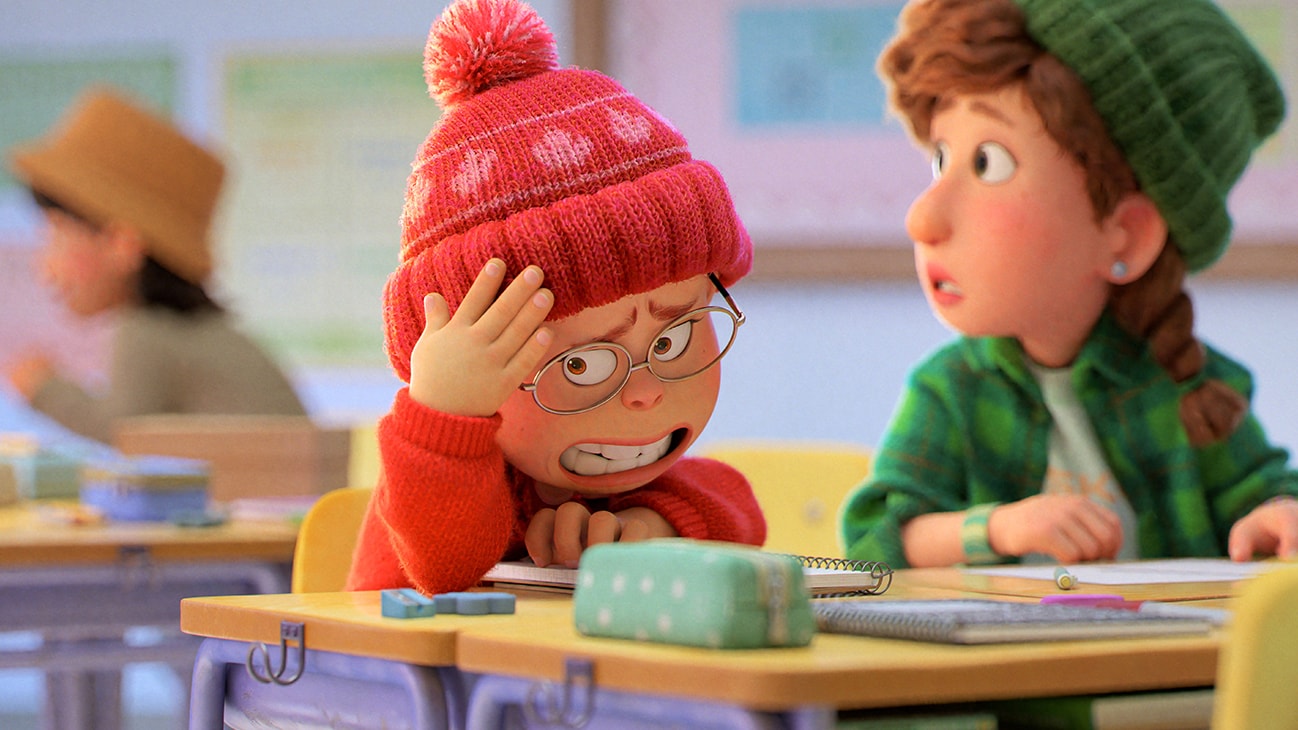
Girls in class
Parents can be a pain. Mailin reacts after Miriam tells her that her mother is outside.

Partly, the movie is a cautionary tale for helicopter parents. If you try too hard to control or solve every problem for your child, you risk driving them farther away when the inevitable life changes come.

Partly, the movie is a female coming of age story, which is both familiar to and different from the coming-of-age process for males. Menstruating is not exactly a common theme in Disney or Pixar films, and, honestly, I was rather delighted that it was a topic in “Turning Red”—as something natural, normal and that makes men (dad) a bit uncomfortable.

It’s also interesting that the movie is set in the early zeros. People who were 13 then are becoming parents now, and if their daughters aren’t yet at the red panda stage of life, making a Pixar movie that will evoke so much nostalgia in new parents does seem like a pretty smart move.

There is some child sass in “Turning Red,” which may make some adults uncomfortable—but it’s a magical realism story where the sass is not overdone and the early teen rebellion is tempered a bit by the reality that the main character still loves her parents and, while wanting to assert herself, doesn’t want to be too far from them, either.

What don’t I like about “Turning Red?” Why “mostly” delightful? My problem is with mom, not only her dismissive treatment of Mailin, but her equal dismissive treatment of her introverted but insightful husband. His “maybe we should trust her” line is bulldozed over.

The most cringeworthy scene is mom’s tirade in the Daisy Mart, and that felt off, to me. That was a level of public shaming of a daughter that even most protective parents could avoid. That, and stalking your daughter and holding up a box of pads before her entire class to say she forgot them—I would think almost any parent, in that situation, would have quietly left the box in the school office with the request that the daughter be notified to discretely come get them.

Mom’s freakout and turning into the “Turning Red” equivalent of the Stay-Puff Marshmallow Man from “Ghostbusters” didn’t bother me as much. That the panda spirit was slightly different in each woman of the family, and that the mom, who suffered so much internal discord over her relationship with her own mother, would have a larger, more violent panda kind of worked. It did seem over-the-top peril of every teen and boy band member at the concert, true, but it was in a clearly fictional Toronto and no actual 4-Townies were stomped in the making of this panda-pocalypse.

In short, I enjoyed the movie. I wish mom had been toned down a little, and that there had been a bit more of the friend group. Miriam was really my favorite character, but I liked all of the friends and wanted a bit more of them.

Was it a better movie than “Encanto?” I don’t think so. It was a different movie and a very good one, but I felt the family themes of “Encanto” ran a bit deeper. And, while the music in “Turning Red” was fun, “Encanto” was a genuine musical production with superior songs that moved the plot.

Also, “Encanto’s” Miriam was Mirabel, and it was nice that the central figure who held the group together was the main character of the film. In “Turning Red,” the heart of the Scoobies, Miriam, was too much of a side note.

Also, not to diss Pixar, one of my favorite movie companies, but “Encanto” was a step above in animation—a visual feast. “Turning Red” was well done but it didn’t have Mirabel’s swirling dress nor bouncing curls (yes, it had a fluffy panda, but I mean overall “Encanto” had far more pleasing, colorful visual details).

I do like that both movies. Along with the “Frozen” universe, they represent a clear, positive evolution in the Disney-verse of the heroine. Unlike the princesses of movies past, current Disney females have much more drive, intelligence and decision-making power. And I’m a fan of the diversity representation, too. We’ve come a long way since “Pocahontas,” thank goodness.