Showing posts with label Movies. Show all posts

Thursday, June 4, 2026

The World Unites: Clearly It’s Fiction

Recently, my wife and I went to the local cinema to watch “Project Hail Mary.” It stars both Ken (Ryan Gosling) and a pile of rocks (James Ortiz), and both play their parts well.

And, subsequently, I’ve read the novel that the movie was based on. I enjoyed them both, just as I enjoyed “The Martian,” book and movie. Both books were written by Andy Weir. And, as if you didn’t already know that, there may be spoilers in this post. You are warned.

From https://www.mgm.com/movies/project-hail-mary

I found “Project Hail Mary” to be well done in both movie and book form—which is something, given that there are differences between the two stories in the two media. The movie simplifies the story and leaves out much of the science details, some of which I wish that they had hinted more strongly in the film. For instance, in the book Eva Stratt had planned for Dr. Grace to be a backup science officer all along and had quietly ensured he had all the necessary science insight. Or that Ryland Grace had to be the one to go partly because of a rare genetic trait that made him unusually likely to survive a long coma.

Most of all, I wish that the way that the breeding of nitrogen-resistant Astrophage worked in the book was in the movie. I liked the slow progress through generations of microbes; it’s a reminder of how evolution and deliberate breeding actually work.

But I understand that it’s almost always necessary to leave details out of movies—they are a different, simpler narrative medium than books.

At least one change from the movie to the book improved the story, for me. In the movie, Eva was businesslike and determined, just as she was in the book. But film Eva has a bit more humanity—the karaoke scene, for instance, softens her. In the movie, she forces Dr. Ryland Grace to go on the mission by inducing his coma early, as she does in the book—but Sandra Hüller’s excellent acting shows the conflict Eva feels despite her compulsion to have the project succeed at all costs.
The book.

Well. I like my science fiction with rivets, and “Project Hail Mary” is science fiction with plenty of plausible, interesting science conjecture—it has got its rivets on. Yet any story is better if it has both factual depth and human heart—and like Sam and Frodo in Lord of the Rings, the deepening friendship between Ryland Grade and Rocky provides a lot of heart. Meanwhile, the themes of what bravery is and isn’t, and whether it’s ever OK to remove another person’s agency to save others—those, added to the science, gives great depth to the story. I also like that Dr. Grace is literally the “chosen one” who isn’t chosen for some magic or innate superpower—he’s chosen for his science background, built over years of study. Score one for graduate school.

He is definitely the reluctant hero. “Some people are failures,” as he says. “Some people don’t rise to the challenge.” And yet, in the end, Dr. Grace does.

Partly due to Rocky. While the designated astronauts are training, Dr. Grace comments to Yao Li-Jie, played by Kenneth Leung, that Grace doesn’t think he has a bravery gene that the crew has. Leung’s character replies that it’s not a gene—you just have to find someone to be brave for. Ironically, Dr. Grace finds an alien to be brave for—I like that the film shows even a coward can sometimes do incredibly brave things.

If anything, the most fantastic, unbelievable part of the book and movie isn’t that mysterious bugs are eating Sol and most nearby stars—it’s that the humans of our world would so quickly unite behind such a complex project. Our current leaders would probably deny that Astrophage is real and refuse to be part of Project Hail Mary because it sounds too Catholic (or is a Chinese hoax). Would that we respected science a bit more in this reality.

There are many stories that work as both books and movies and many that don’t. In my life, my earliest experience with such a working pair was “To Kill a Mockingbird,” by Harper Lee—great book, great film. Also, both the book and movie “The Princess Bride” are wildly entertaining.

Sometimes, one part of the movie-book dyad is superior. I admire Stephen King as a writer, but enjoy many of the movies adapted from his works more than the original books or stories. “Stand by Me” is way more satisfying to me than “The Body,” for example.

Anyway, I’m glad both book and movie work so well for “Project Hail Mary.” It’s an uplifting tale, with troubling elements, which adds to its charm—it can spark endless discussion, as deep stories do. Yes, I am also among those who appreciate that the alien was so “alien,” but in important ways, so much the same as us, too. Even some surprising similarities are explained—Rocky “sees” with sonar and has much better hearing than Ryland Grace, and in the book Dr. Grace wonders why their hearing should overlap so much. Rocky raps on the floor and asks if Dr. Grace could hear that—their hearing overlaps because important physical sounds in both of their worlds overlap in sonic frequency. Well, cool.

So, in summary. I rate the movie “Project Hail Mary” 10 of 10. Or, in other, more musical, words: "Amaze, amaze, amaze."

Saturday, May 17, 2025

Reshaping the Weirdness of Oz to Something New


I have not yet read the novel “Wicked,” but I do plan to, having recently seen the musical movie of the same title.

“The Wizard of Oz” was always a bit of a strange tale to me. I read the book when I was young, and it was OK but not one of my favorites. That also sums up my feelings about the 1939 movie, too—it’s OK, it was on TV in my childhood and I enjoyed it, but it wasn’t something that I was all that gaga over.

Never mind, the world of “Wicked” is a radical re-imagining of L Frank Baum’s and Hollywood’s imaginings, and Oz isn’t exactly the same. Yes, in the 1939 movie, the wizard was willing to hoodwink the crowd with his tricks—but in Wicked, we see a much darker Wizard of Oz.

And I like it. It’s relevant to today. I feel that we follow too many wizards in our lives now—fakers whose only talent is to play to the crowd, and who feel that you unite folks by giving them someone to hate.

My wife saw the stage musical “Wicked” in London, but I have not experienced the stage show, so the movie was my first introduction to this alternative alternate reality. I am a fan, and I find myself really enjoying the songs, too.

When they do work, musicals can be magical. I think part of what they do is what the songs in the musical episode of “Buffy the Vampire Slayer” did—the singing is a convention that allows the characters to think aloud, to reveal themselves. It also helps like a musical when there is a great ensemble song.

“Wicked” is wickedly good partly due to the quality of its songs. It’s also good because of they way in which both the songs and the plot beyond the songs subverts expectations of what or who is truly wicked.

I liked that Glinda (or Guh-Linda), while good at heart, is also vain and shallow. That the most intelligent and empathetic characters, Elphaba, is the one who will be falsely branded as “wicked.” That much of the social life of Shiz concerns ephemeral fads and shallow criteria of what or who will be popular—sort of like school actually was, although more high school than university.

Wikipedia image of book cover.

Popularity as a goal is a strong cultural force in this era of orange ogre Presidents and social media and success measured by clicks—and “Wicked” is partly a rumination on how far some people may go in order to achieve popularity.

Plus, it has all those scary parallels with the world we inhabit: “What you need to bring people together is to give them a real good enemy.” Yikes, Mr. Wizard, that’s so sadly true and sad that it seems so true.

I don’t have an opinion of the way Wicked was “Hobbit”-fied—that is, a shorter story was somehow expanded, for “The Hobbit” was a short children’s book somehow morphed into a trilogy of movies. For “Wicked” a Broadway play was somehow doubled in length and made into two movies.

Poster from www.Wickedmovie.com web site.

I do think that the pace of the first movie was a bit slow at times—I liked the climatic song, but it just went on for a bit too long.

Yet, I can only judge the movie, not it in comparison to the stage show. And I give the movie two thumbs way up. I am excited for part two to come out later this year so this wicked saga can continue. I predict that it’s going to popular, even without a makeover from Gah-Linda.


Thursday, August 8, 2024

A Pair of Cool Summer Films on Life Stages

Magnolia Pictures publicity image for Thelma, June Squibb as titular character, Fred Hechinger as her grandson Danny.
Disney publicity image of Anxiety, voiced by Maya Hawke, from "Inside Out 2."

I don’t go to the movie theater all that often, but twice in recent weeks my wife and I decided to catch a flick at the local cinema. As chance would have it, both movies we saw were, to some extent, ruminations on maturity, on the nature of aging and stages of life. To me, one was good although not great; the other was unexpectedly excellent.

When “Thelma” comes out on DVD, for us dinosaurs who don’t consume all our media from streaming services, you can bet I’ll snatch up a copy. Thelma is the gem.

When “Inside Out 2” hits the bargain bin, I’ll be willing to pick it up, too. It’s re-watchable, a good movie, but the disappointment is that it’s a sequel to a much better film.

“Inside Out 2” continues the adventures of Riley, a girl who has moved from Minnesota to California, where her father is part of a tech startup in San Francisco. The premise of the first movie was to personify key emotions and visually represent the interior working of the brain as Riley struggles with the stress of the move. That first movie was poignant, clever and thought-provoking.

Who thought we could choke up over the fate of an imaginary character who is part cat, part elephant, part dolphin and mostly cotton candy? Bing Bong, Riley may have left you behind, but we won’t ever forget you.

Anyway, that was the first movie. Part of its theme was that sadness is as important as joy, and maturing means learning to acknowledge and live with all of your emotions. At the end of the film, an expanded control panel is installed in brain HQ, with a big warning light labeled “Puberty.”

Which, almost inevitably, sets up “Inside Out 2.” And, of course, the siren sounds, the light flashes and suddenly, puberty hits, signaling a total remodel of HQ, among other things—including new emotions. Anxiety, Ennui and Embarrassment join the club.

The sequel is still clever, and has many good themes and moments. I like the idea of your self-concept being healthier if it is more inclusive of your actual experience and self, and not just what you desire to be rather than what you are. But the new emotions didn’t make as much sense to me. In the first movie, we saw inside HQ of the adult characters, who had the same core set of emotions as the 11-year-old Riley. And while I thought she was amusing to watch, is Ennui an emotion? And isn’t Embarrassment really an Elaboration of Fear?

I also wasn’t in love with all of the new side characters, the popular girls Riley aspired to be with or the current friends she was willing to leave behind. Funny that an imaginary friend from movie one seemed more emotionally “real” than any real friend from movie two. The concept makes sense—puberty is certainly a time of intense anxiety about one’s place in the peer social order, it’s just that the characters and dialogue didn’t resonate all that well with me.

Still, it was a good, watchable film, one I would be willing to see again, but probably wouldn’t do lots of repeated watches as I have with the original "Inside Out."

And then there is “Thelma.” How to describe “Thelma?” Think action move where our hero is a realistic character in her 90s. She has a death-defying trip across a maze—the interior of a cluttered shop—that is as dramatic as any break-into-the vault scene in a thriller, but reflects the limits of mobility of a body as it ages. Thelma has a grandson who looks after her and loves her, but in some many ways, it turns out Thelma is the adventurous, capable one, unfazed by and able to overcome her limits in a way that her grandson isn’t.

I think that’s part of the theme of this movie—so much of what holds us back is ourselves and how we picture ourselves. It’s not only what we can do, but what we allow ourselves to do.

And yet, “Thelma” acknowledges realities of ageing. As her main sidekick, an old man from a nursing home, says, “we are diminished.” A person in their 90s can be emotionally and mentally very sharp, but not quite as quick nor as physically strong as a younger person can be. In one sad scene, Thelma and her sidekick visit an old friend (to “borrow” a gun), and the old friend is obviously well beyond the point where she should be living alone at home. It happens at different rates and different times for different people, but age will eventually diminish any who survive to their golden years.

In a way, both movies are about self-knowledge, about the importance of recognizing who you really are, and what the realities are about your point in the road of life. And both have June Squibb—as a minor character (Nostalgia) in "Inside Out 2," and the main star of "Thelma." In my mind, “Thelma” is a 4.9 and “Inside Out 2” is a 3.9; they’re both worth seeing and thinking about.

And I suppose that’s the best thing one can say about any work of dramatic art—play, novel, TV show or movie. It if makes you more aware of yourself and seems to explore some fundamental realities of this human life, well, that’s a win. Maybe it’s a binge-worthy thing—watch “Inside Out 2” and then “Thelma.” That would seem to be a few hours well spent.

Thursday, March 7, 2024

What I Like and Disliked Exploring 2019 Dora Movie

On the recommendation of a family member, I checked out a DVD of “Dora the Explorer: The Lost City of Gold” from the Marion Public Library.

The plan was to watch it with a grandson who was staying with us that weekend, but the second-grader rejected that option, claiming that Dora and Boots are a menace to society (there is no reason—he’s a second grader), instead preferring “Muppets Treasure Island.” It was, all things considered, a reasonable choice, and the Muppet movie, which draws from classic literature, was better than the Dora movie, drawn from an old TV show.

I watched Dora on my own last night.

The family member who recommended Dora didn’t claim it was a great film, merely that it was fun to see a live actor behaving like Dora, especially when the scene shifts to Dora’s high school years in LA. On that criterion, I would say Dora hit its mark. It playfully portrayed a blend of a cartoon universe with what would happen if that universe intersected the real world.

In particular, I had never seen Isabela Moner, who plays the teen Dora, before—and I think she does a fine job, believably inhabiting the persona of an improbably upbeat cartoon teenager from the jungle suddenly thrust into the jungle of American high school.

Image from Paramount Pictures Dora page.

The film was also deeply flawed. It set up too many pointless action sequences, as modern movies have a tendency to do. Many of the supporting character were thin as cardboard. The teens in LA were trope teens, with the “popular girl” improbably being roped along on the jungle adventure just to provide a wholly unbelievable romance with poor Diego.

At least, and I am grateful for this, Dora herself, while she meets a boy who becomes her friend, is not on the hunt for any boyfriend.

Any movie of this sort is best if it has an interesting villain—think of Tim Curry as Long John Silver in the aforementioned Muppet movie. Sadly, this is one goal the Dora movie doesn’t meet, with the villainous twist being totally unsurprising and the villain’s character and motivations being way too cartoonish.

Still, this flick is an homage to a cartoon. I’ve only seen snippets of the cartoon, but I suspect a fan who grew up on Dora would find this update fun.

And, even if would have liked more depth of character and believable creativity in the plot, I found this film watchable. There are some positive messages, some nice thoughts about the value of being true to yourself, some entertaining songs.

And Isabela Moner, who shows some promise as a young performer.

If I were rating this on the 5-point scale, I suppose I would consider it a lukewarm 3. I’m not going to rush back to the library to get it soon for a rewatch, but if the second grader suddenly decided that he’s a Dora fan and wants to see, well, OK.

The real winner here is the Marion Public Library. I know, it’s nice to get books at a library, too—but they seemed to have a very interesting DVD collection. Maybe I won’t be going back soon to explore Dora again—but there are other films there that I may watch this summer!


Tuesday, May 24, 2022

'Turning Red' Almost Makes Me a 4-Townie

Movie poster
Movie posters. Images, besides YouTube videos, from https://movies.disney.com/turning-red.

Have you seen “Turning Red,” the latest Pixar-Disney movie? “Turning Red” was, for me, yet another hit, a worthy follow up to the other recent female coming of age saga, “Encanto” (yes, I know, “Encanto” was a Disney flick, not a Pixar flick, but it was part of the same film genre, to me) “Turning Red” is mostly delightful.

“Turning Red” starts with a very charming opening credit scene, when Mailin Lee goofs off as only a confident 13-year-old can. In my experience with children, there is an age, around 10 or 11, that I think of as the start of the “mini-adult” stage. The storms of adolescence are not yet in full force, for one thing. If the child is bright, if they’re well-read enough and smart enough, they can make interesting observations. They can be confidence, not yet too self-absorbed and fun to be around. Their future adult personality is showing, but not yet the angst of the teen years.

Not every tween is like that—some who will grow to be dull adults are already working on the intelligence level of bagels, reading makes a huge difference—but there is for many tweens this time of relative sophistication combined with a fresh take as a new human spirit starts to grapple with the universe. Yet, it's an awkward time too, for both young women and young men, a spirit captured in the Barenaked Ladies song "This is Me in Grade Nine."

And Mailin, a driven first-generation Chinese-Canadian living in Toronto, fits into the mini-adult mold. She has a good relationship with her parents (for the most part), a supportive set of close friends and is doing well in school, one of the keys to early adult onset. So it’s not just the Toronto Transit Authority—in some ways, Mailin has reached a foreshadowing proto-adult level of maturity.

Of course, humans are cognitively complex beasties, and it’s dangerous to generalize. And faux adulthood of a 13-year-old isn’t adulthood. There’s puberty (and panda magic) that will create new life challenges.

“Turning Red” is yet another movie in which a maternal ancestor creates the conflict. In "Encanto," it was abuela. In “Turning Red,” mom is having trouble adjusting to the maturing daughter’s changing life—and grandmother is a bit of a foreboding figure, too, as dysfunctional generational patterns that can persist in families is one of the themes of this tale of the red tail.

Girls in class
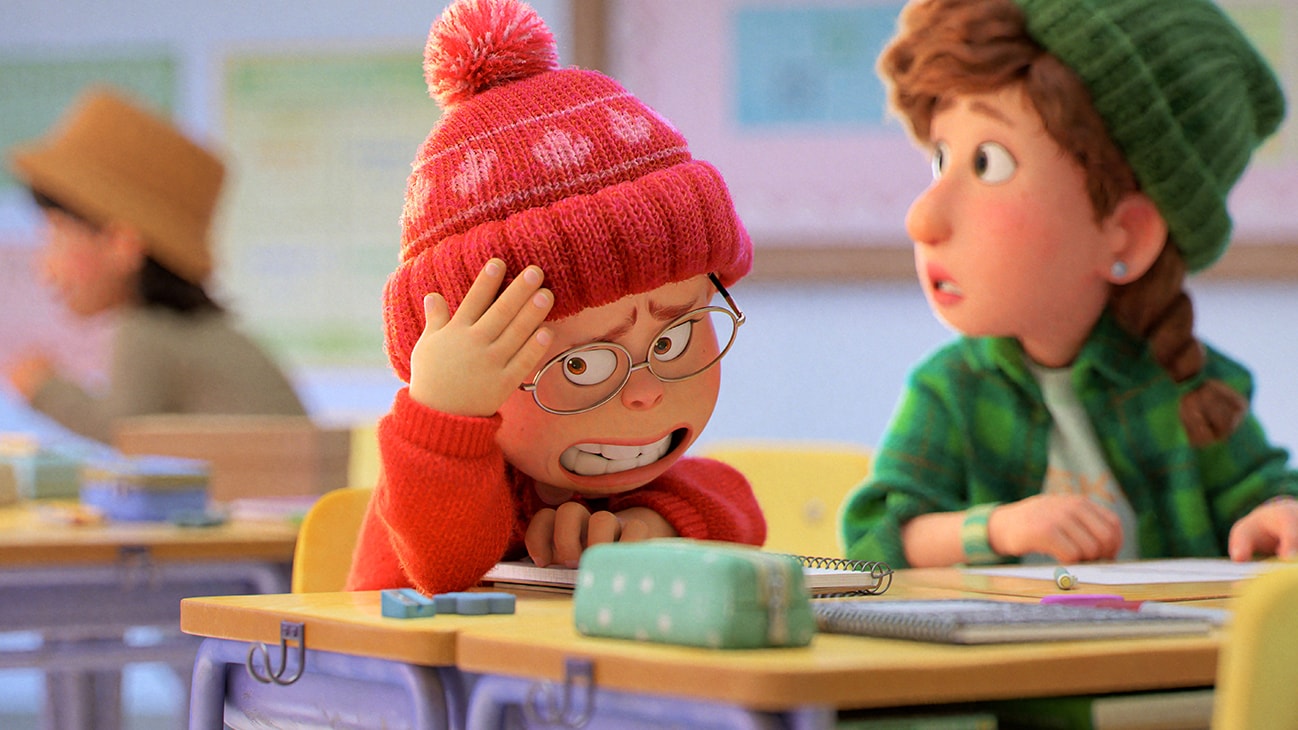
Parents can be a pain. Mailin reacts after Miriam tells her that her mother is outside.

Partly, the movie is a cautionary tale for helicopter parents. If you try too hard to control or solve every problem for your child, you risk driving them farther away when the inevitable life changes come.

Partly, the movie is a female coming of age story, which is both familiar to and different from the coming-of-age process for males. Menstruating is not exactly a common theme in Disney or Pixar films, and, honestly, I was rather delighted that it was a topic in “Turning Red”—as something natural, normal and that makes men (dad) a bit uncomfortable.

It’s also interesting that the movie is set in the early zeros. People who were 13 then are becoming parents now, and if their daughters aren’t yet at the red panda stage of life, making a Pixar movie that will evoke so much nostalgia in new parents does seem like a pretty smart move.

There is some child sass in “Turning Red,” which may make some adults uncomfortable—but it’s a magical realism story where the sass is not overdone and the early teen rebellion is tempered a bit by the reality that the main character still loves her parents and, while wanting to assert herself, doesn’t want to be too far from them, either.

What don’t I like about “Turning Red?” Why “mostly” delightful? My problem is with mom, not only her dismissive treatment of Mailin, but her equal dismissive treatment of her introverted but insightful husband. His “maybe we should trust her” line is bulldozed over.

The most cringeworthy scene is mom’s tirade in the Daisy Mart, and that felt off, to me. That was a level of public shaming of a daughter that even most protective parents could avoid. That, and stalking your daughter and holding up a box of pads before her entire class to say she forgot them—I would think almost any parent, in that situation, would have quietly left the box in the school office with the request that the daughter be notified to discretely come get them.

Mom’s freakout and turning into the “Turning Red” equivalent of the Stay-Puff Marshmallow Man from “Ghostbusters” didn’t bother me as much. That the panda spirit was slightly different in each woman of the family, and that the mom, who suffered so much internal discord over her relationship with her own mother, would have a larger, more violent panda kind of worked. It did seem over-the-top peril of every teen and boy band member at the concert, true, but it was in a clearly fictional Toronto and no actual 4-Townies were stomped in the making of this panda-pocalypse.

In short, I enjoyed the movie. I wish mom had been toned down a little, and that there had been a bit more of the friend group. Miriam was really my favorite character, but I liked all of the friends and wanted a bit more of them.

Was it a better movie than “Encanto?” I don’t think so. It was a different movie and a very good one, but I felt the family themes of “Encanto” ran a bit deeper. And, while the music in “Turning Red” was fun, “Encanto” was a genuine musical production with superior songs that moved the plot.

Also, “Encanto’s” Miriam was Mirabel, and it was nice that the central figure who held the group together was the main character of the film. In “Turning Red,” the heart of the Scoobies, Miriam, was too much of a side note.

Also, not to diss Pixar, one of my favorite movie companies, but “Encanto” was a step above in animation—a visual feast. “Turning Red” was well done but it didn’t have Mirabel’s swirling dress nor bouncing curls (yes, it had a fluffy panda, but I mean overall “Encanto” had far more pleasing, colorful visual details).

I do like that both movies. Along with the “Frozen” universe, they represent a clear, positive evolution in the Disney-verse of the heroine. Unlike the princesses of movies past, current Disney females have much more drive, intelligence and decision-making power. And I’m a fan of the diversity representation, too. We’ve come a long way since “Pocahontas,” thank goodness.


Friday, February 14, 2020

Oh, Have Mercy


From Wikipedia, Warner Brothers poster
Is it just me, or does it seem lately as if movies have grown up a bit?

I missed “Midway,” but saw “Little Women” and loved it. And this week, on a Wednesday night, my wife and I went to the local budget cinema to see “Just Mercy.”

It was a rather somber movie, covering rather serious themes of the death penalty, the criminal justice system and racism. And it was very entertaining and watchable.

One of the characters is a witness whose testimony was used to convict a black man of a murder he did not commit. I had an odd reaction every time he was on screen, a sort of Rocky and Bullwinkle thought.

That voice. Where have I heard that voice?

It wasn’t until later, during the drive home, that it suddenly hit me. The ABC sitcom “Modern Family.” Season three, first episode, “Dude Ranch.” The horny cowboy.

Anyway, “Just Mercy” was an emotional journey. It was hard when one convict lost his appeal and was executed. It was a catharsis when the main prisoner was released, although he and his life were forever scared.

If you can make the time, catch “Just Mercy” before it’s gone from theaters.

Wednesday, October 18, 2017

Two Interesting War Fables

Like River in "Firefly," this is one lady not to trifle with. Warner Brothers publicity photo.

Recently, in the past two weeks, my wife and I have attended two movies at the local second-run theater: “Dunkirk” and “Wonder Woman.”

I think we both enjoyed them both, and it was a bit more of a stretch for her, given she is not a fan of war movies. I don’t like all war movies—I am squeamish and don’t care too much for graphic violence, and I prefer movies that at least seem to attempt to be consistent with history as well as telling a compelling story—but I do like a lot of them.

So, for example, one of my favorite movies is “Eye of the Needle,” which is clearly fanciful, but nonetheless captures the spirit of intrigue during WWII and is a good, tense thriller. Other favorites include “Saving Private Ryan” and the HBO series (not really a movie, but cinematic) “Band of Brothers.”

I don’t insist on accuracy down to the rivets, just, please, nothing wild and impossible. Like “Pearl Harbor.” Sure, they did great filming the attack itself, but the whole Doolittle Raid ending felt false and silly. They didn’t use fighter pilots to fly bombers on that raid, and the idea that the Army Air Corps would seek “pilots who can fly bombers like fighters” is ridiculous on the face of it—“we’re seeking long-haul truckers who can ride bicycles like trucks.” It makes as much sense.

Anyway, there is a whole genre of movies around World War II, which ranks as the great mythic good and evil struggle of the movie era. World War I, while a smaller war, was arguably more important as a historic event, but it’s not seen as often in the movies.

Back to the two recent movies—one set in World War I, the other in World War II. One had the feel of reality even if parts of the story were compressed and reshaped for cinematic purposes—still, I found “Dunkirk” compelling partly because there was so little artifice in the story telling. The other movie featured an incredibly sexy actress in a miniskirt and armored corset battling in a mythical World War I. And yet, I forgive “Wonder Woman” if it plays havoc with the actual historic event—because, after all, it’s a movie that features Zeus and immortal Amazons and a hidden magic island and a shield that can stop machine gun bullets—it’s pretty clear we’re not watching a documentary. Still, even as fanciful as it is, “Wonder Woman” does capture something of the feeling of the hopeless, violent carnage that was World War I, so it has some value in showing a modern audience what trench warfare meant.

On the beach, looking for home. Another Warner Bros. photo--as are the rest in this post.

One film, “Dunkirk,” is almost exclusively male. The other, “Wonder Woman,” has a largely male supporting cast, but does include the aforementioned Amazons, an evil female scientist named Dr. Poison, and an entertaining secretary character.

Despite their clear differences, I did find some similarities between the two movies. One is that both are aided by compelling sound work—musical scores, for instance, that do well in setting the mood.

Both are slightly “dark” in a literal sense—the day scenes are often washed out and foggy, and, especially in “Wonder Woman,” the second half portrays both the front and London as rather dingy places. Some key scenes in “Dunkirk” are below deck in ships, and this movie more than most I’ve seen makes those dark, claustrophobic places seem dark and claustrophobic. Although the mythical Amazon island in “Wonder Woman” is a sun-bathed paradise, I appreciated the sparing use of light in the later part of the movie, and the whole muted look of “Dunkirk.”

Both have implicit anti-war themes. When Wonder Woman stabs who she thinks is the evil god she is chasing—and it turns out not to be—she is shocked that men still wage war. In part, this female-driven movie is rumination on the violence of mankind, in a literal sense. You can’t trust the boys. They make war. And I hasten to add that I consider that not very sexist. In mammals, much pointless aggression is fueled by testosterone, and we all know which human gender that impacts most.

Amazon warrior and stock Hollywood bad person--German solider.
“Dunkirk” is a heroic tale of the British living on to fight another day, but I can’t help seeing the random senselessness of the violence—which I think is fair to the reality of actual war—as carrying an anti-war message.

In both, one of Hollywood’s stock stereotypes of villains is used—Germans don’t exactly get a good name in either film. “Dunkirk” is told exclusively from an allied point of view, so Germans are distant and dangerous and shooting at us—and that doesn’t treat them unfairly according that movie’s premise, even if it’s not great PR. “Wonder Woman’s” use of proto-Nazis is a bit more troubling. It’s one of the weaknesses of the whole Indiana Jones set of movies that Nazis are almost cartoonish bad guys, and “Wonder Woman” comes close to that portrayal. German soldiers exist to be speared, stabbed, knocked out of buildings, etc. They aren’t exactly seen as three-dimensional humans.

Neither movie is anti-German—“Wonder Woman” doesn’t suggest Germans are more evil than any other set of humans, but the evil characters in that film are mostly German (except, of course, for the main bad guy).

Well, I don’t think “Wonder Woman” will fuel any anti-German hysteria—no travel ban is being suggested for October beer drinkers. I just thought the portrayal of evil doers was a bit disappointingly shallow in that tale. Beyond importing Indiana Jones Nazis in a world several decades before they existed, the movie has some other odd mojo going on—what the heck was the deal with the gas that the German general was snorting? An implied anti-drug message?—don’t snort drugs, kids, or an Amazon goddess will pin you to the roof with her sharp thingie?

Meh, I’ve lapsed into complaining about “Wonder Woman.” I really liked the movie despite its flaws.

On the dock. Was that a plane I heard? God, I hope it was not a plane ...
I did find “Dunkirk” to be the superior movie, more underplayed. “Wonder Woman” was a bit uneven to me—the early part where our hero grows up and is trained was a bit slow. But the movie picked up when the Germans landed on the beach. And I did appreciate the playfulness of Wonder Woman trying to make sense of 1918 Europe—the customs, the clothes, the odd meaning of it all. She was, in many ways, the “alien” who comments on life—sort of like Spike from “Buffy the Vampire Slayer” only less evil and more lively.

And, despite some flaws, I think I liked “Wonder Woman” on a sort of Buffy level—Buffy was so entertaining because it turned so many horror movie conventions on their heads. The blonde headed down the alley where there were monsters, and the monsters ended up dead. In “Wonder Woman,” the pretty exotic curvy woman in the teeny skirt and tight armor ended up in the trenches, and the Germans all died.

“Frozen” took the movie world by storm, partly because it’s portrayal of a strong female lead character was off the beaten track and resonated with girls (and male feminists like me). “Wonder Woman” has become a feminist icon, too.

More strong women characters in movies, please. And if a story must be male centric (Dunkirk made sense as a boy movie due to its time and place) then at least have it be thoughtful and relatively accurate in its portrayal of history. The anomalies in “Dunkirk,” having the German plane painted wrong, for instance, are mostly minor details and useful from the story telling point of view without really misrepresenting the events.

So thumbs up for both recent movies, different and similar as they are.

Wednesday, March 4, 2015

What Movies (I Have Not Seen) Do You Recommend?

We played a bit of a movie game in my media class today.

We are talking this week about what films do culturally, and today we were reviewing movie genres. As part of our discussion, I asked the class to each name a movie that he or she had seen, but think most of the people in the class have not seen. It had to be a movie that the student recommends, and then the student briefly discussed it.

It was interesting, partly because the descriptions were almost all character driven—that is, the way we described a movie was basically what happened form the point of view of one or two main characters.

The movies that the class named included:

  • Kramer vs. Kramer (actually, that was my example).
  • Stuck in Love.
  • Hotel Rwanda.
  • American History X.
  • Full Metal Jacket.
  • Snatch.
  • Inglourious Basterds.
  • Prisoners.
  • Seven.
  • Crash.


I can’t vouch for all of them, I’ve only seen about a third of them, but I thought it was an interesting list.

I also suggested four more movies that I thought are worth watching, and that I assumed most students had not seen:

My Cousin Vinny. Two New York college students are charged with murder in Alabama, and Joe Pesci plays the lawyer in the family who comes to their rescue. While Pesci is the main star, his co-star Marisa Tomei steals the show. It’s not a great movie, but it’s an interesting juxtaposition of cultures and courtroom drama. Night Court meets The Dukes of Hazard.


Pieces of April. Several students had seen “My Cousin Vinny,” but none had heard of this movie, in which April, who has run away to New York City as a young adult, invites her family to her first attempt to cook Thanksgiving Dinner. It’s a genuine movie about people who seem “real.” I think Katie Holmes is great as April Burns.


I also suggested a pair of British comedies. We probably covered too many American movies anyway, and British comedies often seem to aim at more dialogue and character driving humor than their sometimes juvenile American counterparts. Anyway, the two British movies I described in class were:

The World’s End. Directed by Edgar Wright and written by him and the film’s star, Simon Pegg. A mix of apocalyptic science fiction and buddy drinking movie, it is the third of the “Three Flavours Cornetto trilogy,” which includes Shaun of the Dead and Hot Fuzz.


Keeping Mum. Maggie Smith is a murderous housekeeper, secret mother, who solves all of a families problems through blunt force trauma. It’s not a perfect movie, and it is rather dark, but it’s also wickedly funny.


Those four are not intended to be, by any means, my best loved or favorite movies—the premise was movies that are obscure enough that others may not have seen them.

What movies would you recommend that most people reading this will not have seen? Name the movie, briefly explain it, and maybe link to a trailer in your comment.


Friday, February 27, 2015

Movies Part I: Lessons From A Blue Dress

From Wired--original dress image in middle, two different color corrections applied on right and left. Read the article in the link below to find out why.

And no, not Monica Lewinsky’s dress-the dress that took the internet by storm recently. The dress that, in the same week Congress was failing to fund Home Security and Jihad John was identified, everyone was talking about.

Proving once and for all that there is little relationship between what people “talk about” and what really matters.

Anyway, the dress of ambiguous color is, according to this article, which I found on Wired, clearly blue. I see the original as white and gold. If you see blue and black, you earn the gold star, or possibly the teal one.

Apparently it’s a perception problem—the issue of how our brain compensates for what it perceives as the prevailing light condition. Years before Photo Shop, the human brain was evolving to color correct our world so that we could see the ripe fruit or the hiding tiger.

What does this dress have to do with movies? Movies, as a medium, are a lot like books. They both require subscription or sales revenue, rather than depending, like most media, on advertising. They are both narrative in form—in fact, there is a close relationship in content between movies and books, although as a reader, I hasten to add that never does the movie recreate the book. The fact that both are narrative media does not mean that they use the same narrative conventions or tools—and a book can almost always tap into more subtleties and interior meanings of things.

The great impact of movies comes from their dreamlike power. Although some are very artistic and complex and make you think, most operate at a cognitively less complex level then books. Books train our minds and enrich our vocabulary. They are like the best lectures in the university of our lives (hang on, students, that’s a metaphor). Movies are the quad, with its nice rose garden, fountain and naked angles in the 19th century statuary (the university of our lives has a nicer quad than MMU).

We still need the quad. We need the sunshine and the flowers and the angels. I’m not dismissing movies nor saying they are secondary in some cultural way to books. I’m merely observing that they touch us in a different way. And maybe I should have called the movies the art gallery, because they change more and involve more thought than the quad, but now we have to usher our metaphor off stage as it’s getting selfish and occupying too much real estate.

Back to movies. They are the dream medium. Granted, books invite you to enter into a dream world, but it requires more mental work on your part, and the dream world in a book is one that you construct just as much as the author does. My book Harry Potter is not the same as yours or even J.K. Rowling’s, but we both see Daniel Radcliffe as the movie HP.

But, even if movies more clearly communicate the writers’, actors’ and perhaps most of all, the directors’ dreams, even this medium that delivers more intact fantasy passes through our personal powers of perception. We both can watch “Pearl Harbor,” but if I know more about the actual World War II than you do, I’ll probably cringe more.

Anyway, perception is a funny beast. Earlier in this semester, a student in my media class noted that she enjoyed the movie “The Interview” due to its comedy. I found the movie primitive, scatological, irritatingly irrational and just not very funny.

She’s not wrong., she is perceiving the movie from her point of view, and I am from mine. Sometimes the dress looks blue, sometimes white.

The “right” answer in the dress case is blue. The right answer in the movie case partly depends on what you mean.

This week as we discuss movies, we may spend a little time talking about what we like or don’t, and I’ll probably write a second blog post to self-disclose a bit about my taste in movies. But movie reviews aren’t really the point of the week.

Understanding what movies can do, what they are capable of, what they mean to us and our culture, and what the future of movies might be might be--those, I hope, are what we’ll spend our time on, whether the dress is white or blue.


So, blogosphere, chime in. Not about the dress, about perception and movies and how movies compare to other media. Do movies move you? Why ore why not? And which ones, and why?