Sunday, August 21, 2022

Saying Goodbye to ‘Reliable Sources’

"Reliable Sources" logo
From CNN.com, logo of "Reliable Sources," last episode was today, Aug. 21, 2022.

So, today was the final show, after 30 years, of CNN’s “Reliable Sources.” Ratings were not always great for this show, and CNN informed host Brian Stelter this week that it was ending the program with today’s episode.

I’ll miss it. Stelter showed class in the final show, ending it by thanking the boss who had fired him, noting that it’s rare for a news program to get a final episode to say goodbye. And he expressed hope that CNN would continue to push its news coverage.

“The free world needs a reliable source,” Stelter said of CNN.

CNN has new owners, and the corporation is shaking things up. One thrust of those changes is to try to emphasize straight news coverage, which is OK, but “Reliable Sources” was useful as a look at the media world. It wasn’t an “infotainment” show of just opinion commentary. While Stelter often made his own comments, at is heart, the show was an interview program and panel discussion about the media.

Brian Stelter on set of "Reliable Sources"
CNN image used on YouTube clip of Brian Stelter's final show.

Some of those guests, and Stelter, made key points during the final show:

It’s not a coincidence that democracy is on decline at the same time that independent news media is on the decline. “The pendulum swinging against democracy all over the world,” Carl Bernstein said. He noted that he and Bob Woodward, who 50 years ago uncovered the Watergate scandal as reporters for The Washington Post, understood that their job was to report “the best obtainable version of the truth.”

But, what truth? Journalists are not stenographers—using sound news judgement to frame events in context is also a key to what journalists need to do. As David Zurawick, a CNN analyst formerly with the Baltimore Sun noted, the current call to report “just the facts” ignores the reality that facts need context—that the body politic needs what he called “explanatory journalism,” such as the many times Carl Bernstein was able to compare action by former President Donald Trump to actions by Richard Nixon.

Zurawick also noted that, in the 30 years that "Reliable Sources" was on the air, local newspapers and local TV news have been on the decline.

Part of that decline is fueled by ownership changes—there always was an elitism problem in American journalism where it was typically rich families that owned media companies, but at least those families had some sense of responsibility that hedge funds lack.

Atlantic Editor Jeffrey Goldberg said that owning a media outlet is “not like owning a chicken restaurant or whatever. You have to be willing to stand up to authority.”

I agree. It’s good that in this social media era, rich owners can’t control the information anymore but it leaves media chasing the eyeballs at the expense of any sense of mission. And the impulse to report “straight” news can be a positive one, although the danger now seems to be a false equivalency where facts and nonsense are reported as equals.

Jodie Ginsberg, president of the Committee to Project Journalists noted that a true journalist doesn’t ask if it’s raining, they go outside to feel the rain. These days it’s harder to agree on “the importance of facts, the importance of agreeing on some fundamental, important information.”

“When those in power denigrate journalism, journalists become fair game,” she said.

The panelists and guests on the final episode, not all of whom I quote here, were insightful and interesting. It impressed me that, although lots of media and news trends are dark, the tone of the show was nonetheless hopeful.

And Stelter ended on a positive note. It was a classy way to go out. The CNN "Reliable Sources" newsletter continues for now, which is nice, but it’s still a sad day when a show that provided valuable context on the media stories of the week is suddenly gone.


Wednesday, July 20, 2022

‘Veronica Mars’: High School Really is Hell

I’m late, of course, to the party. Just as I watched “Buffy the Vampire Slayer” two decades after the show was made, more or less, I’m 15 year behind the time with another show about a compact woman child who packs a punch—in this case, summer 2022 was the summer my wife and I binge watched the three TV seasons of “Veronica Mars.”

And then got the movie and watched it, too.

Veronica Mars in movie
Movie image from IMDB.

I’m sure I’m not the only one who sees some parallels between Veronica and Buffy. Both are attractive blondes who are often under-estimated by their adversaries. Both are quick-tongued—flash back to Buffy: Professor Walsh: “We though you were a myth.” Buffy: “Well, you were myth-taken.”

And both shows begin in high school, which is a bit of hell in both universes.

Wikimedia Common image of Kristen Bell in 2007 on set of TV show "Veronica Mars."

Did I like “Veronica Mars?” Heck yes, for many of the reasons I liked Buffy. Both Sarah Michelle Geller and Kristen Bell have the chops to be leading characters, and both are fun to watch. Both shows feature ensemble casts—indeed, there is a bit of crossover between them, with several actors from Buffy having roles in Veronica.

And I enjoyed both takes on American education. They weren’t either entirely real or realistic, and oddly enough, I found Buffy’s universe in some ways more relatable. It was just a random town, and if Sunnydale still existed in the same universe as LA, it wasn’t like Neptune, a village partly populated by media elite.

Season 3 TV cast of "Veronica Mars." The season ends abruptly mid-story, so it was nice to have a movie to wrap things up a bit. But kid, seriously, you can do better than Logan.

Buffy was a cleaner character, more ethical, in many ways. Veronica was never above bending the rules nor breaking the law to achieve revenge, for example. Buffy could get mean to save the universe, but not so often to offer payback.

That, to me, was the main weakness of Veronica Mars. Too often, it was a revenge fantasy, which left me a bit cold. Fortunately, that wasn’t the main arc of the show, and it was fun to see a feisty female with the smarts to figure it out. When Veronica said, “I know what happened,” she usually did.

Other parallels:

  • Both Buffy Summers and Veronica Mars aren’t lucky in love. Buffy’s serious relationships include two vampires, an ex-soldier who loses his way and various high school boys who either betray her or turn out to be seriously unsuitable, for some reason. Veronica Mars has a very screwed up love life—to me, one of the main weaknesses of the show is that I never warmed up to her longest and most serious relationship, that weird rascal Logan. She would be better off without him.
  • Law enforcement is best not trusted in either universe. The Sunnydale police, at least for a  season, are controlled by a demonic mayor. Keith, Veronica’s dad, gets to be sheriff now and then, but when he’s not, the local deputies are often a disreputable bunch.
  • High School, and college, are populated by awful people doing awful things. In Veronica Mars, Hearst College and Neptune High School are both terrible places. Even worse that Sunnydale High School or UC-Sunnydale.
  • Nerds make the best friends. Whether it’s Willow or Mac, it pays to have a gal pal who knows her way around computers (or witchcraft, in Willow’s case—the equivalent for Mac might be a talent for shady business deals).

Anyway, tonight we watched the 2014 movie “Veronica Mars.” It was fun to see to see the cast run through their paces again, and it did have the attractive flavor of the TV show, warts and all. But seriously, did she have to end up with Logan? Meh.

Wednesday, June 8, 2022

How Media Divides and Unites Us

Two books
Two books about media I have read in 2022.

I’ve recently read two very different books about media, and they prompt me to marvel a bit about how our media consumption can, at the same time, unite and divide us.

“Narratives, Nerd-fighters and New Media” by Jennifer Burek Pierce explores the geeky corner of the internet created by the Vlog Brothers, Hank and John Green. The book describes how the two authors and media producers have created and facilitated a global village of readers and online content creators, centered at first about John Green’s books and their Vlog Brothers channel.

The other book, “Hoax,” by Brian Stelter explores the fake narrative of the 2020 election that took hold and led to the Jan. 6, 2021 attempt to overthrow a legal, and relatively clean, election.

First, the book about uniting. In “Narratives,” Burek Pierce briefly reviews the reach of an online community crated by the Green brothers. Hank Green in particular has been a driving force behind the creation of many interesting corners of You Tube through the company Complexity. SciShow, Crash Course and others are places where one goes to satisfy curiosity.

John has been involved in some of those projects, and is a well-known young adult novelist. In recent years, Hank also has joined John as a novelist, writing two science fiction books. One central theme of Burke Pierce’s book is how central reading is to the online community that centers around the brothers. How reading, and sharing about reading, creates a sense of place.

Place and community can be promoted by the internet. And the Green brothers are to be credited because they use their moment of fame not just for self-gratification, but for their ongoing “project to reduce world suck” in which worthwhile causes, like health care in Sierra Leone, are supported.

“Hoax” is a different kind of book about different media. Stelter describes the weird, symbiotic relationship between Fox News and former President Donald Trump—how, due to his media consumption habits, Trump picked up many of his key talking points from Fox News programs.

And, driven by ratings successes, Fox evolved to emphasize the opinion programming that Trump favored. Journalists and journalism were squeezed out of a network whose name has “news” in it. As the corrosive and destructive Trump presidency went on, it seems like Fox was coopted by the MAGA movement to the point where it was almost captive to the whims of Trump.

To me, one key to the weird new era we inhabit is the influence of social media in the form of things like Facebook and YouTube—where community can form that, unlike nerd fighters, doesn’t seek to build a club of readers so much as a mutually cheering squad that pushes and promotes the most extreme views. What I mean is that the community-building power of the internet can work strongly against the community as a whole. And the incentives to echo more extreme views is something Hank Green ruminated about in the aftermath of the Jan. 6, 2021 insurrection at the U.S. Capital:


The body politic seems to mostly be suffering from the community building being done by election deniers and the MAGA crowd—but I don’t think those negative effects of incentivizing extremism are exclusive to the political right.

Anyway, one interesting aspect of "Hoax" is that, due to its time and place and sizeable audience, part of what drove the Trump years of insanity was Sean Hannity and his kin on an old-school cable news channel.

Of the two books, I enjoyed “Narratives” more, but then I’m a casual inhabitant of the neighborhood it describes. Perhaps “Hoax” is on a more important topic. The books suffers from its chatty, gossipy tone, where who is sleeping with whom gets in the way of the main narrative but is still worth the time to unpack some of what went on as Trump and Fox grew together.

But books both are interesting reads on recent moments in media history. And both remind us that media often rewards the most noise, which can be a detriment to us if we remain unaware of that tendency.

Tuesday, May 24, 2022

'Turning Red' Almost Makes Me a 4-Townie

Movie poster
Movie posters. Images, besides YouTube videos, from https://movies.disney.com/turning-red.

Have you seen “Turning Red,” the latest Pixar-Disney movie? “Turning Red” was, for me, yet another hit, a worthy follow up to the other recent female coming of age saga, “Encanto” (yes, I know, “Encanto” was a Disney flick, not a Pixar flick, but it was part of the same film genre, to me) “Turning Red” is mostly delightful.

“Turning Red” starts with a very charming opening credit scene, when Mailin Lee goofs off as only a confident 13-year-old can. In my experience with children, there is an age, around 10 or 11, that I think of as the start of the “mini-adult” stage. The storms of adolescence are not yet in full force, for one thing. If the child is bright, if they’re well-read enough and smart enough, they can make interesting observations. They can be confidence, not yet too self-absorbed and fun to be around. Their future adult personality is showing, but not yet the angst of the teen years.

Not every tween is like that—some who will grow to be dull adults are already working on the intelligence level of bagels, reading makes a huge difference—but there is for many tweens this time of relative sophistication combined with a fresh take as a new human spirit starts to grapple with the universe. Yet, it's an awkward time too, for both young women and young men, a spirit captured in the Barenaked Ladies song "This is Me in Grade Nine."

And Mailin, a driven first-generation Chinese-Canadian living in Toronto, fits into the mini-adult mold. She has a good relationship with her parents (for the most part), a supportive set of close friends and is doing well in school, one of the keys to early adult onset. So it’s not just the Toronto Transit Authority—in some ways, Mailin has reached a foreshadowing proto-adult level of maturity.

Of course, humans are cognitively complex beasties, and it’s dangerous to generalize. And faux adulthood of a 13-year-old isn’t adulthood. There’s puberty (and panda magic) that will create new life challenges.

“Turning Red” is yet another movie in which a maternal ancestor creates the conflict. In "Encanto," it was abuela. In “Turning Red,” mom is having trouble adjusting to the maturing daughter’s changing life—and grandmother is a bit of a foreboding figure, too, as dysfunctional generational patterns that can persist in families is one of the themes of this tale of the red tail.

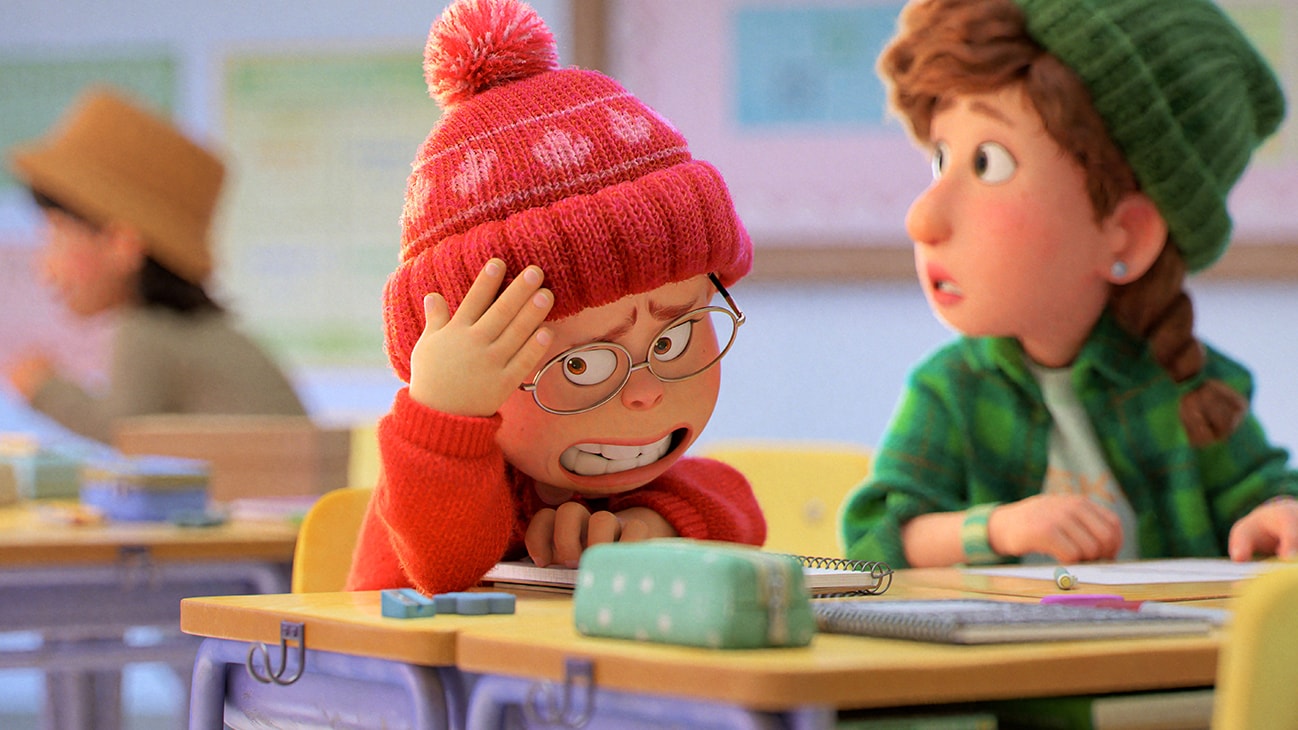
Girls in class
Parents can be a pain. Mailin reacts after Miriam tells her that her mother is outside.

Partly, the movie is a cautionary tale for helicopter parents. If you try too hard to control or solve every problem for your child, you risk driving them farther away when the inevitable life changes come.

Partly, the movie is a female coming of age story, which is both familiar to and different from the coming-of-age process for males. Menstruating is not exactly a common theme in Disney or Pixar films, and, honestly, I was rather delighted that it was a topic in “Turning Red”—as something natural, normal and that makes men (dad) a bit uncomfortable.

It’s also interesting that the movie is set in the early zeros. People who were 13 then are becoming parents now, and if their daughters aren’t yet at the red panda stage of life, making a Pixar movie that will evoke so much nostalgia in new parents does seem like a pretty smart move.

There is some child sass in “Turning Red,” which may make some adults uncomfortable—but it’s a magical realism story where the sass is not overdone and the early teen rebellion is tempered a bit by the reality that the main character still loves her parents and, while wanting to assert herself, doesn’t want to be too far from them, either.

What don’t I like about “Turning Red?” Why “mostly” delightful? My problem is with mom, not only her dismissive treatment of Mailin, but her equal dismissive treatment of her introverted but insightful husband. His “maybe we should trust her” line is bulldozed over.

The most cringeworthy scene is mom’s tirade in the Daisy Mart, and that felt off, to me. That was a level of public shaming of a daughter that even most protective parents could avoid. That, and stalking your daughter and holding up a box of pads before her entire class to say she forgot them—I would think almost any parent, in that situation, would have quietly left the box in the school office with the request that the daughter be notified to discretely come get them.

Mom’s freakout and turning into the “Turning Red” equivalent of the Stay-Puff Marshmallow Man from “Ghostbusters” didn’t bother me as much. That the panda spirit was slightly different in each woman of the family, and that the mom, who suffered so much internal discord over her relationship with her own mother, would have a larger, more violent panda kind of worked. It did seem over-the-top peril of every teen and boy band member at the concert, true, but it was in a clearly fictional Toronto and no actual 4-Townies were stomped in the making of this panda-pocalypse.

In short, I enjoyed the movie. I wish mom had been toned down a little, and that there had been a bit more of the friend group. Miriam was really my favorite character, but I liked all of the friends and wanted a bit more of them.

Was it a better movie than “Encanto?” I don’t think so. It was a different movie and a very good one, but I felt the family themes of “Encanto” ran a bit deeper. And, while the music in “Turning Red” was fun, “Encanto” was a genuine musical production with superior songs that moved the plot.

Also, “Encanto’s” Miriam was Mirabel, and it was nice that the central figure who held the group together was the main character of the film. In “Turning Red,” the heart of the Scoobies, Miriam, was too much of a side note.

Also, not to diss Pixar, one of my favorite movie companies, but “Encanto” was a step above in animation—a visual feast. “Turning Red” was well done but it didn’t have Mirabel’s swirling dress nor bouncing curls (yes, it had a fluffy panda, but I mean overall “Encanto” had far more pleasing, colorful visual details).

I do like that both movies. Along with the “Frozen” universe, they represent a clear, positive evolution in the Disney-verse of the heroine. Unlike the princesses of movies past, current Disney females have much more drive, intelligence and decision-making power. And I’m a fan of the diversity representation, too. We’ve come a long way since “Pocahontas,” thank goodness.


Monday, April 11, 2022

The Maus that Roared

Not a happy story. There's violence, such as World War II. Image from wikipedia description of book.

Late to the party, I know—but I’ve just finished the two-volumes of Maus, the graphic memoir by Art Spiegelman.

Of course, I have the wise leaders of the McMinn County Tennessee School Board to thank. In January, the board banned what is called a “graphic novel” from its eighth-grade curriculum. And I immediately wanted to read it.

A student who leads the campus newspaper staff happened to have taken a recent course on the Holocaust, and Maus was one of the books for the class (or two, they read both volumes). So, she let me read her copies. What with one thing and another (school, exams, etc.) it took a while for me to crack open these comics and have a look see at the latest threat to the tranquility of our children was.

And, wow. They banned that?

I mean, it’s the Holocaust. There was language, implied violence, abuse—all the neat features that genocide brings to the table. Plus, some difficult family dynamics, a mother who committed suicide plus a father who clearly was damaged, and although he’s a survivor, his life and his relationship with his narrator son is neither smooth nor easy.

I had also read that there is nudity—and frankly, I think there may have been some, but I didn’t notice it at all—whatever flash of the naughty bits there was, it wasn’t exactly a central feature of this tale. And, besides, naked mice. Land swan.

Would I have voted to ban this book? Heck no. The 13- and 14-year-olds of McMinn County probably, I would think, experience rougher content in most country music videos, let alone most PG-13 movies. Heck, remember abuela’s pain in Encanto?

One of the values of reading stories, both fictional and fact, is to learn, just a bit, to see the world through another’s eyes. And I don’t know about you, but by age 13 I was ready to learn that the world is not a perfect place of unicorns and fairies. There are cats and mice and pigs and fascists, too. I think it’s fair for a parent to know what their child is reading. And maybe some opt out option has to be offered to a parent who objects—but why would they? Maus requires some processing—some conversation and education. That’s what an eighth-grade class is for. Maus brings a compelling and important story to life in an interesting and different way—it’s exactly the kind of book to help young teens maybe start to understand the value of deeper stories, even if it is an expanded comic book.

For the most part, I don’t think most young teens are too immature for Maus. Apparently, some school board members are.

Banning books that make some people uncomfortable is where we are. It’s a step that ties into all kinds of unpleasant cultural threads that are unraveling our intellectual life and stifling our culture. For example, there are parents who want fairy tales re-written to eliminate what’s dark or scary. And, to be fair, older versions of many of our mainstream fairy tales are far rougher than the versions we typically read today—anybody remember Cinderella’s step sister slicing off her own toes?

However, it’s easy for this protective impulse to quickly go too far. A certain amount of peril or conflict is necessary for any powerful story. It’s why do so many parents die so early in so many foundational stories—a common feature of fairy tales. I think the reason is that children worry about that very thing, and it’s about the worst fate that they can imagine—so the story serves as a pleasantly scary “what if” kind of tale.

That’s fairy tales, however. There are no fairies in Maus. The middle schoolers who should have had access to this truth-based story are long past the point where they need The Wizard of Oz sanitized. Maus has great value because it’s a quick read that touches on deep subjects at many levels—and gives Miss Simmons (assuming Miss Simmons is the eighth grade English teacher) an outlet to bring in the true dark story of what actually happened in the time of World War II.

Truth, they say, is the first casualty of war. Our culture wars have escalated to the point where we don’t wait for combat, we stick a stake in the heart of truth before it can rise from the graves of our ignorance.

If you have a 13-year-old, buy them a copy of Maus. Have them read it (after you have) and then talk about it. It can open their eyes and yours.

And show you how wrong the McMinn County School Board was when they McMinn-imized education for their eighth graders.


Saturday, April 2, 2022

Appreciating the Art of Communication

Unveiling new name and logo
Katy Sebers and Wyatt Sebers unveil the new name and logo for their Marion, Iowa martial arts studio at an open house March 31. Katy, my daughter, designed the logo.

Drew Evans and sculpture
Drew Evans, a Marion, Iowa, artist, checks one of his sculptures brought to Lowe Park for image-making purposes.

As March turned into April, I recently ran into two interesting examples of art used in communication.

Before becoming a college professor, I was a print journalist. Art is outside my area of expertise, but it’s something I enjoy. On March 31, I attended a ceremony where my daughter and son-in-law had a renaming open house at a martial arts studio in Marion Iowa that they had purchased. They unveiled the new logo of the school.The next day, while on a walk in a Marion, Iowa, park, my wife and I by chance ran into a artist who was using the park as a backdrop to photograph several of his sculptures.

I’m going to write more about the logo—since it has a family connection to me and because I just have more to say about it. Besides being an object of art, it’s a commercial piece that has more literal meaning, too.

New logo
Logo from Facebook page of martial arts studio.

Logo
Pictures (above and below) of logo displayed at March 31 open house.

Logo on display

My daughter, Katy Sebers, designed the logo. I like the subtle use of ying and yang in it. The symbol is, I assume, a Korean character, maybe the word for “guardian,” although it could also mean “four busy kids.”

Anyway, the dragons use colors from the Korean flag, used to represent taeknwondo. The yellow color of the character echoes the colors of the Bruce Taekwondo logo, and this studio is a continuation of the Bruce Taekwondo legacy—Katy and Wyatt Sebers purchased the business from Master Bruce.

I like the logo in black and white, too.

Grandson in headband
Grandson wears logo on new headband at March 31 open house.

Logo on t-shirt
Logo in black and white on T shirt.

The day after that March 31 open house, I and my wife encountered Drew Evans, who runs “Chainbreaker Welding” in Marion. We were walking April 1 on the trail at Lowe Park, and Evans was there to photograph a couple of his sculptures, human figures constructed of metal objects welded together. Both sculptures were female figures, one made of nuts, the other of bicycle chains.

Both the martial arts studio logo and the figures in the park appealed to me, for different reasons. As a person who most often expresses himself via words, I respect those who can do visual communication that is evocative. I liked the contrast between a clever two-dimensional logo and the three-dimensional nature of sculpture.

I don’t always understand what an artist is trying to say. Then again, any creative expression partly belongs to the audience—it means not just what the creator intended, but what the viewer or listener extracts.

Artist and sculpture
Drew Evans with one of his figures.

Female figure make of bike chains
Female figure make of bike chains.

Sculptures in Lowe Park
Sculpture by hiking-biking trail at Lowe Park.


Tuesday, March 22, 2022

A Classy Class Visit from Another Tiger

Nicole Agee
Nicole Agee speaks March 22, 2022 in a Mount Mercy University journalism class. This image was made by a student in the class--images in this post are about half my work, half student work.

The focus of good journalism shouldn’t be the journalist—an important point made by Nicole Agee, a local TV anchor (KCRG-TV Channel 9, Cedar Rapids, Iowa) in one of my classes.

“I’m not the story, the people I interview are the story,” she said.

Agee kindly volunteered to visit the class and talk about journalism storytelling, in particular, storytelling via video. As a sample, she showed a clip from KOMU, the Columbia, Missouri TV station associated with the University of Missouri-Columbia School of Journalism.

In video, the images and sounds are a key part of the reporting. Video in a story, Agee said, “takes the place of words.”

Nicole Agee
Here and below, four more image of Nicole Agee speaking.

Nicole Agee

Nicole Agee

Nicole Agee

It’s a large and complicated idea—it helps explain many of the differences between journalists who primarily work in words (we used to call it “print,” although these days, I read New York Times stories on a screen) vs those who are using video recordings. Agee also noted that radio, such as presented by NPR, is another medium with its own story telling style.

But whether words, video or audio, a journalist needs to be an accurate and compelling story teller.

Besides that, I think a beginning journalist needs to be ready to dive in—to get more experience however they can. Agee herself noted a history as a high school and college newspaper journalist before pursuing a graduate degree in broadcasting at Mizzou.

Agee also had some interesting thoughts on the skills needed to be a journalist. Primarily, she argued for the centrality of journalistic curiosity. “We want to know more, we want to know why,” Agee said.

In fact, she said it’s easier to work with a curious new journalist than with a new journalist who considers themself primarily a great writer. “It’s easy to train somebody to write well,” said.

Well, she’s wrong about that and right about it at the same time. A person has to have some base level language expression skills in order to be competent enough to be trainable as a writer. And I think curiosity is a driving force of most really good writers—to be a writer is not just to have facility with the language, it’s to have facility with ideas that can be expressed in language, which requires curiosity.

Student in class
Annie Barkalow, managing editor of the MMU Times, listens to Nicole Agee.

But she’s right, too. Given a base level of writing competence, it’s easier to work on the information processing skills—whether writing, making images or shooting video—of a curious person. Students who struggle in one of my editing courses don’t always agree, but anybody can learn to create a page or web site using InDesign. What’s harder to teach is what should be on the page.

What’s required is the curiosity to seek new answers to common questions. Where do you go for information? What information is important for an audience you’re serving?

Curiosity may kill cats, but it is the life force of journalists.

So, although I work a lot at trying to teach writing—I think I’m fundamentally in agreement with Agee.

Me with camera as student watches
Me, helping a student solve a problem with a camera.

She made another key point, too. That is, a journalist must cultivate connections. She referred to building a personal Rolex when you arrive in a new community (while noting the term is outdated, today a network of contacts may be more related to a list on an Android phone than written cards that are quickly becoming antiques). In other words, a good journalist is active and aware and builds contacts before they must begin working on a given story.

I like to think of it as related to the role of imagination in journalism. That is, journalism, if done correctly, is not at all fiction. None of it is made up. But a journalist must be able to see possibilities, to sense patterns—not to impose narratives, to but recognize them and act on them. That’s related to the challenges of writing and editing, but also to the ability to think creatively when casting the net for information—for cultivating and well using a wide range of connections. An information, or source, network.

Nicole Agee
I can't imagine what Nicole Agee was thinking about here, but whatever, it was worth listening to here.

And the best photographers and videographers also have imagination. Again, not for deep fakes, but to know when to shoot and what to shoot and where to be to get the image or the recording.

The class Agee visited was small—the smallest introduction to journalism class I’ve had in my time as a professor. Yet, as she noted, the skills one learns in a newsroom—working on deadline, being flexible, imaging the possibilities, acting on your curiosity—serve professionals in a variety of circumstances.

She was speaking of the many former journalists she knows who are working in other venues. I think it is one reason why college journalism remains important for a university. Of course, student journalists serve their community as journalists serve any community, by making overt what is hidden and should be known. But they serve themselves, too—developing habits of mind and skills that are keys to a curious, interesting, well-written life.

Nicole Agee
Final image.